
Do the words disability and handicapped mean the same thing?
This is the second in a series of posts to explain some of the basic ideas of inclusion and normalization.
The first was from one of my heroes Norm Kunc. Norm Kunc| What’s Your Credo?
If you find these useful, I hope you will comment and then share them on Facebook, Twitter and your other social media. Thanks.
Words and labels make a big difference in our lives. How you answer this question can make all the difference for a person you love.
“Disability” or “Handicapped”?
Do the words disability and handicapped mean the same thing?
The short answer is NO. Disability and handicapped do not mean the same thing. And the differences are important.
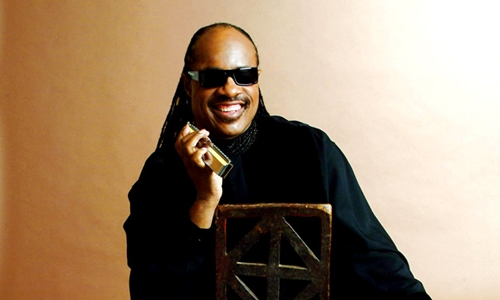
Is Stevie Wonder handicapped?
Does Stevie Wonder have a disability?
“A DISABILITY refers to a reduction of function or the absence of a particular body part or organ.”
So YES, Stevie Wonder, who is blind, would qualify as a person with a disability.
A disability is usually a lifelong condition: autism, an intellectual disability (the new term for mental retardation), cerebral palsy, or being deaf or blind….
Does Stevie Wonder have a handicap?
“A HANDICAP is viewed as a disadvantage resulting from a disability that limits or prevents fulfillment.”
Does being blind prevent Stevie Wonder from singing or achieving personal fulfillment as an entertainer? NO. So Stevie Wonder, though he has a disability, does not have a handicap.
Does Stevie Wonder need support? Of course. If Stevie Wonder did not have a personal assistant or any of the other modifications and adaptations he needed, then he might be handicapped.
See the difference?
Terrence Parkin swam in the 2000 and 2004 Olympics, winning a Silver Medal for South Africa. Does he have a disability? Yes, he is deaf. Does he have a handicap? Not as long as they add strobe light signals to the usual auditory buzzer to start the race. If however, the committee didn’t agree to add the strobe lights, then Terrence would have been handicapped and unable to participate in the Olympic Summer Games. Being handicapped can depend on the attitudes and social construction of the culture.
Disability is socially constructed
Like many people my age, I have trouble reading small print, (Disability). If I lived in a society where there were no books, or it was against the law to teach women to read, it might not matter if my eyesight was as sharp as it was when I was younger. However, in my culture, so many people wear glasses there is no stigma attached to having the disability of poor eyesight. So, I do not have a handicap. If I use a wheelchair and the building is accessible, I can still have a disability, but I can go to the grocery, do my banking… and not be handicapped. (I hope this makes sense. We will talk more about this in a future post.)
Why is this important?
If you or someone you love has a disability, it is not the end of the world. Even though there might not be a medical miracle or cure at this time, the disability is just a disability. No one wants to be different than anyone else. No one wants to have a harder time doing things than other people, but with the right supports it is possible to have a fulfilling and satisfying life, and not be handicapped.
This is a message full of hope. Robert Schuller says, “Look at what you have left, not what you have lost.” Physical, Occupational, Speech Therapists, Teachers, Counselors, as well as family members, friends and neighbors can look at their attitudes toward a person with a “disability” and rather than get stuck on something they can’t fix, instead spend their energy on creating an inclusive environment that is accessible for all of us.
This is our call to action: We can each think about what we can add, subtract or change to the environment to give a person with a disability the support they need so they will never have to be handicapped.
In the comments tell me what you are thinking. Do you have a story to share? How are you making your child or loved one less handicapped?
Keep Climbing: Onward and Upward
All my best,
Mary
Reference:
Bauer and Shea (1997) Special education: A social systems perspective. Brown and Benchmark: Chicago.p. 12.
————————————————————-
Just learned from Katie Snow of Disability is Natural:
LANGUAGE CHANGE!
Thanks to the hard work of the Advocacy Leadership Network (ALN) of Hamilton County (Ohio) DD Services, the Hamilton County Board of Commissioners officially resolved that “accessible” will replace “handicapped” on all new and replacement signs in the county! ALN, composed of leaders who have disabilities, had previously been instrumental in having the phrase “mental retardation” removed from state laws in Ohio.


Hi Mary I really like this. If only someone would have spread this simple truth around when I was growing up.
I’ll add a little twist I read a long time ago. I can’t for the life of me remember who or in what book I read it in. So here it goes. A disease(read impairment) has two components. 1. the actual disease itself. 2.the meaning that the disease is given.
Have a great day.
You are right, there is the actual disability and then there is all the stuff associated with the disability.
that’s inspiring, some people are handicapped even though they don’t have any disabilities, its all because of limiting beliefs
Glad to have you here. You’re right, words make for a tricky business.
Great blog! I definitely love how it’s easy on my eyes and also the data are well written. I am wondering how I could be notified whenever a new post has been made. I have subscribed to your rss feed which really should do the trick! Have a nice day!
Thank you so much. Just got the “subscription” app. today. It’s in the top left corner. You are great for my confidence and I think the first subscriber. HOOT! HOOT!
I’ve also added some social media buttons, so you can tweet the articles, pass on to Facebook, your friends…. Thanks so much.
I think this is very important. Thanks a lot.
For those who understand the difference, this is a life changing idea. Hope you can use this in your work.
This is the most comprehensive and well written material I have come across on this subject, You are provided an incredibly important service writingthese types of articles.
Aaron’s physical therapist said this concept originated with therapist. I couldn’t find an citation, but that makes sense.
I’ve considered many blogs and I can for sure tell that this one is my favorite .
Glad you liked this Domenica. I’ve been learning about disabilities for over 30 years. Hope you’ll stop by again.
Great article! We were considering writing something very similar, would you mind if we incorporated some of your thoughts into our article if we link back to you? By the way, keep up the excellent work.
I cannot WAIT to read more of this. I mean, you just know so much about this. So much of it Ive never even thought of. You sure did put a new twist on something that Ive heard so much about. I dont believe Ive actually read anything that does this subject as good justice as you just did.
I like the way you think. I had never considered that.
Very interesting entry, I look forward to the next! Thx for share
Geeze, I never knew…
If this helps you, we’d love to have you give examples.
I read something a long time ago that didn’t use the terminology “handicapped” versus “disabled”, but made a similar point. Let’s say you’re a person who uses a wheelchair. You live in an apartment in the city. The apartment building has elevators; the city has curb cuts; you have access to a bus with a lift; the grocer, your workplace, the hair salon, the restaurant are all accessible. You are probably able to do whatever you want to do. Then take the same person, put them in a house in a rural area with stairs, no transportation, etc. Their abilities change dramatically.
Exactly! You got it.
The positive part is that while me might not be able to cure the MS, or Polio, or CP or ….
We can add ramps and make buildings accessible.
Hi Marry,
I just want to make a general comment about your blog. Your blog is really a good place to let people know more about people with disabilities and their families. You are very optimistic and devote yourself in this world and your action can actually influence others. You let me know more about the daily life about people with disabilities and their families, you let me get concerned about this group and be encouraged by your strong spirits.
I will always support you Marry! Go, Go, Go!
HI Siyang,
You will never know how much I appreciate your kind words. I get so discouraged that few people comment or even read my blog. It is a real boost that you see the essence of what I am trying to do: talk about real people and real issues and give hope. Thanks.
Good post Mary!!!
I love this great quote from Stevie Wonder: “Just because a man lacks the use of his eyes doesn’t mean he lacks vision.”
Thanks Ana,
That is a great quote. Stevie Wonder really is a Wonder.
Kind of reminds me of a quote they use in the FC Institute: “Just because a person can’t talk doesn’t mean they have nothing to say.”
We can learn so much if we just look and listen. Thanks for adding your voice to this community.
Diffen.com has a wonderful Layman’s definition to explain the difference as well. “A disability is an inability to execute some class of movements, or pick up sensory information of some sort, or perform some cognitive function, that typical unimpaired humans are able to execute or pick up or perform. A disability may be physical, cognitive, mental, sensory, emotional, developmental or some combination of these.
A handicap is an inability to accomplish something one might want to do, that most others around one are able to accomplish.
It’s possible that a disability is the cause of a handicap. For example, if a person a disability that prevents a person from being able to move their legs would result in a handicap in driving. Disabled people do not have to be handicapped, especially if they can find a way around their disability. For example, Braille for the visually impaired or wheel chairs for those who cannot walk. ”
My grandmother is confined to a wheelchair after surgery several years ago to remove a tumor from her spine… they got too close to her cord. After almost a year of nursing homes, she was able to return home BY HERSELF. WE had remodeled her bathroom to make it wheelchair accessible and a ramp in front of her home. Besides needing someone to drive her to where she wants to go, she is not handicapped. She makes her life fulfilling.
Many people with disabilities don’t even know they are “disabled” unless someone tells them and points it out. They often times have more abilities than the “majority” of others.
Thanks Jeanie, your passion comes through.
It’s great your grandmother got the modifications and accommodations she needed so she would no longer be “handicapped” and could live back in her own home. I’ll bet your loving family all worked with her to make this happen and I’ll bet it has given her a better quality of life than being in a nursing home.
We have learned so much and there are such great technological advances. I agree with you that it is just a matter of attitude and finding what works for the individual person. The future really is brighter for each of us. We can have a more inclusive life, but sometimes it takes planning and loving family and friends.
Great post, Mary! I have often wondered about this. In the UK we switched from using the word ‘handicapped’ to ‘disabled’ years ago, so it confused me when I moved to the US to still find ‘handicapped’ used and often wondered about the definition. You laid your explanation out clearly and calmly and now I know that I am disabled (wear glasses for reading) but not handicapped. Perfect! Now, should the commonly-used term change?
Alison Golden recently posted..5 Inspiring and Unconventional Personal Development Blogs You Should Read
Thanks Alison, the difference makes all the difference.
Check out what Aimee Mullins says – TED talk on “adversity”
That’s going to be the next post
Thanks for mentioning it.
http://climbingeverymountain.com/disability-handicapped-aimee-mullins-and-survival-of-the-fittest/
Mary recently posted..Systems Theory| The Circles of Life
This is our call to action: We can each think about what we can add, subtract or change to the environment to give a person with a disability the support they need so they will never have to be handicapped.
gold price recently posted..No last blog posts to return.
Hi! I just love the images you put in here. They fit so well with what you’re trying to say. I’m sure you’ll reach so many people with what you’ve got to say. Good luck!