
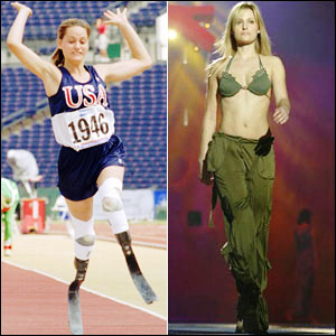
“Disability,” “Handicapped,” Aimee Mullins and survival of the fittest.
Remember Susan Boyle and the sensation she made singing, “I dreamed a dream”? Well, I think this video by Aimee Mullins has the same kind of transformational power.
Watch it and take notes because: 1. There are some amazing one liners. 2. I’m counting on you adding a comment and expanding the discussion (Hah, you can take the teacher out of the classroom…
Aimee Mullins at the TED conference
Is that a WOW or What?
TED is for the “thought leaders” of our generation. I’m so glad Aimee Mullins stood up in front of the world and talked about the words we use, the way we tell stories, our prejudices about people with disabilities and our ability to change and influence lives.
I’m thrilled she is beautiful, an accomplished athlete, and can deliver a message with the best communicators in the world. Chalk one up for our side. Aimee you did us proud.
Language
I was really struck by the definitions. Yes, even in 2010 the words “disability” and “handicap” carry such derogatory connotations. Every time I hear the traffic report and they say, “there’s a disabled blocking the west lane” I just cringe.
I recently spent some time looking up the words: “retarded, moron, idiot and imbecile” and their histories (click here for related article).
Aimee talking about the negative effect these labels would have made on her when she was a young child was sobering. (See related article on the difference between handicap and disability.)
I particularly liked Aimee’s references to Darwin. Our ability to adapt, change, and transform determines the “survival of the fittest”.
Inclusion is our “survival of the fittest.”
This is why I believe in inclusion I agree it means the difference between survival and a decent quality of life. (related article).
Inclusion is about adapting, changing and transforming. It is about blending into the normal population the same way animals learn to camouflage themselves into their environments
The medical doctor saying that she was an example of the “X” factor was my takeaway moment.
WE ARE THE X FACTOR.
If you are interested in my take on the differences between the label of “disability” and “handicapped” (click here). I would love to be able to pass this information on to Aimee. Perhaps it might help.
Come Dance With Me: Share your thoughts.
Were there any new ideas? Which of Aimee’s stories did you think were the most powerful? Do you have any stories about Medical or Educational professionals? What message would you want to send to Aimee? To her parents? To the medical professionals? If you had a chance to be a thought leader, what would you talk about?
Keep Climbing: Onward and Upward
All my best, Mary


Aimee is an amazing light being! Just like the dancers & kids at AZDance in their holiday performance.
They walk their talk and serve to remind us to “dance with adversity!”
I like how are you thinking…and I must confess I’m totally addicted to your articles!
Thanks. Aimee Mullins is truly an inspiration.
Love the TED conferences, thanks for sharing this!
It’s great isn’t it? If you come across other training materials you think our readers would be interested in, let me know. Welcome to our community.
This is amazing! Mary, I just subscribed to your blog and am loving it – totally inspiring. I have a severe hearing loss myself, a student at Miami University, and people have had low expectations of me my entire life. Luckily, I have incredible parents who raised me to be strong and persevere, so I am excited about becoming a high school math teacher and hopefully passing on all of the important knowledge from your blog to the next generation of students.
I’m sure you have it written somewhere, but what specifically is your disability? And it what ways has it impacted you the most?
Hi Clair,
Welcome to our Climbing Every Mountain community. Sounds like you are going to do great things and make a difference in the world. You will have students with all sorts of labels and needs in your high school math class. If you learn to differentiate the curriculum for each individual, each student, with or without labels, will have a better chance at success.
My son, Aaron has the label of autism, cerebral palsy and motor issues. Like your parents, I do my best to help him. If you want more information go to the “About” page at the top of the blog, or check out some of the other articles. I brag about him a lot.
I think it’s very important to spread awareness of the language we use towards people that have disabilities or are handicapped. Especially in the younger generations, people are unaware that they language they use can really affect others. It can be very offensive and it is completely unnecessary. The only way society will learn is if people like this make others aware of their actions. Sometimes, individuals don’t even realize what they are saying and that is what needs to change. Sensitivity, intelligence, and tolerance are very important aspects of change.
Hi Alexa,
You are right language makes a big difference. There is a 3 year old little girl, who today in 2012 is being told she will not even be put on the waiting list for a kidney because she has the label of mental retardation. Who knows what the potential of a 3 year old is. Labels can be powerful.