by Mary E. Ulrich | Jan 15, 2011

 photo credit: stvcr
In “Dear Caregivers” Part 1, I talked about the critical role and some of the issues of the caregiver or direct care staff. Today in Part 2, I’d like to share a story of what happened last Thanksgiving weekend. Holidays stress everyone–the people with disabilities, the parents, the staff and the system.
Nobody’s Home
We usually take Aaron home to our house for the holidays so we picked up Aaron on Wednesday. Our regular staff person happily began her vacation and we were going to return Aaron on Sunday evening.
We had a nice Thanksgiving with Grandma and the family. All is right with the world, right?
Blame it on the Hose
On the Saturday after Thanksgiving, Cincinnati was due for its first winter freeze. Tom remembered the outside garden hose was still hooked up at Aaron’s house. Since we take care of all the flowers, mulching and gardening at the house, Tom was worried the hose would expand, break, and cause damage to the plumbing inside the house. We treat Aaron’s house the same as we treat our own, so we drove to Aaron’s house to take care of the hose.
Somebody’s Home
When we arrived, we were shocked that all the lights were on in the house. We knocked, but when there was no answer, we used our key and yelled our “hello.” The TV was on, there were newspapers scattered all over the living room, there was an open purse sitting on the chair, but no one was home.
Our first reaction was to check the house for bodies, worrying someone was hurt and therefore couldn’t answer the door.
Next, we wondered if someone broke into the house and ran out the back door when we pulled up.
Several years ago, the residential company brought homeless people into Aaron’s house when they knew Aaron and Jack were away for the weekend, (another post sometime) so we considered that possibility.
We debated calling the police but decided to first call the residential supervisor.
“What is your problem?”
She told us Jack and the sub staff person must have decided to go out (without her purse, I might add).
The supervisor assured us her company would NEVER just bring strangers into a home (she’s only been with the company for a year so legitimately, she might not have heard the homeless story). She told us they always have plenty of staff to cover holidays and basically made it clear we were bothering her when there was NO PROBLEM.
She also told us that even when Aaron and Jack go to their parent’s homes every weekend, there is still staff covering the house—which we knew for a fact wasn’t the truth.
So, what to do?
We fixed the hose. We left the lights, TV and mess. But once again, we cursed the residential company we are forced to live with. Once again they lost our trust.
Anybody Home?
We brought Aaron back with us, hugged him and gave him extra attention all weekend. We seriously considered just keeping him with us, but there are thousands of people on the waiting list for the Medicaid Waiver. So, if we gave up Aaron’s Waiver, it could be years until he got another one and we aren’t going to live forever. So giving up Aaron’s residential “slot” would only be a short-term fix to a long-term problem.
“I didn’t want to hurt your feelings.”
The next week we found out no one wanted to hurt our feelings and tell us no staff person wanted to work with Aaron. Apparently, they could find a sub staff person for Jack, but not Aaron. No one thought we would find out, and they thought they were sparing us emotional pain.
So
It was hard to be angry with anyone. Unlike the supervisor, we had a long history of trust with some of our caregivers. We know they love Aaron and give him extra attention and support. They are the ones who bathe, dress and feed him. They clean up his messes and work with us when we take our vacation. They were genuinely trying to protect us from the feelings of rejection they knew we would feel. But the miscommunication and chaos theory that geared its ugly head, made things worse. After all, Jack and Aaron were okay.
We told them to just tell us the truth next time—even if you know it will hurt our feelings.
There were also other messes that needed to be cleaned up from leaving the house in the hands of subs for the holiday.
Vacant
When the staff person checked the mailbox her first day back, she saw a note from the mailman declaring the house “Vacant—no further mail delivery.”
Stay tuned for Part 3 of our continuing soap opera… Caregivers| “It’s NOT my job.”
Share your thoughts:
What would you have done if you were the staff person? What would you have done if you were the parents? What would you have done if you were the supervisor? What is the role of TRUST in a relationship? How did it make a difference? How do you think you would feel if no one wanted to work with your child?
Keep Climbing: Onward and Upward
All my best,
Mary
by Mary E. Ulrich | Jan 11, 2011

photo credit: easystand
Supported Living, Assisted Living, Independent Living, Residential Services: The key to quality care is good caregivers.
Dear Caregivers,
It takes a special person to work with my son, Aaron, and other people with severe disabilities.
Even though you hear, “Ah, you must be so patient and kind” and “God will reward you in the next life” working with people with disabilities is a job without status. Often you are lumped into the same devalued fringe of society as our children.
The pay sucks. You work for the company for 10 years and you might make $10.00 an hour.
It is a lonely job. You basically have all the responsibility and there are few opportunities to talk with other caregivers, even the staff working with the same people.
The hours are long and since they require overnight, holiday and weekend stays, they disrupt your family and make it difficult for you to have a regular social life–even on your days off.
You can’t sleep well, you can’t plan your time, you are often given more responsibility–but no compensation….
You don’t have the support you need:
If you call a supervisor, you spin a roulette wheel and gamble whether someone will call you back, answer your question or give you backup. After all, the supervisors usually work during the day, and you don’t begin your shift until the day staff goes home.
Since there is such turnover in the field, you often can’t find a replacement for your own health and vacation time, even if you follow the appropriate procedures. There are few subs for emergencies.
When things go wrong, you are usually on your own to figure things out.
Many companies don’t have money for inservice, so while you work with people with some of the most complex needs in the country–you don’t get information and instruction on what you do.
You do get the blame if you do anything wrong.
Most companies don’t pay for sick days, so you are forced to come in sick.
Most companies don’t pay for your meal or expenses when you take the “client” out into the community.
Most companies won’t even pay for your mileage (unless the “client” is in the car), even if you have to run all over town to deliver timesheets, go to meetings, pick up prescriptions….
If a “client” gets sick, or there is a snow day, the roof leaks or the schedule changes, YOU are the one who must change your life to cover the person in your care.
Sometimes, the person you serve has a better life style, home and community life than you do.
BUT, BUT, BUT…
You are a critical member of our child’s team, and your attitude, work ethic and habits make a huge difference in our child’s life–and in ours.
So, why do you do care for people with disabilities?
I have met caregivers who say they feel this work is their calling. Others do it for religious reasons. Some do it because they have a family member and know the need.
Others do it for reasons that are not so noble. In the next post, I’ll talk more about this group.
Meanwhile, Every caregiver who sacrifices to work with Aaron and others is a blessing to our children and our family.
Every caregiver who can see our child and love them for who they are, is a gift from God.
We have had caregivers make Aaron part of their family. One even named their child after Aaron. Another took him with them on family vacations. Another took him to workout at the gym, picnics, and camp-outs with his friends.
One caregiver has been with us for almost 9 years. She works with us if we have to change our schedule. She has watched Aaron grow up. She makes sure he is always well groomed. She makes healthy meals. She is a gem who is now a treasured part of OUR family. We know she loves Aaron like her own child. She will tell us when the other caregivers are not giving Aaron the support they should.
There is no praise and thanks we can give to the dedicated caregivers who have been part of Aaron’s life. They make all the difference.
What are your thoughts?
Have you had experiences working with residential companies? Did the staff do things and engage with the “consumers” in activities of daily living and in the community? What thoughts do you have about what is mentioned? Have you had a caring long-term relationship with a child? family?
Keep Climbing: Onward and Upward.
All my best,
Mary
If you thought this was useful, please retweet and post on Facebook. If you would like to have notices sent to your email check out the top left hand corner of the website.
by Mary E. Ulrich | Nov 9, 2010
When you fail to plan, you plan to fail. R. Schuller
Dream Plan for Aaron: 1981 (Part 1) (click here) talked about Aaron when he was age 6 and Tommy age 4. In Part 2 I will talk about when Aaron was in Junior High. In 1989 Aaron was 14 and Tommy 13. In a later post, I will describe exactly how we tried to implement this dream plan. The successes and attempts that failed, er, were learning experiences.
Dream Plan for Aaron: 1989 (Part 2)
Each day Aaron will get a hug, a song, a tickle, opportunities to exercise and to help someone.
He will have choices in each activity and environment which fills his life space (community, school/work/vocational, leisure/recreation, domestic domains).
He will have the best adaptations, supplementary materials, communication system and other modifications so he can be as independent as possible.
He will at least partially participate in all of his life activities, with the constant goal of increased participation.
But the most important part of the dream is for Aaron to have people who love him, and who he can love–a strong circle of friends.
Community Connections and Networking
Aaron will have increased opportunities to be around people who are NOT PAID to be with him.
He will be part of several groups/clubs which are composed of persons with and without disabilities. These groups will be for people about his same age, who share some interest.
They will get to know each other over time, and will have many shared experiences. There will be a formal “Circle of Friends” session to outline people and goals to achieve community connections.
This networking will include each of their families and friends so there is a community of people who care about Aaron.
School Domain:
Because Aaron has the label of autism and mental retardation, we know he will learn fewer things than 99% of the population.
We know it will take him longer to learn them,
We knowhe will forget and lose skills he doesn’t practice.
We know Aaron needs adaptations, modifications, etc. to even partially participate in activities; and,
We know he will need direct /indirect supervision at all times.
Aaron has been in school 13 years he has only 8 years to go:
In school, Aaron will have a functional curriculum (vocational, recreation/leisure, domestic and general community functioning) which looks at he needs in his life spaces. This will carry over in all parts of his life–all year long (including summer school).
It will be arranged around activities which are jointly decided by Aaron, his family, friends and professional team.
Vocational/Job Domain:
Aaron will continue to build his job resume. During his last year of school (age 22) Aaron will be placed on the permanent job he will continue after graduation. He will have the communication system and other adaptations he will need.
Aaron’s employment may include paid and unpaid hours. It may include 4 hours/seven days each week because of Aaron’s love for routine. It may include the same job (loading pop machines, emptying waste baskets….. in several sites. It may include a variety of tasks (so he doesn’t get bored) and could require a co-worker with complimentary skills so Aaron and he/she could share a job.
It should be a job he likes and around people who will get to know and like him for a long period of time. The ongoing support of the Butler County Adult Supported Employment Services Division will be in place because of a well developed transition plan for vocation and independent living between the school and adult services.
Domestic Domain:
Around age 22, Aaron will move to a shelftered apartment/condo or co-op housing unit in his community (West Chester).
He will live with one or two other people with disabilities or in a foster family/shared-parenting arrangement. He will recieve supported living personnel from BC Residential Semi-independent Living Services.
Aaron will actively participate in his own shopping, cleaning, cooking, yard work and personal grooming needs. He will use the communication systems he learned in school.
The home, as close as possible, should match the lifestyle of the neighbors/community and be near his natural family.
Leisure/Recreation Domain:
Aaron will have supported recreation/leisure activities in his community and will join some community groups/clubs; tandem bike riding, bowling, YMCA, Exercise, horseback riding, swimming, etc.
Long Term Supports:
Financially, Aaron will be dependent on SSI and Medicare. An insurance trust will be set up to supplement his basic needs, activities, clothing, recreation/leisure and medial care in the case of his parents passing away.
Tommy will be Aaron’s guardian and though not providing direct care, he will oversee the quality of care. This will work if the trust is large enough when the parents die.
We know 99% of people with severe disabilities are either physically, emotionally or sexually abused or neglected.
We know Aaron is especially vulnerable.
We hope to surround Aaron with people who care about him, love him and at least a few people who don’t have to be paid to be around him.
We want to give him varied opportunities to make choices and be challenged to increase skills in all his environments and activities.
Though dependent in many ways, Aaron will have self esteem and confidence in the things he does– and be a contributor to his family, his extended family and society.
Judith Snow urges us to “Dream more than plan. Plans tend to become hardened–they lose the capacity to change. If you take the first step toward a dream, the dream will change as you go along. The dream will be changed by reality, but the dream will also change reality.”
Beth Mount, et al. What are Learning about Circles of Support 1988.
Speak Your Mind:
When you were in Junior High, what kinds of dreams did you and your parents have? How were they alike and different than our dreams for Aaron? Could you see the evolution from the 1981 Dream Plan (Part 1) to the 1989 Dream Plan (Part 2)? What do you think Aaron’s life might look like in 1998?
Keep Climbing: Onward and Upward
All my best,
Mary
Part 3 will be a list of Aaron’s likes and dislikes we gave to the residential staff when Aaron moved into his own place at age 25.
by Mary E. Ulrich | Oct 28, 2010
 http://www.deal.org.au/anne-mcdonald-1111961-–-2210-2010
Until Eternity
When I go to a funeral for a person with a severe disability, there is always someone who thinks they are helping by saying: “She is no longer suffering–even if the person wasn’t sick.” or “Now that he is in Heaven, he will be able to walk.” Or, “Finally Jenni will be able to talk about all those things she was trying to say and we could never understand.”….
I don’t know.
In fact, no one knows. Heaven is a place where we can hope or speculate–but the people who cross-over are as silent as many of the people we love.
There is no way for us to really communicate until eternity. But, it makes me wonder:
What is Heaven?
Is it a place where we are surrounded by God’s love,
and our family and friends?
Are wars and battles replaced with caring communities and friendship?
Are people who were old, now young again?
Are people who could not walk and talk, now dancing and singing with the Angels?
Are people who have suffered from abuse and illness, now strong?
Will we know the answer to life’s biggest questions and mysteries–like WHY?
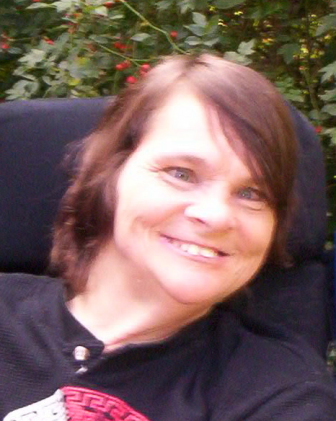
Anne McDonald
Anne McDonald died Oct. 22, 2010. She was never able to say a word, or walk, or physically care for herself. She lived in Australia, on the other side of the world from Cincinnati, Ohio. So how is it that she influenced the lives of Aaron and our family? Anne was the person who first introduced Facilitated Communication to the world. She and Rosemary Crossley met with Doug Biklen, Anne Donnellan and others who had to rethink everything we knew about communication and movement disorders in people with cerebral palsy, autism and other physical and intellectual disabilities.
Anne was the person who cracked the paradigm forcing the professionals to throw away their tests and not judge people by how they looked and acted. She was the one who began the movement for the freedom to communicate. She rocked the world of disabilities.
Here is the official press release from the Australian Government:
We mourn the passing of Anne McDonald, an author and advocate for people with disability. Her death in Melbourne on Friday is a sad loss for the disability community and all Australians. Born with severe cerebral palsy and unable to walk, talk or feed herself, Ms McDonald spent 14 years in a state institution after she was wrongly diagnosed. With the aid of disability advocate Rosemary Crossley, Ms McDonald eventually learned to communicate and when she turned 18 she went to court to win her freedom from the institution. She co-authored the best-selling book about her struggle, Annie’s Coming Out, which was later made into an award winning Australian movie. Ms McDonald also completed a degree in humanities, becoming one of the first people with severe cerebral palsy and no speech to obtain a university degree in Australia. She dedicated her life to advocating for the rights of people who can not talk and was recognised for her efforts with the National Disability Award for Personal Achievement in 2008. Ms McDonald was a pioneer in the field of disability rights, courageously taking on landmark legal battles that have changed the face of disability law both in Victoria and across Australia. She also published articles and gave presentations at conferences around the world, sharing her inspirational story with others. Today our thoughts are with her family and friends, as we mourn the passing of a truly amazing Australian.
So that’s the official story. But, like everything about this woman, you must hear her own words. She writes about her hell in the institution (click here):
This is the speech Anne McDonald delivered at Parliament House in 2008 when she won the Australian National Disability Award for Personal Achievement.
“I spent my childhood and adolescence in a state institution for severely disabled children. I was starved and neglected. A hundred and sixty of my friends died there.
I am a survivor.
That isn’t a heroic achievement. Anyone who was put into a large institution in the times when large institutions were sugarcoated concentration camps was as much a hero as I was.
They stayed alive when they could and they died when they couldn’t. Such heroism is easy to achieve in giant barracks where the prisoners stay alive through being cheery enough to attract a staff member to give them that vital extra spoonful of food.
I wasn’t exceptional in anything other than my good luck. I was selected for an experiment.
Rosemary Crossley wanted a subject for her Bachelor of Education literacy project. She chose me. The aim of the experiment was to see if I could make gains in my tight-armed pointing to blocks with different colours on them.
Rosemary found I could point to colours, then to words, and then to letters.
She taught me to spell and to make my wishes known. I made known my wish to leave the institution, and then all hell broke loose.
I went to the Supreme Court and won the right to manage my own affairs. Unfortunately, that didn’t mean that the institution offered the other residents the right to manage their own affairs.
I was an exception. Through no desire of my own, I was out front in the struggle to get rights for people without speech.
I tried to show the world that when people without speech were given the opportunity to participate in education we could succeed. I went to Deakin University and got myself a degree. That, too, was seen as an exception.
I gave papers and wrote articles on the right to communicate. I set up a website to show that there was hope for people without speech. People thanked me for being an inspiration; however, they didn’t understand why there weren’t more like me. They continued to act as if speech was the same thing as intelligence, and to pretend that you can tell a person’s capacity by whether or not they can speak.
Please listen to me now.
The worst thing about being an inspiration is that you have to be perfect. I am a normal person with only normal courage. Some people who should know better have tried to give me a halo. Anybody could have done what I have done if they too had been taken out of hell as I was.
If you let other people without speech be helped as I was helped they will say more than I can say.
They will tell you that the humanity we share is not dependent on speech.
They will tell you that the power of literacy lies within us all.
They will tell you that I am not an exception, only a bad example.
Many are left behind. We still neglect people without speech. We still leave them without a means of communication. It should be impossible to miss out on literacy training, but thousands of Australians still do.
As Stephen Jay Gould wrote,
“We pass through this world but once. Few tragedies can be more extensive than the stunting of a life, few injustices deeper than the denial of an opportunity to strive or even to hope, by a limit imposed from without, but falsely identified as lying within.”
I don’t know what Heaven is like. But if anyone deserves a reward for her life on earth, and happiness for all eternity–it is Anne McDonald.
God Bless Anne.
Thoughts? Questions?
What do you think about Heaven? Do you have any stories about Anne, Rosemary or Facilitated Communication?
Keep Climbing: Onward and Upward
All my best, Mary