
Building Community | People First Language
People First Controversy
Background:
There is controversy in the disability community about the use of People First or Person First language.
I’ve written several posts about People First language:
*Stigma and segregation caused by labels like “mental retardation“ and,
*Challenge to bloggers to use People First language.
Some self-advocates on the Autism Spectrum disagree They feel parents want to deny “autistics” and “aspies” their unique voices. They say parents only want to destroy autism and cure their children.
I am proud to support Rosa’s Law and advocate for People First Language. Perhaps these personal stories will explain.
I’m going to start and end with “Wheelchair Becky” but also share some stories about the past history of people with disabilities, my son Aaron, myself, and my hope for the future.
Is People First Language important for “Wheelchair Becky”?
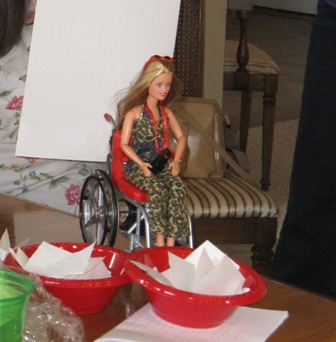
In a previous post: Building Community | Wheelchair Becky vs. Flat Stanley, I wrote about the way the Mattel Company thought “Wheelchair Becky” and “Black Barbie” would teach children about diversity and tolerance…and how it backfired.
I think People First language is part of the solution. If you disagree, that’s okay. It’s part of celebrating diversity.
Is People First language important for Aaron?
Aaron is my son’s name.
He has been depersonalized, reified and labeled by doctors, psychologists and other professionals as autistic, cerebral palsied, DD, MR, sensory deficit, movement disorder, severe/profound….
In the precedent setting Roncker case, the school psychologist testified under oath that Neill Roncker and others (like Aaron) had such low IQs “they wouldn’t know the difference between sitting next to a real person or sitting next to a rock.” So segregating them in separate schools with their own kind would make no difference. She considered their education a waste of school resources. Many people still agree with her.
So, I feel strongly People First language is important. Aaron is a person first. Others can give him labels. Some are medical and diagnostic but others are cultural: brother, son, uncle, friend, neighbor….
This has nothing to do with wishing Aaron was cured. This is not denying the “autistic” culture. This has nothing to do with “disability pride.” It has everything to do with survival.
People First language reinforces the moral argument that people with severe disabilities are people and have a basic right to exist. A right to breathe, to be a member of the human race, to live with our families, go to neighborhood schools and community activities–rather than live in institutions. Check out Parallels in Time history of people with disabilities It is filled with the abuse of those basic human rights. The more we know about our history, the more we understand the need to protect our rights to “life, liberty and the pursuit of happiness.” This is a daily challenge as we fight for caring staff, decent living conditions, health care, opportunities to be safe and belong to our families and communities. There are many people who see only the disability–and think that means we don’t need the same care and support–we are not really citizens, not really human.
Aaron is a “person” with wants, needs, likes and dislikes like everyone else. He is Aaron, that unique PERSON whom I love. He is Aaron a citizen with rights.
As I look at my life as a parent, advocate, teacher and friend to people with disabilities, I find I have excluded myself from my community. Yea, me–the advocate for inclusion.
Is Mary a Person First?
All mothers understand this conundrum. Especially when your child is so vulnerable. I’ve spent many years hanging around people working for the civil rights of people with disabilities i.e. Mothers of Special Children, Special Education Parent Groups, Arc, Autism National Committee, TASH…. I am a member of Disability World. Maybe not a primary consumer, but certainly a secondary consumer.
At some point, I realized I had to reclaim my own personhood. My personal resolution to rejoin the mainstream of my community included finding writers’ groups.
OVRWA
Fortunately, I found the Ohio Valley Romance Writers of America (OVRWA) in my community. These talented women have become more than mentors, they have become friends. I learned almost every one of them has a PEN Name, some have more than one.
Men with Pens
Men with Pens has also been a terrific community for beginning writers and bloggers. I’ve met James Chartrand who also wrote about using Pen Names and Pseudonyms.
Positive Solution: Writer’s Groups and Pen Names
So, it occurred to me: What if our stigmitized “Wheelchair Becky” started to include herself in these writing communities? After all, she’d graduated from the high school yearbook committee, right?
What if “Wheelchair Becky” chose her own Pen Name, became her own person, and like Flat Stanley started to integrate herself into the community?
Pen Names
Urban legend says one way to pick your Pen Name is to:
1. Write down the name of your first pet.
2. Write down the name of your street address when you
owned that pet.
I consulted with “Wheelchair Becky” and she agreed to make this into a community-building activity at the OVRWA holiday party.
Everyone wrote their pet’s name and put the papers in one red dish.
Everyone wrote their street address and put the papers into another dish.Then “Wheelchair Becky” with the help of a friend, chose one name from each dish and VOILA—
Smokey Woods was born.
How do we build an Inclusive Community?
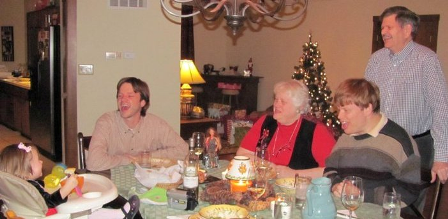
In the tradition of Flat Stanley and many writers, Smokey Woods began to make friends and include herself into the community. Here (at the head of the table) she is toasting in the New Year with our family. (BTW: She doesn’t eat much and is a cheap drunk.)
Here my precious granddaughter is playing with Smokey Woods the romance writer.
Smokey Woods is a doll, a toy. Smokey might use a wheelchair to get around, but she has a name.
My granddaughter represents the future. For Aaron, for me, for all people with disabilities. She will see people like Smokey in her classes and community. When she watches Glee on TV, she sees Artie singing and dancing. He also uses a wheelchair, but Artie has a name–and it doesn’t start with “wheelchair.”
Names matter. Aaron is Aaron. Mary is Mary.
I’m not promoting People First language because I am looking for a cure. I’m looking for survival and ways to prevent the abuse and segregation of the past. I’m looking for community inclusion.
For Aaron.
For myself and my family.
For all the next generation of little kids who will be learning about diversity by playing with dolls and watching TV.
I also think Mark Twain, Dr. Seuss and all the other writers who use Pen Names would approve.
Keep Climbing: Onward and Upward
All my best,
Mary and Smokey
Your Turn:
Did this make sense? Are there important reasons to use People First Language? Can we learn more about community inclusion and what it means to be a real person by looking at our language and the names we call each other? Do we need to study the past so we can move forward? In the comments please share your ideas.


Thanks, Mary. You have a great way of hitting upon topics dear to my heart. I agree with you that promoting People First Language is about survival, respect, and safety. To me it is not about issues of cures. My experience is in working with people who have labels like those of your son. They are people who struggle to be recognized as thinking people inside bodies that may not work as they wish. They have been severely and profoundly misunderstood, overlooked, disregarded, mistreated, left out, talked about in their presence and worse. They have not been seen as individuals with a contribution to make. They have been viewed and treated as one of a group of people who are not really fully people, and this view has been perpetuated in the language that people have used over time (“retarded people”, “the disabled”, “those people”, “them”, “their kind”, and so forth). Our language is very powerful in shaping and maintaining our view of what is real. To challenge and reshape that view, it sometimes helps to change how we talk about the world and about people. That does not always work, as sometimes people just say, we used to call it “…” and now we call it “…”, without changing their thinking at all. But I, like you, think that words matter and that we won’t change attitudes and foster new perspectives without changing the way we talk about and think about people and how we are all in the world. It works for me in my life. Changing the words I use helps me to change the way I see and think about something. Thanks for this discussion.
Judy Bailey
Judy you have so many beautiful thoughts in your comment–it should be the post!
I know several people have unsubscribed from ClimbingEveryMountain because I didn’t agree with their position about using people first language.
I wish they could have talked with you and learned from your experience. You are right, there is so much at stake. I guess the young people on the spectrum will have to learn their own lessons.
This is such an important discussion topic. It is great that they are making diverse toys for children such as “wheelchair Becky” and “black Barbie.” Exposing children to differences in people early on in life is important, however having the disability-first naming makes the children think that this is the defining element of the person. I never had learned how important people-first naming was until I started learning more about people with disabilities and the disability rights movement. Making people aware that the disability is not what makes a person who they are is the first step, I think, in getting society to accept these people as they are. Thanks for the topic, I hope more people read this and that people-first naming will allow for more inclusion of individuals with disabilities in the very near future!
Thanks for your thoughts Kara. Being a person-first is a critical step toward getting civil rights. Just as the slaves, immigrants and other minority groups were not considered “people” –people with disabilities have had an uphill battle for civil rights. The more people we have on our side, the easier it will become.
Hi, how can I subscribe to your blog? I like it, thanksRegards
Go to the top left corner and find “get notice of new posts” and welcome Sam.
Language is so powerful. We subsume language into our consciousness almost by osmosis and there it sits doing it work – for good or bad. The only way to make sure it is for good, is to raise it back up to the surface again for examination. Good work, Mary
Alison Golden recently posted..The Ninth Reason I’m A Bad Mommy…
Osmosis it is! Your comment made me think of our kids who soak up our language–even those “bad words” that Mom lets slip
Wonderful post Mary. Several things hit me as I was reading this. Firstly they are persons. I am a person who just happens to be challenged by several congenital birth defects.
Secondly I was reminded how the Europeans settles who came into this country excused their behavior by saying the the Native Indians where not human. The savagery that caused included among other things smashing babies and toddlers heads into trees to save on bullets.The teachings of Jesus were pervesrely changed to excuse this kind of conduct.
Thirdly on a much lighter note many native Indians gave themselves and their children rather unique names. Sometimes it was based on a vision that a person had, it could be something unique that happened when a child was being born. Unlike us with are first name and a pedigree for a last name. Well My breeding stock was the Jordons.
Well I’ll keep climbing some mountain. Not sure which one hehehe.
Oh the shot of you granddaughter with the Smoky woods doll was adorable.
Thanks Gary,
You are absolutely right about the Native Americans also being a devalued group. Great points all.
Did you know that in the closing arguments of Brown vs. Board of Education, the school’s attorney argued that (something like) “If you allow Negroes into the schools, then you are going to have to allow the mentally retarded and even the Indians.”
You are so right. Language is so important.
Dear Mary,
I have been following your blog in accordance to a class I am currently taking that focuses on children with exceptionalities. Something we have been doing each week in class is talking about how we are and have been labeled. It has been really interesting to hear some of the labels that my classmates have received throughout their lives; some are positive while some are very hurtful and negative. My professor really stresses the point of how important language and labeling are. I have never really taken this into consideration before, but I am starting to discover how important language is. People with disabilities cannot be solely defined by their disabilities. I would hate it if someone constantly labeled me as Worrywart Leah. I tend to worry a lot, but I do not want this to be how others identify and label me. I do not find my identity in worrying. As I continue to become aware of how I label people, I am trying to increase my use of People First language. Thanks for reminding me again to consider how I use my language!
Sincerely,
Leah
Welcome Leah, I send my thoughts into cyberspace and am never sure what my readers think…so thanks for the feedback. We all use labels all the time, I smiled at the worrywart label because I can relate.:) But you are right, some negative labels hurt and stigmatize unfairly. I hope you’ll share more of your thoughts. Mary
You definitely educated me in this regard. In my family, “you idiot” is a loving term, not a derogatory one – sort of like saying “you goof.” I was surprised when you pointed out it could be taken in an entirely different way. We use “you’re nuts” or “you’re crazy” in the same way.
Now I’m much more conscious of how these and other commonly used words can be considered hurtful. I was just reading a book that used “moron” several times in a humorous manner in a way that was intended to be loving. My first thought was, “I don’t think Mary would like this word.”
I know I have a long way to go, but thanks to you I’m thinking more about the words I use. Thanks, Mary!
Thanks for sharing your story Becke. My feeling is that if people really understood what “idiot, moron, imbecile, lunatic…” really meant and the history of the words they would NEVER use them for a loved one.
Every time I see the words in books, on TV… (which is often) I cringe and hope we can make change in our culture like other derogatory words. Indeed, it is an uphill battle, but many people have embraced the more respectful language.
Thanks again for considering your words and sending you many many hugs for my endearment.
Mary recently posted..Building Community | People First Language