by Mary E. Ulrich | Sep 8, 2016
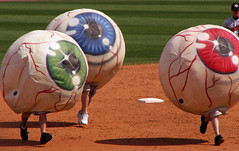
 photo credit: Sister72
The Race Toward Inclusion| Do you see it?
I love this picture. It reminds me of many of my favorite quotes:
“The real voyage of discovery is not in seeking new lands, but in seeing with new eyes.” Proust
“No one’s blinder, than s/he who will not see.” Kenny Rodgers’ song
“The race is not only to the swift, but to s/he who keeps on running.” (unknown)
“It is only with the heart that one can see rightly; what is essential is invisible to the eye.” Antoine de Saint-Exupéry
Eyeballs Running Everywhere
The racing eyeballs also remind me of late at night, lying in bed when my thoughts just keep galloping around in my head.
Our world is filled with a myriad of choices, distractions, good and bad news–all begging for our eyeballs and attention.
Parents of typical kids have trouble sorting out their priorities, and much of their intense parenting ends when their kids are 21. For parents of kids with disabilities, our hardest years are after graduation.
We are supposed to be experts on everything, autism, intellectual disabilities, developmental disabilities, govenment laws and departments on local, state and federal levels, advocacy organizations….
We are supposed to visualize our future, our children’s future.
We are supposed to foresee what will happen, so we can be prepared to protect our vulnerable children.
It makes me dizzy.
I want my bloodshot eyeballs to stop racing around trying to keep up. I want to be able to look forward to a future where my son will be okay. I want to be able to trust the professionals to do their jobs…I want to sleep in peace–(well, not the eternal kind of peace, just restful, you know sleeping through one or two nights 🙂
What about you?
Can you see the good–and ignore the distractions of failed levies, government cutbacks, negative news?
Can you watch the media focus on new segregated programs and ignore inclusive programs?
Can you envision new inclusive services in the community?
Can you discover hopeful ideas and events?
Can you anticipate next week being better? Next month? Next year? 10 years from now?
Can you believe you will have the people and resources you need?
Do you also feel dizzy?
We need to narrow our focus and concentrate on “the essential”: What can we do today to move toward the inclusion of our children in society?
We can’t solve all the issues of the world. But we can exercise the Power of One and do one thing today to make a more inclusive world for the person we care about. One thing. Today.
But how do we decide on that one thing? How do we filter out all the choices?
Pruning
Just like a gardener or farmer prunes the dead wood from a rose bush or apple tree, we need to teach ourselves to prune the information that bombards us everyday. We can make the choice to throw out some information, ignoring potential goldmines. If it is really a goldmine–it will still be there tomorrow. I do this by limiting the time I spend watching TV, the news, using social media like Twitter and Facebook. I don’t care what Brad Pitt is doing, I don’t want to hear about recent car wrecks, abused children, or floods in Asia. I can’t do anything about it. If it is bad, scary, if it is going to keep my eyeballs busy while I am trying to sleep–I prune it out. The world can move on without me.
Planned Ignoring
Planned ignoring is consciously making a decision to ignore certain things. Planned Ignoring gives me time to digest and analyze the information I already know. We need to allow ourselves to “see” and “not see” as we make our priorities. This will help us reduce the overwhelm. We can stop the racing eyeballs in our minds. We can allow ourselves the luxury of closing our eyes for a moment, and find our FOCUS.
Seeing with New Eyes of Inclusion
Long ago, I decided my “voyage of discovery” was to the land of inclusion. It meant learning new ideas, shifting my paradigm, and it is based on the principle of normalization, I want my son Aaron to have as normal a life as possible (period). I can make a difference for him by seeing with my new eyes of inclusion.
What do I see? What does my loved one see?
Is this moving toward inclusion?
I have to live in the real world, so I compromise a lot. But I try to keep my vision focused on the goal: Inclusion for Aaron and others. For instance, yesterday I again had a discussion about filling out a form when we picked Aaron up at his house. Because of the principles of inclusion and normalization, I will still make up my own form, rather than use the medical model form from the agency. Six month ago I was promised this would be changed, but Herbie still lives. Herbie bits the dust“>Click here.
When I first confronted the agency six months ago, I was using “pruning.” I would chop out the old policy. I made phone calls, was given assurances that it would be changed.
For the last five months, I’ve used “planned ignoring”. I kept hoping they would keep their promise to change the form. I kept signing the form I made myself. (The house staff was also using planned ignoring–and just let me do my thing.)
But now, it’s time to use my “new eyes” and make one change as we journey into our annual ISP (Individualized Service Plan–the adult service version of the IEP only without the due process).
I’m predicting: The EYES will have it!
Sweet Dreams Everyone.
Keep Climbing: Onward and Upward
All my best
Mary
COMMENTS:
What do your eyeballs see? What is your vision for the future? Do you think the concepts of “pruning,” “planned ignoring” and “seeing with new eyes” are useful strategies? Are some people incapable of “seeing”?
by Mary E. Ulrich | Aug 18, 2016
In Bob Perske’s memory, I’m posting some of my favorite posts about him.

Bob Perske by Joe Arridy's Grave
On January 7, 2011, Colorado Governor Bill Ritter, Jr. issued a “posthumous pardon” to Arridy, one of the five wrongly executed people with intellectual disabilities.
BOB PERSKE:
Pastor to People with Disabilities and their Families
Bob Perske is one of the most gentle and positive people I know. He lives God’s message to care for the “least of my brethern.”
It might surprise people to know Bob hangs out with criminals on death row.
In a previous post I shared his “history of people with disabilities and hope for families.”
Because Bob understands the history of people with disabilties, he knows FEAR was one of the main reasons for removing people from their families and locking them up in institutions, away from society. Fear is still one of the main reason people are excluded from quality lives in the community.
The world in which we live is not always safe, secure, and predictable. It does not always say “please” or “excuse me.” Everyday there is a possibility of being thrown up against a situation where we may have to risk everything, even our lives. This is the real world. We must work to develop every human resource within us in order to prepare for these days (Robert Perske: “The Dignity of Risk.” 1972).
Bob is still hopeful for families, but he wanted to share his recent testimony about people with intellectual disabilities who have been convicted of serious crimes they didn’t commit. Crimes they confessed to because they wanted to make the police officers happy or get them to stop the interrogations. Crimes they didn’t even understand.
Everyone wants people who kill, steal and rape people behind bars. Everyone wants dangerous people off the streets. Everyone wants JUSTICE for the victims. And, Everyone wants the right person convicted.
But Bob Perske and others ask:
“What if the person who confesses to the crime is a person with an intellectual disability?”
Certainly, just because a person has the label of intellectual disability doesn’t make them innocent–but it also shouldn’t make them vulnerable to giving false testimony in our criminal justice system.
Bob writes:
Although I did a lot of writing about kids and families earlier, deep in my heart I think they also need to be aware of futures where they can be misunderstood by interrogators and they need to be alert and ready for these grim possibilities.


What can we do?
ELECTRONIC RECORDING OF CUSTODIAL INTERROGATIONS
Robert Perske, Citizen Advocate
Persons With Intellectual Disabilities
[email protected]; www.robertperske.com
www.friendsofrichardlapointe.com
www.friendsofjoearridy.com
CT: REGARDING SB NO. 954 AN ACT CONCERNING THE ELECTRONIC RECORDING OF CUSTODIAL INTERROGATIONS (March 9, 2011)
Dear Committee Members:
For the past 34 years, I have served as a worker and author on cases involving persons with intellectual disabilities who were coerced into confessing to major felonies they did not commit.
I am a member of The ARC of Connecticut and The ARC of the United States.
I am the author of “Perske’s List: False Confessions from 75 Persons with Intellectual Disabilities.”
It will be published in September’s Intellectual and Developmental Disabilities, a journal of the American Association on Intellectual Disabilities. (AIIDD).
The article is 24 pages long. It shows that:
• 65 have been legally exonerated.
• 29 have been exonerated by DNA tests.
• 5 are now headed for court hearings thanks to “Innocent Project” groups.
• 5 have been so wrongly executed they will always be painful to justice-loving lawyers when they think about them.
• 1 of the five wrongly executed was Joe Arridy. On January 7, 2011, Colorado Governor Bill Ritter, Jr. issued a “posthumous pardon” to Arridy.
• I predict that Richard Lapointe of Connecticut will someday be added to this list.
The time has come when judges and juries should be helped by advanced video technology to see everything that went on in an interrogation room. Until they can do that, our justice system will be tainted.
Respectfully Submitted
Robert Perske
RESOURCES:
Check out Bob’s articles, books, websites or give him a call.
Closing Thoughts:
As parents we worry about our children being victims. Few of us imagine our children as the aggressor.
What can be done to give them better protection, a more fair and equal justice? Because sometimes even the people who have confessed to being the aggressors–are Victims.
Electronic equipment seems like an easy answer to me. I would think it would help protect the rights of everyone, including the police officers.
Keep Climbing: Onward and Upward
All my best,
Mary
Discussion: These are life and death issues. Would video technology and electronic recordings of custodial hearings bring better justice to everyone? Is this worth the cost? What do you think of Bob’s role as a pastor and “citizen advocate”? How can we make our children less vulnerable?
by Mary E. Ulrich | Apr 7, 2016
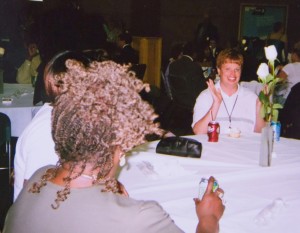
Aaron and Friends
Test Questions | Segregation or Inclusion?
Friends and family members send me newspaper stories about people with disabilities. Some stories make me shout with joy and others make me want to cry and give up. Often my friends can’t figure out which ones are which.
For those of you who have been following my blog, think of this as the end of semester test–one of those little Reader’s Digest sort of quizzes.
Below are three stories followed by three sets of multiple choice questions? What do you think of these stories? Please respond in the comments.
1. It’s always sunny in Life Town: (click here) The mocked-up village square allows children with disabilities to learn the skills they need in daily life. (Sunday, April 3, 2011 By Jason Shough THE COLUMBUS DISPATCH)
a. This story about inclusion makes me shout for joy.
b. This story about segregation makes me want to cry and give up.
c. I’m not sure.
2. A prom: An enchanted evening for students with intellectual disabilities (click here) A Pennsylvania high school held a prom Thursday night for students with intellectual disabilities. The event included many elements of the traditional high-school event, including dinner, dancing, pictures and entertainment. “Many of them will not attend another prom because of some of the limitations they have,” teacher Amanda Murray said. “But they deserve it. They never have an opportunity to be together without tons of rules outside a school situation.” Pittsburgh Tribune-Review.
a. This story about inclusion makes me shout for joy.
b. This story about segregation makes me want to cry and give up.
c. I’m not sure.
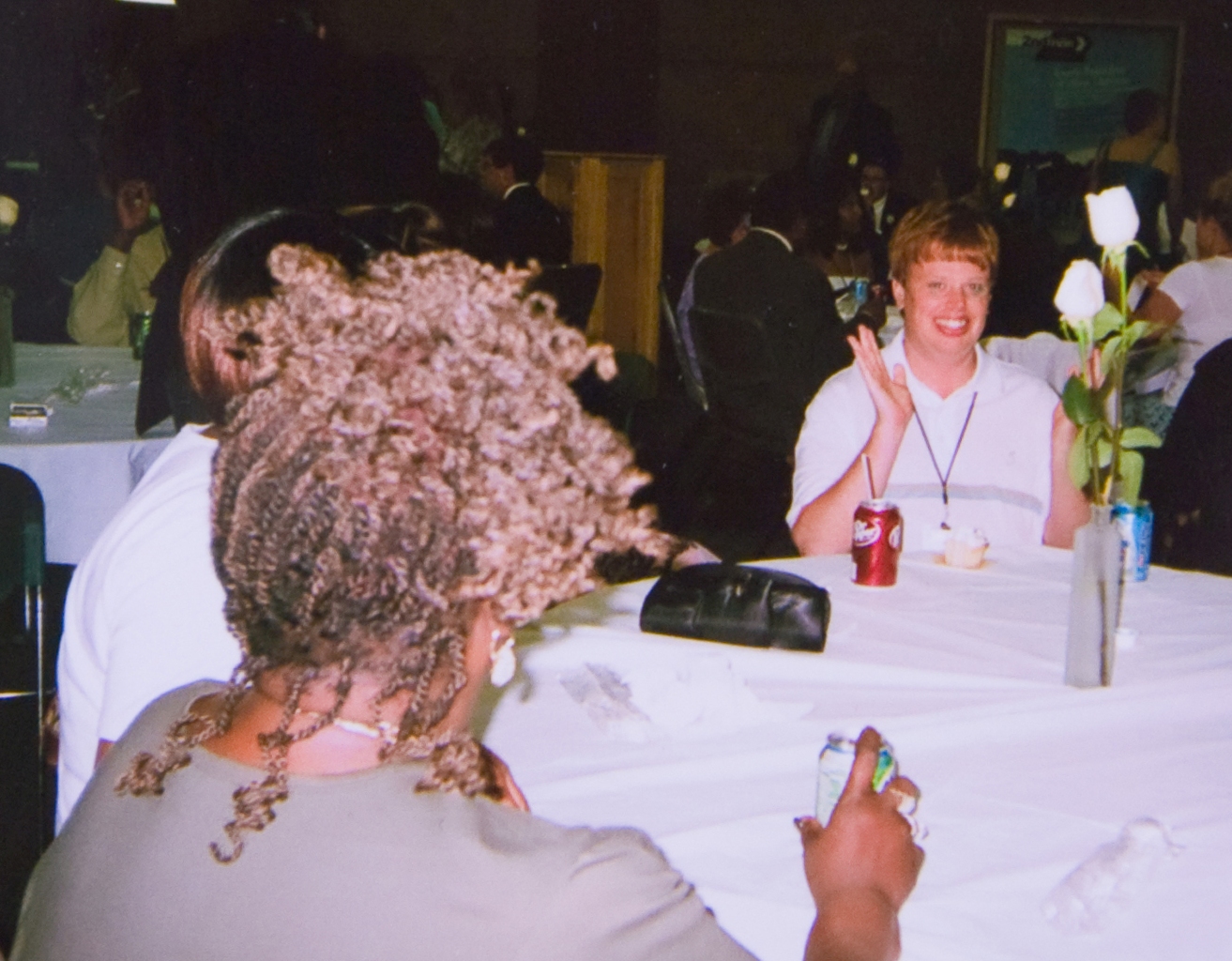
3. Story Three: see the picture, Aaron and Friends, at the top of the page.
Aaron, my son with the label of autism, is at a Spring Gala dinner and dance with his neighbors.
Susan and her husband, Charles, live next door to Aaron. They belong to a church at the edge of the neighborhood.
Susan invited Aaron and Jack (Aaron’s housemate) to join her and her husband for the church spring gala. They picked him up at the house and Susan introduced Aaron to the Minister and her friends, helped him get his dinner, danced with him, took pictures, and brought him home.
Aaron’s staff person was there to help if needed, but Susan and Charles did everything they could to make sure Aaron and Jack had a terrific night.
They told me later, they really enjoyed being with the guys and thought everyone had a great time. Susan was surprised Aaron enjoyed the band and watching all the people. She hopes to take them again next year.
a. This story of inclusion makes me shout for joy.
b. This story of segregation makes me want to cry and give up.
c. I’m not sure.
——————————————————————————-
Okay, now respond in the comments. No peeking at my response:) Remember your response is based on your paradigm and not mine, diversity is allowed. This isn’t a test where you have to please the teacher. This is a discussion of important issues.
Undecided?
Check out my previous article: Teachers| Segregation or Inclusion
Consider the core question: Does each of these activities lead toward the inclusion or segregation of people with disabilities?
For a definition of inclusion check out the article: What is Inclusion? plus, pictures of Aaron and Tommy at graduation.
Still Undecided?
Check out Norm Kunc: What’s your Credo of Support? Does this activity build authentic self-esteem and skills, or does it support the charity model?
Answer to Question 1: Mock Town by Barb McKenzie
Here is a response to the first article about the mock town from Barb McKenzie, a parent leader:
After seeing the title and reading the article below from today’s Columbus Dispatch newspaper I wondered, “Can benevolence get in the way of equality and ordinary opportunities?”
A generous person wants to help. We are taught to help others; it feels good to help others. But what perceptions might that ‘helper’ and ‘helpee’ relationship procreate? Is the ‘helper’ some how better than the ‘helpee’? Does the ‘helpee’ always need to be helped, never given the opportunity to share his or her gifts and enjoy the good feelings we get from our generosity? Do we believe that the ‘helpee’ has anything to share?
Why, especially when it comes to children or adults with disabilities, do we feel we must create special, pretend places to practice in and learn the skills to interact in society in the “real” world? Why can’t we try and figure out how to provide genuine, authentic, ordinary opportunities for all IN the “real” world? If natural supports or additional assistance are needed for any of us to be participating members of our neighborhood community, can’t we work together to figure out how to do that? Don’t we all learn better with and from each other in the real world, in the real school, in our real community?
Do our good intentions sometimes get in the way?
Mary’s Answer: Question 1
I agree with Barb. “Life Town” can never be a mock town. This artifical town reminds me of “safety town” for preschoolers and kindergartners to learn how to drive their bikes. Or the little pretend kitchens in kindergarten rooms. Or, Lou Brown’s famous cardboard bus that some special education teachers made for their classes in the ’70s.
There are some people who think that because a person’s IQ score says they function at a 6 year old level, doing pretend kindergarten type experiences makes sense. What the research shows people with disabilities have trouble generalizing to other environments, and because this was a one-time experience (not really a teaching experience with multiple trials and practice), and because the mock town was just that–mock.
In my mind, this whole experience does not promote inclusion in the community, instead it promotes segregation because it assumes the students need a protective environment and a “get ready” for the real world attitude. The twenty volunteers and the time, money could have been much better spent to practice “community” skills in the real community–they are high school students, they don’t need to be in a pretend environment. I’m embarrassed these teachers didn’t know any better. They should know more about authentic learning and functional curriculum.
Here is a new resource from a member of TASH if anyone is looking for best practice for people with severe disabilities.
“Systematic Instruction of Functional Skills for Students and Adults with Disabilities by Dr. Keith Storey .” This is a practical “how to” text for teachers and other service providers. The format, readability, and detailed description of instructional methodology make it a resource for instructors responsible for improving the skills of learners with disabilities.
Answer to Test Question 2: Dr. Cheryl Jorgenson
Here is a response from Dr. Cheryl Jorgenson from the University of New Hampshire:
This kind of segregation of students with disabilities should be part of our long-past history, not featured in a national news brief for educators in special education. The statement quoted by the teacher (Ms. Murray) that the students have limitations that “prevent” them from attending the regular prom is beyond the pale. Can CEC seriously be promoting or even acknowledging this practice? IDEA states that students with disabilities have the right to participate in extracurricular activities alongside their peers without disabilities.
I believe that CEC owes an apology to all students with intellectual disabilities and should make a commitment to publishing stories that promote the full membership and participation of all students with disabilities in school and community life.
Mary’s Answer: Question 2, Special Prom
I agree with Cheryl. In fact, Aaron and his friend Jenni went to his High School prom twice (with another couple who supported them). He thought it was great, though he said the black patent leather shoes hurt, the music was too loud and the tux had funny buttons.
Mary’s Answer to Question 3: Aaron at Spring Fling.
Going to the Spring Fling with the neighbors is exactly the kind of experience that builds inclusion. Let’s look at the definition of normalization and inclusion:
Is it an age-appropriate activity? YES
Will this be an activity the person would enjoy? YES
Does it take place in the real community? YES
Is there “natural proportion”? Are no more than 10% of the participants people with disabilities? YES
Will it be status-enhancing? Good for the person’s self-esteem? YES
Does the person with disabilities have the support they need? YES
Does the person with disabilities have the opportunity to blend into the normal environment and be like everyone else? YES
Is this an opportunity to meet new neighbors and establish new relationships? YES
Is there the chance of this happening again? YES
Many people think that because I do not like the “charity model” I am not Christian, or against churches or religion. In my mind, Susan, Charles and the other members of this church were practicing the Christian spirit and the best of religion.
I hope this make sense. There are many people who just cannot understand the differences between inclusion and segregation. To Aaron and our family, the differences make all the difference.
Keep Climbing: Onward and Upward:
“When we stop to lift one another up on the climb, we all reach a higher place.” Mimi Meredith
All my best,
Mary
Comments: What do you think?
Do these kinds of stories inspire you or drive you to distraction? What would you say to good, caring people who want to create segregated events? Would you participate? Is this better than just sitting in the classroom? What does inclusive or segregated events teach the community about people with disabilities?
by Mary E. Ulrich | Oct 21, 2015
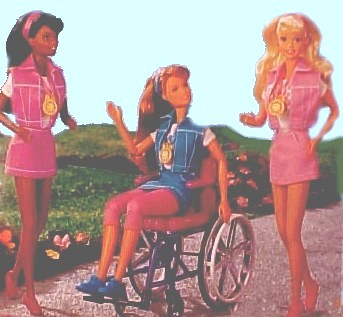
Barbie tries to become PC
Clueless Barbie
Some of the major stores are already advertising their holiday toy sales. This made me think of Barbie and her friends.
Some say the Barbie doll was the most influential icon of late 20th century American culture. In fact, she rated no. 43 on the 101 most influencial people who never lived (Click here).
Some say Barbie had it all: perfect body, perfect boyfriend and perfect everything.
Many little girls still think Barbie is the definition of beauty and a great role model, after all she has been a presidential candidate, an astronaut, in the arm services, in the business and entertainment worlds. Barbie didn’t even need a phone booth like Superman, all she had to do was change her shoes. In 2009, Barbie brought in $1.2 billion in annual revenue for Mattel.
But in my opinion, Mattel missed a powerful opportunity to be a leader for inclusion and community building–a real chance to make a difference in the world.
Mattel captured the feminist and toy market for “perfect” dolls, but it didn’t do as well with the non-white, “non-perfect” market. In the 1980s Barbie went multiracial and Mattel introduced Black Barbie, Hispanic Barbie and other dolls in their International Collection.
But these new “culturally diverse” dolls still had European features, and to me, seemed to be basically the original Barbie in costumes, with darker hair and skin.
Instead of becoming a leader, promoting sensitivity and understanding, Mattel reinforced the dominant cultural stereotype and dismissed the natural beauty of other races and cultures. A lost opportunity for all of us. Certainly a lost chance to teach tolerance and respect for people with disabilities.
In 1997, Mattel ignored even the basic “People First” language (click here) with Wheelchair Becky. When a little girl with cerebral palsy complained, they renamed the doll Share-a-Smile Becky. Most advocates would say, “Becky” would have been enough.
Good intentions aren’t enough.
Like many perfect people, Barbie and Mattel didn’t get past their good intentions. When everyone learned Becky’s long hair got caught in the rungs of her wheelchair, and Barbie’s Dreamhouse and expensive cars were not wheelchair accessible, Mattel folded.
Rather than make Barbie’s perfect world accessible and promote universal design and inclusion, Becky disappeared from Barbie’s neighborhood, er… store shelves.
Who wants to be perfect anyway?
But like many people with disabilities, Wheelchair Becky was resilient and found her own friends and adventures.
Last week someone sent me a web update on what Wheelchair Becky has been doing. Click here to join her for a beer and enjoy her wild ride– with Perfect Barbie nowhere in sight.
(Exaggeration is part of humor and comedy. If the pendulum moves a little too far for your taste, remember this is about making Becky more human. I liked that she is shown as an adult…for good or bad. Attitude and change are not child’s play.)
Seeing her here, there and everywhere, the Wheelchair Becky adventures reminded me of the building community activity I did with several classes around the book, Flat Stanley.

photo credit: davidwatterson
Flat Stanley doing it right
Like Wheelchair Barbie, Stanley had an accident that resulted in some physical challenges. But Flat Stanley was also resilient, clever and he uses his unique physical condition to his advantage. Because he can now fit into an envelope he doesn’t have to worry about crowded flights and paying extra for luggage.
If you go to the Hall of Fame (click here) you will see Stanley has been in space, to the Academy Awards, to the White House and many exciting places.
In the picture we see Flat Stanley with a new friend in Kenya. Wouldn’t it be neat to have a pen pal from the other side of the world? Many teachers and school children think this personal connection is the best way to teach about different life styles and cultures.
The Flat Stanley Project is an international literacy and community building activity for students of all ages, teachers and families.
Check out http://FlatStanley.com for student and teacher testimonials, a phone app, templates for Flat Stanley and other characters including Flat Pilgrim, Flat Santa and the newest Flat Mrs. Claus.
For a history of the Flat Stanley project, click here.
My class used Flat Stanley and other Flat characters like Flat Pilgrim, Flat Santa, and the new one, Flat Mrs. Claus to become pen pals to let the children share their cultures with different people as well as practice their literacy skills.
Literacy and Service Learning Project
One group of preservice teachers was tutoring primary students with learning problems. They made the Flat Stanley Project into a literacy experience and a service learning project. We all donated a couple dollars and sent copies of the Flat Stanley books as well as art materials, disposable cameras and mailing supplies so our pen pal classes could exchange letters and pictures. We even found colored markers and pencils which allowed more diversity in colors and shades of skin tones. We included scissors which could be used by students who were left or right handed.
We paired the students in the literacy practicum from our small college town, with a class in an inner city in Charleston, SC and on an Indian Reservation in Montana. The project was a great success.
Dolls, Books, and People teach about diversity.
Inclusion is a way of life. And it includes Wheelchair Becky, Flat Stanley and yes, even Perfect Barbie.
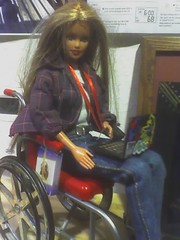
photo credit: Liz Henry
Comments: What are the lessons of Barbie and Friends vs. Flat Stanley? What could have been different? Can we use toys for social change?
Becky looks like she is going to do some social networking on her laptop. What do you think she would write? What about Flat Stanley and Flat Mr. and Mrs. Claus? And what recommendations do you have for Barbie and other toy manufacturers? Are there some lessons for the holidays? Tell us what you are thinking?
Keep Climbing: Onward and Upward
All my best,
~Mary