What message would you tell Jeremy if you had the chance?
Jeremy Sicile-Kira’s Graduation Speech
Jeremy graduated from Torrey Pines High School with a 3.70 GPA on June 18, 2010. Jeremy has the label of autism with little verbal speech and gave this commencement address using voice output technology. His father, Jim Sicile, shot and edited this short movie.
Comments: Any other graduation stories you want to share? Don’t you wonder what is happening now? Is he in school? on a job? Does he live with his family or in the community? Does he have friends? I hope Jeremy is having a wonderful life with all the support he needs. Is graduation really the beginning?
To the best of my recollection, this is how it worked:
The Landscaping Mobile Work Crew
Definition: Supported Employment Model: Mobile Work Crew
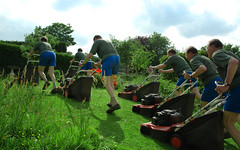
A small crew of persons with disabilities (up to 6) works as a distinct unit and operates as a self-contained business that generates employment for their crew members by selling a service. The crew works at several locations within the community, under the supervision of a job coach. The type of work usually includes janitorial or groundskeeping. People with disabilities work with people who do not have disabilities in a variety of settings, such as offices and apartment buildings. Supported Employment
Sometimes Cemeteries are for the living.
JOB ANOUNCEMENT: The cemetery board posts the lawn maintenance jobs for bids in the local paper.
JOB DEVELOPER:
The County Board of Developmental Disabilities (CBDD) job developer bid the job. Because of the size of the cemetery, the administration of the cemetery awarded several contracts. (For the five years I was involved, the CBDD got one of the contracts each year.)
Paid
The CBDD paid the workers minimum wage from this contract. Each member of the Mobile Work Crew was already on Medicaid/Medicare and the seasonal wages were within the limits of their SSI and SSDI requirements.
The job developer negotiated the details of the contract as well as was the contact person for any problems between the cemetery administration and the board as well as members of the mobile work crew.
Natural Supports
The cemetery provided the equipment. There was a garage-type lounge for all the crews and workers with a table and restrooms. They could mingle with the other workers from other lawn companies (non-handicapped) in the lounge. There was some natural support from the other workers who were doing the same jobs and the same sweating.
SUPERVISOR OF MOBILE WORK CREW
There were six people with disabilities and a supervisor on the crew. The supervisor was a year long salaried employee of the county board of developmental disabilities. She had experience working with people with disabilities and had been trained as a special education teacher. She had total responsibility for keeping the workers safe, happy AND getting the job done. If she needed extra help, she would go to the job developer or her other CBDD staff.
Aaron’s job coach was under her supervision (because she was in charge of the whole job) but worked independently with Aaron.
TRANSPORTATION
All the adults with disabilities would be transported from their homes to the sheltered workshop. The supervisor would drive a small van, similar to the vans the other lawn service companies used, from the sheltered workshop to the cemetery and then back to the sheltered workshop for the trip home.
Inclement Weather
On days when it rained, the crew could stay home if they wanted, or hang out at the sheltered workshop. If there was work at the sheltered workshop (usually not) they were able to jump in. If there was no work they could hang out with their friends and play cornhole, bingo or whatever the activity.
JOB DESCRIPTION
Ongoing Support
Before the crew began work, the supervisor and job developer made task analyses of each of the jobs. The individuals with disabilities applied and interviewed with the supervisor. If there was a good match, the training, modifications and accommodations were added to the individual’s Individual Service Plan (ISP).
OVERVIEW:
Who knew there were mowers about a foot wide which fit easily between the older tombstones? There were four mowers in this mobile crew.
There were two weed-wackers or whatever they are called. (The cords swing around and cut the weeds which the mowers miss.)
There was a “task analysis” of each job.
They were trained on the job. (They didn’t practice cutting the concrete in the parking lot to get ready*smile*)
Because the job was repetitive, it was a perfect fit for many of the workers. They knew exactly what they were supposed to do, and after a short time, were independent in many parts of the job.
If any of the workers needed adaptations (shorter hours, more breaks, special gloves or boots…) these were included in their ISPs (Individual Service Plans). Therapists (Occupational Therapist, Speech/Language and Physical Therapist) were available for the initial evaluations/training, if necessary.
Establishing Routines
The supervisor would start the day with some conversation, some joking around and individual attention to each of the crew members. They would get a short break mid-morning, they brought their own bag lunch, and a mid-afternoon break. But most of the day, it was sweaty and hot and lots of hard work—serious business.
The supervisor made sure the crew members had sun-screen, hats, appropriate clothing, solid shoes (no sandals), water….
She also worked side-by-side with the workers. She made decisions to go to another section if a funeral was in progress, if the area was underwater…; she pulled weeds… and did whatever it took to make sure everyone was successful, and the finished job met the requirements of the cemetery board.
Partial Participation
Aaron, my son with the label of autism, does not have the skills to run a lawnmower or weed-wacker. He would not be able to be part of the mobile work crew of 6 workers who are mostly independent on the job once they are trained. Because Aaron was in the official “transition” from school to work, he was eligible for a job coach from Rehabilitation Services.
So, because he had the physical support of a job coach, Aaron had the opportunity to join the workforce.
Is there some job he could do at the cemetery? Could he partially participate in this work?
After doing an ecological assessment of the job, Kim (Aaron’s job coach) decided Aaron could pick up the sticks before the lawn mowers came. So Aaron and she would drive a golf-cart to the area where the crew was mowing, and then they would collect sticks, dead flowers, and other stuff left on the graves, put them in a trash container tied to the back of the golf-cart and then take it to the dumpsters.
Aaron loved this job. First of all, he loved Kim, the job coach. She made him feel important, she helped him when he had trouble bending over, she helped him put the sticks in the trash container, she helped him wheel the container to the dumpster. Kim, looked at every piece of the job and asked herself, “How could Aaron at least partially participate in this job?”
Plus, Aaron loved riding in the golf-cart. When Aaron did particularly well, Kim would give him an extra long ride around the large monuments.
The side benefits were Aaron made a small amount of spending money, he paid into social security, he was out in the sunshine (with lots of sunscreen) and glowed with health, he was physically strong from all the exercise, plus the emotional benefits: he knew he was contributing, he was part of a group of people who valued his work, he could make all the noises he wanted (and wouldn’t wake up the dead), he enjoyed riding in the golf cart, instead of physical therapy practicing his balance climbing steps to nowhere—he had a functional way of practicing his balance in the real world. He had a great friend and mentor in Kim. It was a terrific experience.
And, for Memorial Day, 4th of July, Veterans Day… Who was the person who put the flags on the tombstones?
It was Aaron.
Trivia too good to pass up: One of the cemetery monuments is enclosed and heated. Yes, the person who died years ago was so afraid of being “cold”–they stipulated in their will that the space above the grave would be heated (including a back-up generator in case the electricity failed.) That is a powerful “fear.”
Keep Climbing: Onward and Upward
All my best,
Mary
Comments:
Have you ever seen a mobile work crew of workers and wondered how it worked? Is partial participation better than no participation? Should people with disabilities be allowed to work?
Proust says, “The real voyage of discovery is not in seeing new lands, but in seeing with new eyes.”
Can I love Aaron and hate autism?
If I say, “I love my child, but hate cancer or heart disease…” many people would say that is okay.
If I say, “I love my son, Aaron. I hate autism.” some people say that is NOT okay.
So, call me a villain, ignorant, hypocrite, politically incorrect, or whatever–but I refuse to celebrate autism–I refuse to give autism that power.
I gladly celebrate the diversity of individuals. This diversity makes our world stronger and a more interesting place to live.
I love individuals who have autism, just the way they are.
But–I will not celebrate autism like it is a good thing.
World Autism Awareness Day April 2
The United Nations designated April 2 as World Autism Awareness Day. April 2nd next year is already designated too.
Are you going to wear blue? Will blue lights in the Empire State Building, or on the Jesus statue in Rio, or the top of a pyramid in Egypt really mean anything?
Is this like a birthday party? Something we celebrate every year? Send up the blue balloons? Paint your face blue?
I think wearing black would send a better message. Autism Awareness should send a plea for action NOW. We need help and resources NOW.
So, the United Nations has established April 2 as World Autism Awareness Day. Great! Let’s talk about autism.
What causes Autism?
Well, no one knows for sure. The “experts” have narrowed the cause down to environmental, biological, sensory, abuse and neglect, genetic, chemical, neurological, food…and the ever popular–it’s the parent’s fault.
So the short answer is, who knows?
Yesterday someone told me our children have autism because they don’t get enough eggs. Just add that to the list. They might be right.
I recently read a study (2013) that blames the grandparents. They conceived the parents late in life.
Don’t you love scientists–probably funded with the autism awareness fundraising, eh?
Dr. Anne Donnellan spent her career working with families and people with autism. She often says, “The more theories, the more proof that we don’t know.” She also gives her version of circular logic in Disability World.
Circular Logic
Parent: My child keeps flapping their hands.
Doctor: Ah, that is because your child has autism.
Parent: How do you know?
Doctor: Because your child flaps their hands.
Is Autism the Greatest Gift?
Some advocates want you to think autism is the greatest thing ever. They talk about the special abilities of people on the autism spectrum and say it is only because of autism they have these talents.
Hummmm. Is that so?
Sure Temple Grandin, with a glance, can tell how many nails are needed to build a livestock yard–but is that only possible because of her autism?
Rainman could count the number of toothpicks on the floor. Is it possible there is someone else in the history of the world that could also do that?
Are we again caught in circular logic?
Parent: My child can count the number of nails or toothpicks.
Doctor: Ah, that is because your child has autism.
Parent: How do you know?
Doctor: Because your child can count the number of nails or toothpicks.
There are some people with the label of autism who can tell you the day of the week for every calendar year in recorded time.
I can’t. Probably you can’t. But, is it possible there is at least one other human being without the label of autism who can?
The Guinness Record books are full of typical folks who can do all sorts of incredible tasks.
Hurry, quick. Do we now need to give those persons the label of autism?
There are some who are going back to past genius’ and claiming they must have been autistic…Mozart must have had autism. Disney perserverated on those mouse pictures–he must have had autism…
Couldn’t Temple Grandin and Donna Williams just be talented people? Isn’t it demeaning to say, “No, the individual Temple Grandin has nothing to do with it, it is only because she has autism?”
Is it possible the statistical increase in the number of people with autism is partly due to our current scientific paradigm of labeling and sorting people? And some people promoting “autistic envy”? The new figures are 1-50. One child in every fifty–and all we are doing is having Autism Awareness Day at the Philadelphia Zoo?
What is normal?
Well, turns out we don’t really know that either. Plus, we could say “normal” changes every year in every culture.
Sure we have tests, but anyone who studies IQ or other quantitative or quantitative measures will point out the flaws.
Multiple Intelligences| Howard Gardner
Howard Gardner studied people with autism who were labeled as autistic savants (actually “idiot savants” was the term used at the time). He was able to identify at least eight different kinds of “gifts or intelligence.” Now, in every school in the world (that uses best practice) his theory of multiple intelligences helps all children learn. Gardner says each of us has all these eight intelligences, some are just more developed than others.
This is one of the side benefits of autism. Without the diagnosis of autism, the scientific community might have had a harder time making this discovery. Science needs large groups.
Could it be we all have gifts and traits of genius, gifts, and traits that could be labeled as autistic? Are we all a little autistic? Are none of us “autistic” in the pure definition of wanting to be apart?
Stinkin’ Thinkin’
So, what’s the deal with autism? Can’t we just celebrate individual diversity?
If we really believe autism is a tremendous gift, then it would be logical for each parent to wish their child would have autism. Right?
I once went to a conference for people with Down syndrome. Everyone kept talking about how people with Down syndrome were the happiest people in the world–how glad they were to have their child in their family. They used examples like, “They will always believe in Santa.” “They are pleased when I fix them chocolate milk.”…
Using circular logic:
Parent: I want my child to be happy.
Doctor: Children with Down syndrome are happy.
Parent: Then I want my child to have Down syndrome.
So, if we want our children to be happy maybe we should try to figure out how to add an extra chromosome to every baby’s DNA.
If autism makes us gifted, maybe we should be researching how to make 100% of the population have autism–add autism magic to our babies’ lives.
This kind of thinking is just nuts, yet it is common in each area of disability. Stick around Disability World and you will hear people yearn to have the courage of people with cystic fibrosis and muscular dystrophy, and be sexy like people with cerebral palsy…
Okay, I understand some advocates are probably hyperventilating at this point. How dare I talk this way about people with autism and Down syndrome?
The person who gets joy in Santa, or in having chocolate milk is an individual. Each individual person–even if they have a label– is different.
We can love the individual–not the disability.
As family members, friends, and as self-advocates, we can value the individual person’s talents, gifts, joys, and sorrows. We can see them in the context of their environments–but, we don’t have to give all the power and credit to the label of disability. The individual should get the power and credit. They are the ones who are who they are.
I can love my Aaron–I don’t have to love autism.
I can see Aaron’s gifts and talents–I don’t have to think they are only because he has the label of autism.
Aaron is a loving person who makes kissing noises as I turn out the light. He smiles when I pull on the toes of his socks. He gives me hugs when I walk past him. He is patient as I try to figure out what he wants. He concentrates on his books and loves pictures. He gets excited when I come in a room. I love when he relaxes in his bath. I love when he initiates a song or goes to the bathroom. I love when he figures out how to eat the cheese off my sandwich…
Aaron is unique. He adds his own version of diversity to the human family. He is a great son, brother, uncle, and friend… just the way he is.
Autism sucks. Aaron doesn’t.
Autism affects each person differently.
In Aaron’s case, Autism means he can’t talk with words. It means he is 38 years old and can’t always tell when he needs to go to the bathroom. It means he has trouble making friends. It means he yells in public restaurants. It means he chews on his clothes and books and the car seats. It means he has motor difficulties and trouble walking–crossing from the rug to a tile floor. It means he is always afraid of falling and losing his balance. It means he bites his hand to calm himself. It means it takes him a long time to learn things. It means he will forget them if he doesn’t practice them every day. It means he likes music, but not loud noises. It means he likes to be moving (in cars, buses, boats, and planes…) It means he likes to swim, but not bend over. It means he can’t tie his shoes or dress independently…it means he cannot be left unsupervised even for a minute.
That all sucks.
I wish it was easier for him. I wish it were easier for me to help him.
But all those difficulties don’t mean I don’t love Aaron with every fiber of my being.
Each day for the last 38 years, I work to get Aaron the support he needs to live, work and recreate in his community. To allow him to be the best person he can be–For him to be able to make choices and have the opportunities he wants.
There is a difference.
Dream Plans for Aaron Ulrich
I am adding our dream plan for Aaron. You can click on each of them and see I am NOT trying to cure Aaron. I am NOT trying to make him a different person. I love and respect him as the person he is.
I am NOT trying to make him the person I want him to be.
Every day Aaron teaches me about courage, love, and tolerance. But he knows he can count on me, my husband, and his brother. He knows Annie, his caregiver will do her best to look out for him. He wants a new housemate, like his former housemate Jack who will be there for him. He knows his grandma and extended family including Ana and his niece love him just the way he is.
And until our dying breaths, we will do our best to make his life happy.
No, I’m not going to inject Aaron with an extra chromosome to make sure he is happy. No, I’m not going to give this thing we call “autism” supernatural powers to dominate his life.
But I will give him opportunities to make choices about his life as best he can–in spite of “autism.”
Yes, I can Love Aaron and Hate Autism.
Autism Awareness Day Marching On
Celebrate each wonderful individual person you meet in this video.
Keep Climbing: Onward and Upward.
All my best,
Mary
Comments:
Are you sitting there thinking, “how can this mother be an advocate for people with autism?” Do these words make you upset? Do you agree? Do you think “Disability World,” thinks differently than “The World”? Can we separate the individual from the label?
Related Article:
Here is another article about Autism Awareness Day asking people to do more than just wear blue.
They ask the tough questions.
They demand answers.
They show up at budget meetings and want copies of the agenda and handouts.
They show up at board meetings and introduce their child.
They study the friggin’ law and quote it at you.
They call the State Department when they can’t get what they want at the local level.
They are politically savy–not politically correct.
No matter how many times we tell them, “You are not credible because you are too emotionally invested,” They won’t give up.
They don’t care the budget has been cut.
They don’t care we are sharing offices and there is no toner for the copy machine.
They aren’t reasonable about “waiting”… or accepting excuses for shoddy performance…or people who don’t call them back.
They embarrass us by going to meetings where they are the only unpaid person in the room, and they are more prepared then we are. And they go to more meetings… and more meetings.
They just won’t give up.
If we try to slip one by, it’s like they have built-in radar. They just seem to know when we filled a staffing gap with an inexperienced person, or if the caregiver had a beer.
If we tell them the “research says”–they want to see the research.
They give us copies of new research.
They call the researchers–collect.
They even have the nerve to point out flaws in the research studies and want their child in the next study.
If we tell them they can’t possibly understand the research, they read books, network, take courses until they become the experts. Some even get their Doctorate degrees.
They insist we don’t give up.
When we do something right, they tell us we are wonderful and they are thankful, BUT….
Damn, there is always a BUT.
When we tell them to “Trust Us,” they smile and tell us that is like asking GreenPeace to “trust” the oil companies.
They just won’t give up.
Damn, they drive us nuts….
But we know that after we retire and get our pensions, they will still have to be harrassing our replacement because their child will always need someone to advocate for them.
We respect them because we know they force us to do a better job.
We know that when they are helping their child, they are also helping all children.
We love them because their motives are pure and they make the world a better place.
And most of all, we admire them because they don’t give up.
This is dedicated to:
Mary and Oliver Triplett
They were the parents who ignored advice from the professionals and kept their son Donald home from the institution. Their son became the famous Donald T. in Leo Kanner’s research article identifying the phenomenon he named autism. This article in The Atlantic shows how Donald is living today. Though the story is about Donald–I think it is his parents’ love and advocacy that is the REAL STORY (click here).
Anne McDonald and Rosemary Crossley
Anne McDonald and Rosemary Crossley kept teaching us all about the right to communicate, and they didn’t give up.(click here).
Jon Morrow
Jon Morrow is an associate editor on CopyBlogger whose blog article: On Dying, Mothers, and Fighting for Your Ideas went viral. He is a success story and has done amazing things, but when you are reading this, think of his mom. (click here).
Nina and Joseph Marcellinos
Nina and Joseph Marcellinos knew the word “retarded” hurt their daughter’s future–and they didn’t give up until they changed the Federal Law. (click here).
Tell us about your experiences:
Do you know any remarkable parents and/or advocates? Do you love, hate, respect, admire, or despise them?
When you are reading about great advances for people with disabilities, the elderly, and children… do you look underneath the headlines and see the parents and advocates? Have you done something where, against the odds, you didn’t give up?