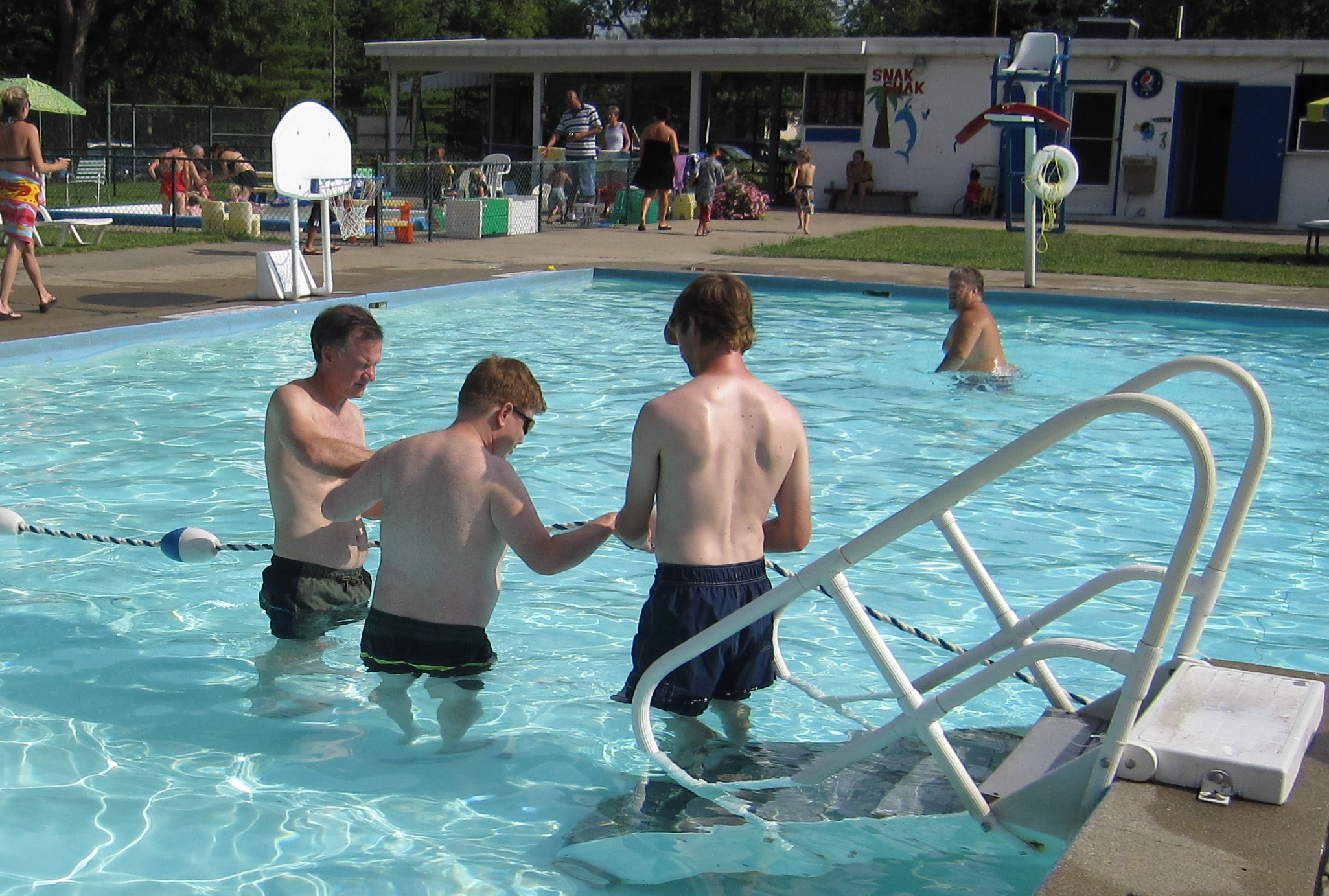
by Mary E. Ulrich | Apr 29, 2024
I’m Memory of Bob Perske, a real hero to families and people with disabilities.
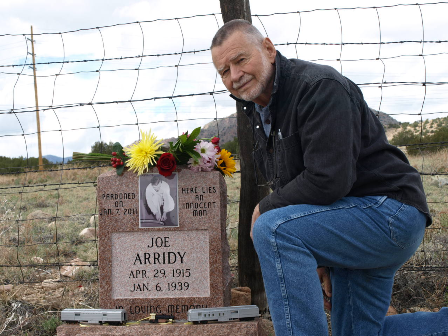
Bob Perske is a pioneer, a storyteller and a “Group Man.”
In his book, Circle of Friends, he tells the story of vulnerable people building circles of support.
Bob wrote the following speech to bring together Joe’s Circle of Friends who, even though they couldn’t stop his execution, used citizen advocacy like a jazz band, and blended their talents to prove Joe’s innocence 19 years later.
Bob ends with lessons learned and suggests action steps so Joe Arridy’s life and death will not be forgotten. Perhaps he couldn’t stop the injustice of his execution, but now there is a legacy which can help others.
It is my honor to share Bob’s words:
REFLECTIONS ON THE GROUP THAT FOUGHT FOR JOE ARRIDY
Written by Robert Perske but Voiced by Attorney Anne Treimanis
Pioneer Museum, Colorado Springs, Colorado, May 18, 2011
The Circle of Life:
Fifty-three years ago, I befriended a teenager who worked in a mission hospital in Espanola, New Mexico. His name was Richard Voorhees. He worked a morning shift in the hospital’s kitchen, went to high school and returned for an evening shift.
We got together a lot. He saw me as a mentor. Later, the mentorship was reversed when Richard Voorhees went on to become a skilled professor of sociology and anthropology.
That’s why, in 1992, while doing research in Greenwich Village, New York, Voorhees discovered a poem in an out-of-print book. He sent it to me and said, “I’ll bet this grabs you.” The poem described a warden “who wept” as he watched a death row inmate playing with a toy train on the floor of his cell.
For more information on Joe Arridy
On another occasion, Voorhees taught me how to feel a deep respect for trumpet player, Miles Davis. Davis was uncanny when he played in combos with other great musicians. Davis never played solos. He said, “I play what WE can play; NOT ME. I never play what I can play. I am a “group man.”
I THINK MILES DAVIS WOULD HAVE BEEN MOVED BY THE WAY OUR GROUP HANDED OFF TO EACH OTHER THE SAD MELODY OF JOE’S LIFE.
The Sad Melody of Joe’s Life:
• The poem about the warden who wept was sent to Watt Espy, the archivist at the Capital Punishment Project, in Headland, Alabama.
• Espy researched and connected the poem to the execution of Joe Arridy. He sent a packet of news clippings and detective magazines on the case.
• News reporters and history archivists up and down the slopes of the Rocky Mountains helped with the search.
• A book about Joe Arridy’s life and death was published.
• Pete Strescino, a reporter for The Pueblo Chieftain wrote a review of the book.
• Screen writer Dan Leonetti read the review and the book — and then wrote a screen play called “The Woodpecker Waltz.”
• A California film producer named Micheline Keller read the screen play and shed tears like the warden did.
• Teddi Roberts, the executive director of The Arc of the Pikes Peak Region and the members of her group offered a home base for many who worked on Joe’s case.
• Arc Street Worker, Craig Severa, became Joe’s “foot man,” “bag man” and “on-the-street cheerleader.”
• Attorney Anne Treimanis created a website www.friendsofJoeArridy.com. She did it at her own expense and filled it with every pertinent fact she could find on the case.
• The Arc organized a fund raiser to pay for a dignified tombstone that replaced that awful rusty motorcycle license plate marker on Joe’s grave.
• The Arc gathered 50 of The Friends together for a tombstone dedication ceremony at Joe’s grave.
• Mike Radelet, one of the nation’s leading spokesmen for stopping death penalties came to the ceremony.
• Photographer Antonio Sanchez created a montage of photographs of the group in action.
• Antonio Sanchez and Dan Leonetti talked Denver Attorney Dave Martinez into attending the tombstone ceremony with them.
• Attorney Martinez became interested in the case.
• Then all of the Arridy files were transported to his office in Denver.
• Attorney Martinez worked off and on with all of us for the next three years before writing a petition to Governor Bill Ritter, Jr.
• Terri Bradt, the granddaughter of Attorney Gail Ireland, heard about The Friends and she joined them. Then she wrote a book about how her grandpa rose up and fought like a tiger to save Joe’s life. She described how Ireland managed to get at least six stays before Governor Teller Ammons called the prison warden and ordered Joe to be killed within the next few minutes.
• Lisa Cisneros, Director of the Colorado Alternatives to the Death Penalty (CADP) offered her organization’s support.
• A heart touching song entitled “The Woodpecker Waltz” was written by “Identity Traveler Tom Garcia.
• A lovely, tender-voiced singer named “Molly” keeps the tears flowing when she sings Garcia’s song.
• Attorney Annie Treimanis recorded the song for all to hear by placing it in Joe’s website.
THEN CAME A SCARY DAY
• On October 27, 2010, Attorney Martinez delivered a 523-page “Pardon Application for Joe Arridy to the Governor of Colorado.”
• It contained:
— The Petition and Footnotes (41 pages)
— The Legal Memo (11 pages)
— Exhibits (173 pages).
— Affidavits in Support of the Petition (88 pages)
— Letters of Reference in Support of the Petition (210 pages)
THEN CAME THE GOVERNOR BILL RITTER’S ANSWER
• On January 7, 2011 — exactly 72 years to the day when newspapers announced Joe Arridy’s death — Governor Bill Ritter, Jr. issued a posthumous pardon.
THE GOVERNOR DID NOT STOP THERE
• He went beyond the expected by writing an in-depth three-page press release that went to newspapers and electronic media up and down the state. In it he explained in rich detail why he issued the pardon.
AFTER THE PARDON WAS ISSUED, OUR GROUP EXPANDED
• We were pleasantly surprised when relatives of Joe suddenly came out of the darkness and celebrated in public with us.
THEN CAME ANOTHER SURPRISE!
• We learned that Maria Tucker, a member of the Arridy family was employed as The Special Collections Manager for the Pueblo Public Library.
• Immediately, Dave and the group arranged for the transfer of the Arridy files to Maria who is now archiving them in the Western History Division of the Pueblo Public Library.
I AM AMAZED BY ALL THE SOLID PRODUCTS THAT HAVE BEEN PRODUCED THAT WILL NOT GO AWAY.
• There is a book about Joe Arridy’s life and fate.
• There is a book about Gail Ireland’s legal fight to save Joe’s life.
• There is “The Woodpecker Waltz,” Dan Leonetti’s heart touching filmscript.
• There is the website.
• There are hundreds of facts about Joe Arridy now being sent into cyberspace for the whole world to read and ponder forever.
• There is Dave Martinez’s petition for Joe Arridy’s pardon and the Governor’s response now filed in the vaults of the Colorado State Archives.
• All files on the case have been archived in the Western History Department of the Pueblo Library.
NOW COMES ONE MORE ROCK-SOLID PRODUCT!
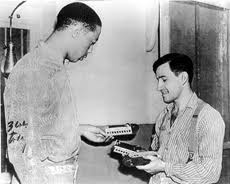
• Five new words have been chiseled deeply into the face of Joe’s new tombstone. (See picture above.) They say:
“HERE LIES AN INNOCENT MAN”
• (Craig Severa will probably go to jail for adding them without asking permission from government officials who rule on such things.)
• Tomorrow all of us will go in a caravan to Woodpecker Hill to dedicate it.
IT TOOK 19 YEARS OF STRUGGLE
BEFORE WE COULD PUT THOSE WORDS ON JOE’S TOMBSTONE!
NOW, I SAY LET’S GO FOR ANOTHER 19 YEARS!
• Let’s apply what we learned on other heartbreaking miscarriages of justice.
• By the end of this next segment, I will be 103.
• So let’s get going!
• Here are five issues I would like to see us tackle.
1. WE NEED TO GAIN A CLEARER UNDERSTANDING OF THE HUMAN “WILL TO BELIEVE.”
As a young dad, I lectured my five kids about putting my woodworking tools back on their assigned hooks in the garage after they used them. Once, when one of my tools was missing, I yelled at the son who failed to put it back. I nailed the little guy. I harangued and harangued and I didn’t let up . . . until my wife softly took my hand and led me to the place where I had left the tool!
After sitting in many courtrooms, I have sensed how that wily little rascal, “the will to believe,” can corrupt the true facts of a case.
2. WE NEED TO STOP THE DEATH PENALTY
I shudder when I try to figure out how one mortal man can legally execute another mortal man. The Supreme Court’s ruling, in Atkins versus Virginia in 2002, did ban the execution of persons with intellectual disabilities, but I can’t let myself off the hook until the rest of humankind has this legal protection as well.
3. WE NEED TO DO EVERYTHING POSSIBLE TO SUPPORT AN ORGANIZATION CALLED THE “MURDER VICTIMS’ FAMILIES FOR RECONCILIATION.”
I am deeply touched by a certain fast-growing movement of families whose loved ones were murdered. Members of this group meet together and help one another to stop the agony that comes from screaming for “paybacks” for the killers of their loved ones. Now hundreds of murder victim’s families are helping one another to find a reconciliation. For them:
“Reconciliation means accepting that you cannot undo the murder but you can decide how you want to live afterwards.”
4. WE NEED TO FIGHT FOR THE VIDEOTAPING OF CRIMINAL INTERROGATIONS.
Due to our faulty “will-to-believe” attitudes, we will never “get the truth and the whole truth even with God’s help” when officers and suspects merely swear on the witness stand about what happened in the interrogation room. I believe that:
Judges and juries must be helped to see and hear for themselves everything that went on in the interrogation room. In this digital age it can be done by videotaping.
5. WE NEED TO RESPECT THE GOODNESS IN POLICE OFFICERS
I cannot name a school teacher who became a positive force in my life. But I can name a cop who did. His name was Bob Swanlund. He crossed my path on the inner streets of Denver when I was a teenager. He took to me and I sure took to him. On days off, we pitched a tent on Squaw Peak, the 11,540 foot mountain, 29 miles west of Denver and just in front of Mount Evans. We camped up there at least 40 times in three years. He became a father figure to me. During that time, I even tried to walk like him and talk like him. We stayed close until I went into the service in World War II and he became a department head in the Colorado State Patrol. During that period, he gently drummed into me the basic mission of every good police officer:
“The mission of every good police officer is to insure the safety and security of the neighborhood in which he serves.”
There is no job that is more noble than that.
SO NOW YOU AND I WILL BE MOVING ON.
I plan to go as a true believer:
I believe in God.
I believe in Evolution
I believe that all of us are brothers and sisters who were tied together by a single DNA match millions of years ago.
I believe that our earth revolves around the sun.
I believe there are thousands of solar systems like ours.
I believe that Martin Luther King was right when he said that “the arc of the moral universe is long but it bends toward justice.”
I believe that someday I may meet with Joe Arridy . . . I want so very much to do that.
In my career I came to care about many people like Joe:
So vulnerable
So concrete in their thinking
So unable to figure out all of the complexities going on around them
So trusting of those who understand more than they could
So quick to respond to kindness from others.
So I believe that someday I will be able to get down on the floor together with Joe and his train. . . and both of us will be laughing and shouting:
“Train wreck! Train wreck!
Comments:
Each of us “wills to believe” our government and justice system will find and punish the guilty, and free and protect the innocent. It is unsettling when the system doesn’t work. What are your thoughts?
Should people who have the label of intellectual disabilities have additional protections in the criminal justice system? Are the above action steps Bob suggests, so drastic and costly they cannot be implemented?
Bob’s song reminds me of Jazz, where each musician plays their own instrument and contributes their soul to the song. The members of Joe’s song were attorneys, friends, organizations… each adding their voice to the music. Is there a way to use each of our talents to work for social justice and change? Are you a “Group Man” or “Group Woman”? Is the song of Joe Arridy really a sad song?
Related Posts:
Hope for the Families
Richard Lapointe and more
Unequal Justice
Bob Perske’s website
Keep Climbing: Onward and Upward
All my best,
Mary
Bob we love you.
by Mary E. Ulrich | Apr 19, 2024
A Good Day!
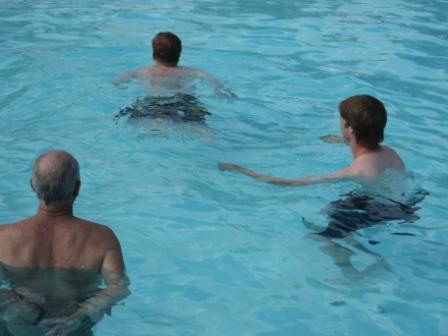
Aaron swimming
As the number of adults with autism and developmental disabilities rise, many professionals and parents ask me what I am looking for? Will I ever be satisfied? Is it just a pipedream or can we really build an inclusive community around a person with severe disabilities? Can there be a combination of natural supports and paid supports? Does the family have to do it all? Can an adult with autism have a decent quality of life and be happy?
They tell me it doesn’t really make any difference to Aaron, my son with severe disabilities and autism. Their logic says that since Aaron can’t talk, and therefore can’t complain, it is only the mother (me) who has these high standards and expectations and Aaron is just fine and the mother is well, you know, ….
Many times, they tell me how lucky we are… Aaron has a Medicaid Home and Community Based (HCBS) Waiver when there are thousands of people on the waiting lists; Aaron lives in a nice house close to his parents–not in an institution in another city….
The media is full of stories about desperate families of adults with autism and intellectual disabilities: abandon your child to get services — To the parents and professionals who want to give up or “re-institutionalize,” Can we prove inclusion in the community can work?
Many nights these tapes play in my head over-and-over keeping me awake. I ask myself what else I can do to make Aaron’s life more inclusive. I count my blessings.
We are lucky. We’ve worked hard to be where we are, but there is still much to do.
But last Sunday, I went to bed and smiled: “Today Aaron had a good day!”
We usually bring Aaron home with us on Sundays. Here is what this inclusive day looked like:
Aaron’s dad picked him up at 9:30 AM from his house. He talked with Kevin, Aaron’s long-time caregiver. Kevin knew when Aaron had had his last BM. Kevin had given Aaron his breakfast and he was dressed in his Sunday clothes—hair combed, shaved and teeth brushed. He looked like a typical 38 year old.
Aaron came to our house and immediately got his favorite books from the closet. His dad and I sat on couches near him in the living room. Aaron put his books on the coffee table where he turned the pages in two books at one time. When he wanted more books, he went to the closet, chose his books, and carried them to the table. (I know this doesn’t sound like a big deal but because of Aaron’s severe motor and balance issues, this is something we have worked on for years and years.) He also went to the fridge and when I ask if he wanted the pitcher of ice tea or the juice, he pointed to the ice tea.
When he got tired of the books, he went into the kitchen, sat at the kitchen table and we ate our spaghetti lunch together. Aaron put his dishes in the sink.
At approximately noon, Tommy and Isabella (Aaron’s brother and niece) came over. We all changed to our swimsuits, lathered up with sunscreen and walked to the pool at our condo.
Dad started with Aaron in the deep end and Tommy stayed close to Isabella with her floaties. Sometimes we were apart, sometimes we all played ball together and Isabella would swim between Uncle Aaron and Grandpa.
The other families each did their own thing, but we all crossed paths in a friendly community sort of way. There were about 8 other neighborhood kids and their parents in and out of the pool. They all said hello and though we didn’t really know any of these neighbors (it’s a big complex) they were friendly to Aaron and interacted as anyone would. I introduced myself, Tom, Aaron, Tommy and Isabella and hope we will see them again next week.
After about an hour or so, we headed back home, changed clothes and everyone had a drink and ate cheese and crackers.
Isabella wanted to play Hide and Seek in the house (her favorite place is under my desk) and Aaron and I would count to ten and then go and find her. Isabella loves to hide, but then she giggles so much it is easy to find her. Aaron enjoyed the game the first couple times, but then Isabella wanted more and more and so he just sat back on the couch with his books and watched.
About 4 o’clock, Tommy and Isabella left to meet Ana, her mom, who was getting off work; Tom, Aaron and I took a ride to the post office and grocery.
At 5:30 we took Aaron back to his house and Kevin and his wife were waiting for Aaron to take him to King’s Island, an amusement park. We took him to the bathroom, washed his face and hands, checked his shirt and hair and again exchanged some details about how Aaron likes the Octopus and train ride and …
Aaron got in their car and they were off for the evening. Tom and I went back home.
Too much to ask?
Now, I ask you… is this really so difficult to visualize?
If it was only paid staff, Aaron’s parents are dead or out-of-town, could the staff figure out how to fill up a weekend afternoon with some friendly faces and meaningful activities in the community?
Would Aaron be groomed and the staff person double-check his toileting schedule so he is comfortable? Would Aaron be in status-enhancing clothes that were clean and age-appropriate so he could blend into the community?
I know Kevin can do it, because he and his family have known Aaron for years. But I can’t understand why other staff don’t get it.
Aaron is currently between roommates, so right this minute, he has 1-1 staff. This is the best opportunity of his life for getting out into the community, when he gets a roommate it will be 1-2 people and much harder to take them out.
Focus on the positive
Today I have a reason to feel good about Aaron’s life. We all shared a pleasant summer day. Aaron and our family did what many other families were doing all over the city. Aaron was surrounded by people who love him and care about him. We celebrated his self-determination to make choices and do the activities he likes. Aaron used the skills he learned in his 22 years in school and therapy. Aaron had staff who were willing to try and give him a good time. Aaron was healthy and happy. I only saw him bite his hand one time all day. The activities were in his home community. There are future opportunities for building a network of long term support and acceptance.
And this is inclusion. This is our vision for Aaron. This is the future we hope for our son. This is all we are asking for. Carpe Diem!
COMMENTS
Come on, share what you are thinking. Am I being unreasonable to expect these kinds of days? Should I just accept “reality”? Do I just count my blessings? Do you have similar experiences? Should we go back- and re-institutionalize?
Keep Climbing: Onward and Upward
All my best,
Mary
Related Posts:
Aaron needs a roommate
Aaron’s Dream Plan #4
Going to the Family Reunion
by Mary E. Ulrich | Apr 19, 2024
Going to the family reunion, or not?
part 3.
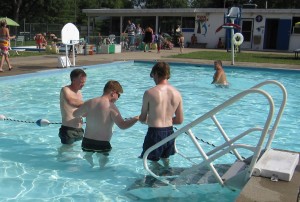
access ramps shout \”Welcome\”
Absolutely gorgeous day for a family reunion at the swim club, the mid-80s, no clouds, not even any bugs to speak of. This is my third post about Going to the family reunion, or not? In post one (click here) I talked about planning and doing an evaluation of what my son Aaron, who has the label of autism, would need in terms of modifications and accommodations to feel welcome and included. In part two, (click here) I wrote about the layers of social systems that are part of each family. Today in part 3, I’m going to talk about the actual activities and events that happened.
Informal Support Systems
Tommy (Aaron’s brother), Ana, Baby Isabella and Ana’s parents from Brazil arrived about the same time we were unloading the coolers, so they helped me carry the stuff and guide Aaron through the parking lot. My husband, Tom had to work so he had to miss this year. If Tommy’s family wasn’t here to help, Aaron and I wouldn’t have gone. I figure there were about 60 relatives ranging from my mom age 88 to Baby Isabella, one year.
Aaron started repeating his, “You Okay?” routine and everyone came over and gave him a high 5, patted him on the back, or laughed and said, “Yes, Aaron we’re okay.” They were welcoming Aaron on his own terms. Sometimes Aaron looked at them; sometimes he didn’t. He said, “You okay?” about one time every other second. So that’s a lot of “You okays.” Everyone just took it in stride and went back to what they were doing.
Setting up the routine
In past family reunions, everyone swam and then ate about 6 pm. So we arrived at about 4 PM to find everyone eating. Oops.
Even though we split an Arby’s sandwich on the way to the swim club, if everyone else is eating, you can bet Aaron is going to want to get a plate ASAP. I introduced Ana’s family the best I could, but getting Aaron settled and fitting in the social setting was priority one.
Almost immediately, Aunt Ann started putting melon balls on Aaron’s plate. Some male relative who I didn’t even know had the brats and metts ready to go, so with a little help, Aaron was happy as an ant at a picnic—aarhh. How Aaron melded into the group in the first ten minutes makes all the difference.
While Aaron was busy eating, the rest of the family settled in, made introductions and even though Ana’s parents’ first language is Portuguese, everyone was excited that they were here for a visit. Various Aunts, Uncles, Cousins, second cousins and relatives I swear I’ve never seen before, were all very gracious. Ana’s parents are just naturally friendly and their English is incredible. (They learned it by watching American movies and taking English classes in high school.)
As soon as Aaron finished eating, Aunt Ann cleaned up Aaron’s spot. Uncle Steve and Tommy offered to take Aaron swimming. I didn’t even have to ask. They helped him put on sunscreen, take a quick trip to the bathroom and then just whisked him off (of course Aaron doesn’t really whisk anywhere).
Terri, my cousin who organized the whole event, told us that the neighborhood swim club was just given a ramp by the Jewish Community Center when they built a new facility. (Note to self: next year do not take off Aaron’s shoes until he gets to the ramp—the sidewalk was too hot and he had trouble walking to the ramp.)
Aaron, Tommy, and Uncle Steve went in the big pool. Ana, her parents, and the baby went to the baby pool. I took pictures and held my breath. Aaron had a couple of tough moments, but he calmed himself by biting his hand and then was fine.
I got to talk with a couple of people, and watched everyone playing in the water. Aaron can swim pretty well. He does this sort of dolphin movement and though he doesn’t close his mouth he can swim from one side of the pool to the other. The lifeguard watched Aaron and his team the first couple minutes and then when everything looked in control, he relaxed and just concentrated on the entire pool as usual. After about half an hour, other relatives and Ana’s parents joined everyone in the big pool. Baby Isabella had a great time meeting new cousins and playmates. The toys went in and out of the pool, the kids stood up, fell down—all was well with the world, just a sunny day in paradise.
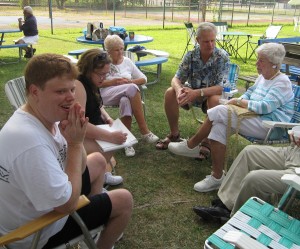
The Circles of Life
Everyone caught up on the recent engagements, school arrangements, camping trip, new babies… all the gossip and family changes. Ana made a Flan dessert which was a big hit. Someone brought about five of those blue ice containers and put them together like a cold plate—instead of a hot plate—and I thought that was very clever. Everyone ate, traded stories, pictures, and just had a great time.
Uncle Ed
Uncle Ed’s memorial dinner was the next day, but my cousin Dan, who is a Bishop, came and ask about how Aaron was doing. How was Tom doing? (When someone in the family isn’t there, they are missed.) We got to tell the story of how Tommy surprised us by moving back to Cincinnati last year… it was just normal, everyday family talk.
Because of people helping out with Aaron, it was an enjoyable day. We left after 4 hours, just long enough.
Worth the price of admission:
My favorite moment: One of the dads was holding his two-year-old baby in his lap. The baby had an angelic face and a devilish grin. They were relaxing after a swim when the baby suddenly reached up and grabbed the hair under his dad’s arm. OUCH! His dad—I mean you could hear him gasp and see his eyes tear up-couldn’t reach his son’s hands. Every time he tried to lower his arm, the hair was pulled tighter. We were all laughing so hard everyone’s body was shaking up and down in their seats. Grandma looked like she would need oxygen. The more dad tried to pull the baby’s fist away, the tighter he squeezed.
I thought the lifeguard was going to blow the whistle from all the hoots and hollers. It was a memorable moment that will become an urban legend in our family as the repetitions help the story grow. (Remember, Mark Twain, said to never let the truth get in the way of a great story.)
Summary:
All our planning worked. Aaron and all of us had a great time. He belonged. We all had a chance to reconnect to all these people who are connected by blood but now are also connected by new memories.
Moral of the story: shave your armpits before going to family reunions:)
Did you ever think of all the modifications and accommodations we just naturally make for babies, seniors, people with disabilities? Baby bottles need to be kept cold and then heated, Grandma likes soft foods, Uncle Charlie always likes a ball game on a radio or TV– we make these kinds of modifications all the time just because we want to make the people we love happy and comfortable.
And what about us regular folk, we also use modifications and adapt environments and “things” all the time. We bring our lawn chairs, sunscreen, ball gloves to protect our hands… we like our hotdogs with… spicy mustard, or ketchup, or sauerkraut or well done or on buns, or not …?
We don’t think of these small ordinary “things” as adapting a hot dog? Because we are all normal, yet it is what we are doing.
But putting in a ramp or curb cuts–well, even if we normal folks use it, it is er, handicapped or special or an ADA adaptation.
When builders use the principles of “universal design” and blend the adaptations into the everyday way we access buildings or swim pools… then parents won’t have to think of ecological assessments before they go to a family reunion, everything will already be in place.
ADA is good for all of us. i.e. Now most grocery stores have accessible entrances. Grocery carts and children’s strollers and people in wheelchairs can just go through the front door. And, since it is now so common, no one even notices that the entrances have changed. They meet “universal design” for EVERYONE.
The world is becoming more accessible and just in time. Because me and all my relatives are getting older and like it or not, we will soon join the ranks of the “disabled” and our life activities will depend on all those loving people around us, and those universal designed environments.
Tell us in the Comments
What are some of the things you do to make your family reunions more inclusive? What do you think of Universal Design? Is ADA just another government example of “Big Brother” and forced rules and regulations?
Keep Climbing: ONward and Upward
All my best,
Mary
by Mary E. Ulrich | Apr 19, 2024

 photo credit: Swamibu
2006
Aaron, my son with the labels of autism and developmental disabilities, had a doctor’s appointment so I brought him late to his adult day program.
A Visit to the Jungle—Jungle Jim’s that is.
Thanks to cell phones, I connected with his group on their community outing at Jungle Jim’s in Hamilton, Ohio This is a mega grocery store with a jungle theme: animated monkeys, giraffes, and other animals spread throughout the store. It’s a pretty neat place and features foods from around the world.
Like most people, Aaron and I got a grocery cart when we entered the store.
Adults with Disabilities in Large Groups
We found the group–immediately.
Coming down the meat aisle, two women in their 30s were holding hands walking in front of three people in wheelchairs. Both woman had Down syndrome and were about 5’6” and weighed about 200 pounds. Another man (about 50) was holding hands with a female staff person. The second staff person was pushing one of the people in a wheelchair. They did not have any shopping carts.
Gosh, I wonder how we found them so easily.
When one of the staff people saw Aaron pushing a grocery cart, she said she was surprised he had those skills and could tolerate the noise and confusion of a grocery. I assured her Aaron was fine and in fact, since he was in second grade, grocery shopping was part of his functional curriculum (click here).
Plus, when he lived at home, he went with me to the store 4-5 times a week. I expected Aaron to do well in the grocery and even expected him to participate in the shopping and make choices for the items he liked. Aaron actually met some of his former classmates at our community store (click here).
The staff person didn’t really pay attention to what I was saying. Since she was the professional in charge, and I am clearly just the mother, she politely said I could leave and she would watch Aaron (along with the other six people).
To her surprise, I smiled at her and said there was NO WAY I was going to leave. (What I actually said was a lot nicer–what I was thinking was actually not a lot nicer.)
Preschoolers
A group of preschoolers was also visiting Jungle Jim’s that day. The teacher had prearranged an instructional tour. A store employee, dressed like a jungle safari guide, was explaining how cheese comes in huge round blocks from many different countries. Even with the guide in her camouflage pants and a netted hard hat, and the teacher saying “Who can tell me what shape that is?” all the kids were gawking at our group.
Our two aides, of course, just kept herding the group of adults with disabilities down the aisle. They talked to each other about the general prejudice of our society toward people who are different, and young children who just didn’t know any better. After all, they are Christian women who care about the “least of God’s children” and they are the enlightened ones earning their crown in Heaven.
Purpose of the Grocery Trip
Unlike the preschoolers who were making the trip to the grocery an educational experience, I asked one of the aides what our group was buying at the grocery. She shrugged her shoulders and said, “Oh, it is the end of the month, we are out of funds–so we are just looking around, enjoying the air conditioning.”
Shock in Aisle 4
I was with Aaron and our group for about 15 minutes and I was on the edge of hysteria. I literally had to do calming breaths. I felt like I was in a time warp from the ‘80s. I kept thinking of the years Aaron’s occupational therapist, speech/language pathologist, physical therapist, teachers, and instructional assistants taught Aaron to plan his purchases, buy items, make choices, use his picture communication book, use his wallet, push the cart without hitting anyone, maneuver around kiosks and displays set up in the middle of an aisle…. Aaron even worked at a grocery store, with his job coach, stocking shelves as part of his work transition plan.
Normalization
I also thought about everything I knew about normalization–to go to the store in small groups (no more than two) and blend into the population. To have the skills and behaviors of a consumer so you were a valued customer and respected member of the community.
I remembered Alison Ford’s presentation about, “There is so much more at the grocery store” and the Syracuse Functional Curriculum. And Marc Gold, Lou Brown, and Sharon Freagon’s slides used the grocery store for a teaching environment because it was a community environment that would be used for a lifetime–multiple trials over multiple years.
Inclusion and the Jungle
One of the lessons of nature is that for animals to survive, they need to blend in, or be camouflaged into the environment. That is why polar bears are white, and alligators look like logs floating in the river. It is why the female cardinal, who carries the young, is dull brown and her male partner is bright red to attract the attention of predators.
The history of man also tells us about the power of in and out-groups. We segregate criminals in orange jumpsuits so they stand out and everyone knows there is danger. The Nazis forced the Jews to wear Stars of David armbands to clearly stigmatize and identify their enemies. Police uniforms identify people who we can ask for help.
The history of people with disabilities also includes the stigma and isolation of people as being so different, so dangerous that parents would point to strangers and urge their children away.
I talk about some of these stigmas in my story about America the Beautiful (click here).
Because Aaron does not communicate like other people. Because Aaron has some bizarre behaviors. Because it takes people a while to get to know him. Because of his labels… we make sure Aaron is well-groomed, wears stylish clothes, and can survive by blending into existing groups.
We practice the principles of normalization and inclusion everywhere we go. We work hard to help Aaron be seen as a contributing member of the community, a valued member of a family, a friend, and a loving uncle.
Like the jungle, “the survival of the fittest” belongs to those who can camouflage themselves into the natural world, or in disability-speak, be included in the community.
Tiger Mom
Obviously, none of these aides had read about this, or anything else. In fact, these loving caring aides who work for minimum wage do the job as a labor of love. They are not trying to stigmatize Aaron and his group–they just don’t know any better. They are not trying to alienate and waste the people’s time and let their skills deteriorate—they really, really, really just haven’t been trained.
So, of course, Tiger Mom took over.
That day I decided to stay and try to teach some skills. I have trained parents and teachers, I have a lifetime with Aaron so Tiger Mom went into action.
I figured the normalization lesson would have to wait because there was no way our group was ever going to blend in. (How could two aides handle seven people with significant disabilities, three who used wheelchairs?) We also did not have enough staff to divide up into small groups and spread out in the store.
Let’s Buy Something?
So I suggested, “Let’s buy something, and I will treat you. What could we make for a snack? Or what do you need?” (MAKING CHOICES—giving dignity to the people.)
One person suggested we make smoothies. Great, smoothies! (That is AGE-APPROPRIATE. People of all ages like smoothies. It was hot outside so it was appropriate for the time of year.) Smoothies it is!
Task Analysis
I ask the group what ingredients we needed to make the smoothies. Each of the seven people had a particular item to find on the shelf and put in the cart Aaron was pushing (FUNCTIONAL SKILL: IF THEY DIDN’T GET THE ITEM, SOMEONE ELSE WOULD HAVE HAD TO GET IT.)
Aaron pushing the cart was a balancing and behavioral technique to keep Aaron on task and keep him from running off down the aisle. It also put Aaron in a valued position because he was needed for each item. It also required each of the people to (SOCIALLY INTERACT) with Aaron.
Teaching “Learned Helplessness”
The people with disabilities all got into it. But the kind, but totally clueless aide was doing everything for them–even putting the item in the cart for them. And, obnoxious me, I would return the item to the person, put it in their hands, and ask them to put the item in the cart. (LEARNED HELPLESSNESS.) Geesh!
Since Aaron was pushing the cart, he was like the leader of the safari. He did great, but I swear, the others had either lost their skills or hadn’t had much opportunity to learn about PARTIAL PARTICIPATION and practice being an active participant in the shopping environment.
We had a hard time finding the frozen juices, but guess what? Near the ceiling, there was a big sign that said “JUICE” – which I, of course, pointed out so the group could read CONTEXT CLUES.
The aides–actually, I don’t know what the aides were thinking—they looked at me like I was nuts to point out a sign to these people who they knew couldn’t read.
CONCLUSION
The safari ends with checkout and the group being loaded into the vans.
I let Aaron leave with the group. I said goodbye and I hoped they enjoyed their smoothies, and then… I sat in my car and cried for 20 minutes and was depressed for the next week.
All of our fight for inclusion in a regular school, fight for a functional community-based curriculum, all the research and knowledge we have acquired for the last 30 years in special education–and here is Aaron in the middle of what felt like a freak show.
Even if I tried to feel some redemption about the functional shopping experience with the outcome of them making a smoothie, and even if I tried to ignore my overstepping boundaries and staying, “Just a mother.” The low expectations (click here) and lack of skills felt hopeless. All the skills that Aaron had, and now was losing.
I haven’t resolved this. The aides were good people doing a tough job. Imagine lugging 7 adults in and out of vans, and not having the funds to buy anything on a trip to the grocery?…. but my heart just breaks for Aaron. His dream plan, years and years of work–and it is like it never happened.
Children have value and hope. The adult world has no mandates, no IEPs or due process. Where are the people who certify these programs? How can these good aides have so little support and resources?
Thanks for listening, I know you don’t have the answers either. I stopped in Aaron’s day program again yesterday and the group was making ladybugs on green construction paper leaves from a preschool activity book. Geesh!
Deep breathe, in-out-in-out.
Lady bugs are supposed to be good luck, right?
I feel like I should end with a joke or something to lighten this up, but I feel betrayed by the paid “Professionals” in our county who know better. Where are they?
Am I really supposed to just “feel grateful” that Ohio has any programs at all, and Aaron’s developmental twins in Tennessee and South Carolina are just sitting at home doing nothing?
Of course, last year was worse and at least now, Aaron is out of the crowded back room with no windows in the sheltered workshop.
He is surrounded by kind people who care about him. It could be worse. But wow, it certainly could be better.
Keep Climbing: Onward and Upward
All my best,
Mary
Please chime in:
What would you have done? Would you just watch it? Would you just leave Aaron and go? Would you go back to the grocery for a bottle of scotch? Any suggestions? In this jungle, what would a “normal” shopping trip look like for people with severe disabilities? What message do you think the preschoolers got? What would be better?
If you liked this article, please share it on Facebook, Twitter, and other social media. Thanks.