by Mary E. Ulrich | Apr 18, 2024
This is Part 2 of a 3 part series:
Going to the family reunion, or not? Part 2: The Circles of Life
See Part 1: Going to the family reunion, or not?
See Part 3: Going to the family reunion? Shave your armpits.
The Circles of Life
We’ve all heard the quote about how the most important thing on our tombstone is NOT the date of our birth or the date of our death. The most important thing is the dash—what we did between the two dates. Our birth to death time-line is not just linear.
Our World View is Unique
We live in complex interrelated systems which give us a unique lens to view the world:
*the individual,
*our nuclear family, our extended family and friends
*our local community professionals (bus drivers, barber, doctor…)
*our organizations (churches, clubs, schools…)
*our beliefs, culture, government, and our world
Uncle Ed
My Uncle Ed was one of the most inspiring people I ever met. In our Archdiocese, he served as a priest in several of the poorer parishes. One Sunday he was actually robbed and shot for the money in the collection plate—definitely not the best neighborhood. When he could have retired, he became a missionary in Grenada where he built a school, a nursing home, and two churches. He loved everyone including those marginalized by society: people who were sick, poor, had disabilities, the young, elderly, prisoners… everyone. Always, he modeled commitment and used his special gifts of humor and basketball to spread the word of God. Another thing Uncle Ed did was lead the songfest at each family reunion.
In part one of “Going to the family reunion, or not?” I talked about preparing BEFORE going to the family reunion. Today, I want to talk about systems theory. I thought about going straight to chaos theory because if your family is anything like mine, chaos rules the day… but systems theory actually helped me make sense of the circles of life.
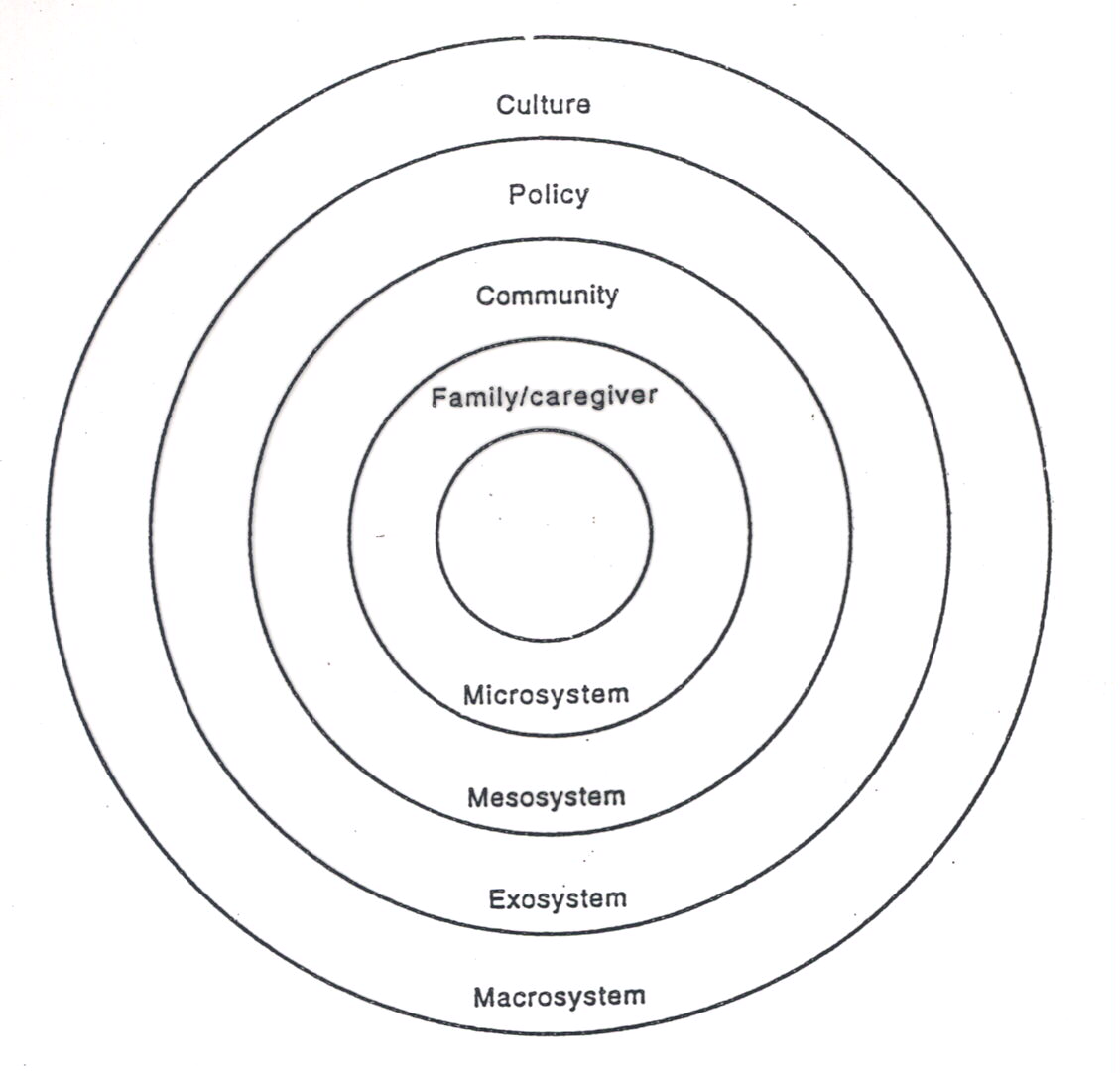
Bronfenbrenner’s System Theory
In a systems theory perspective each individual is in a dynamic and interconnected relationship with other people and environments.
Resource: Bronfenbrenner, U. (1979). The ecology of human development. Cambridge, MA: Harvard University.
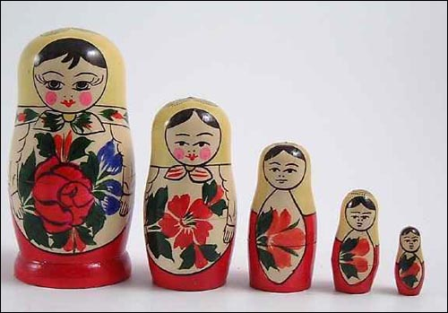 Picture nested Russian dolls where one fits inside the others. In Bronfenbrenner’s social system theory the smallest system is an individual person. But everything is connected; what influences one circle influences all the others. The circle of our family’s culture, traditions, likes, dislikes all influence who we are and what is valued. It is as important as the common blood or DNA.
The Micro System
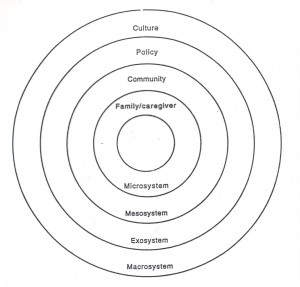 Each aunt, uncle, cousin, grandchild in my family has their own experiences and beliefs about people who are different. Based on their ages and backgrounds they could have few or many inclusive experiences. Fortunately, Aaron is a part of the family, because of his blood, he belongs. They try to see the good things in Aaron, my son who has the label of autism. When we get together for family gatherings, they each try to fit Aaron into the environments and accommodate his needs.
Some of my cousins are teachers, counselors, business owners, nurses… Some work with people with disabilities in a professional capacity while others have had personal experiences with people in their communities. My sister recently had some hip surgery and applied for a Handicapped Parking permit–as we are all aging, we are all starting to understand the ramifications of being “temporarily able bodied.” Each individual and each family member shares those common experiences, but just as I am learning about growing older from my seniors and elderly relatives, many are learning about inclusion from Aaron.
Macro System
Considering people with severe disabilities have suffered abuse, neglect, and been ostracized from their family (tribe) being given the opportunity to participate with the family is a gift. I am thankful. I also hope we give positive modeling of what to do, how to act, how to accept others who are different.
Most of my relatives go out of their way to try and help Aaron in the swimming pool, bring him a drink, and help wipe up a mess if he spills something–instead of blaming him. I think some of this was learned from my Uncle Ed.
Uncle Ed always “Got it.” He was a pioneer for inclusion before inclusion was a word. At our family reunions Uncle Ed always brought people from the neighborhoods where he was pastor. There would be kids of all different religions, races and cultures. He was teaching about diversity as we all got in line for the potato salad and hot-dogs, as sure as he was teaching about God and God’s children. When Uncle Ed led the traditional singing, we didn’t sing special religious songs only our family would know, we sang camp songs where everyone could join in: “The bear comes over the mountain” or “The food in the army, they say is mighty fine” and school fight songs.
Uncle Ed was teaching about inclusion, about belonging and the power of a face to face connection. And he lead the way to change attitudes through his embedded social systems.
The last song before the picnic ended was always, “He’s got the whole world in His hands.” Uncle Ed never offered to lay his hands on Aaron and ask for God’s cure. He never tried to “counsel” our family about accepting God’s will. He never gave a sermon on how Jesus cured the blind man. Never once did he tell me I was chosen.
But like Tom, Tommy and I were trying to model, Uncle Ed just accepted Aaron the way he is, saw his beauty and gifts. Didn’t try to change him or us. In the many choruses of “He’s got the whole world” we joined hands and sang about how “He’s got the mothers and the fathers, the sisters and the brothers…He’s got the little bitty children… and He’s got Aar-on in His hands, He’s got the whole world in His hands.”
I know sharing pictures and snapshots of family reunions is boring as can be, but I hope this story shows why our family and extended family are such an important part of who we are. I am so thankful Uncle Ed was a part of my family, a part of my social system. I am hoping my family will also say the same about Aaron.
What about your Circles?
Does systems theory make sense to you? Who are the people/groups/clubs in your circles? How do these impact your life?
Tell us about your social systems, how is your family changing?
Keep climbing, onward and upward.
All the best,
Mary
by Mary E. Ulrich | Apr 17, 2024
Part 1
Going to the family reunion, or not?
My cousin rented her local swim club and invited all 26 cousins and their families for our annual family reunion. She scheduled it on a Saturday when many of my cousins would be in town. She is working hard to keep our large family together and give our children and grandchildren some of the same fun family times we had when we were growing up. Cousin Terri is offering a gift to our family.
So, will we go, or not?
Even though our oldest son Aaron has the label of autism and developmental disabilities, we try to include him in all our family activities. Now that he is in his forties, we have gotten pretty good at the extra planning and preparation to make sure all turns out well.
Today I want to focus on “ecological assessment”. Drs. Lou Brown, Alison Ford, Anne Donnellan et al. from the University of Wisconsin–Madison introduced this concept years ago and it has made a huge difference in how I look at the world. I’m not using their fancy checklists but I’m hoping to show how to analyze and plan for our visit– in this case, Terri’s local swim club.
Ecological Assessment with Commentary:
We can’t assume all swim clubs are alike. We have to access this one particular swim club. But we can compare/contrast it to Aaron’s past experiences.
We have been to this swim club before, if we hadn’t, we would have gone a couple of days before and scouted it out. Most people don’t like surprises or change. It’s not a coincidence that major chain stores like Target or Walmart are all laid out the same way. Each of us likes to know the lay-of-the-land. There is comfort in familiarity and that helps reduce our stress in any environment.
Terri’s swim club is about twenty years old. You’ve seen hundreds like it. The swim lanes, the three lifeguards, the signs telling the kids not to run… It is the same swimming pool our family enjoyed when we were teeny-boppers dripping Popsicles and walking around hoping our swimsuits didn’t make us look fat. (Oh, to only be as “fat” as I was when I was 12.) There are no steps and they have a ramp into the pool. (Thank you ADA.)
Swimming:
Aaron likes the water and is a pretty good swimmer. He started aquatic therapy when an infant to relax his muscles. My husband Tom will be in the water with him one-on-one. His cousins will be in the pool, so they will be aware of Aaron and add an extra layer of safety from stray beach balls.
Aaron has red hair, fair skin, freckles and if we lather him with sunscreen and he wears a t-shirt in the water he will be protected from burning. Past experiences predict Aaron will probably only stay in the water for about a half hour or so. The exercise will be wonderful for him and he will sleep well. Because Aaron swims with his mouth open, he probably will swallow some water and wet the bed. We’ll make sure he gets to the bathroom at night and we’ll use a mattress pad protector just in case.
Restroom:
The swim club has two separate restrooms and changing facilities. They have shower curtain dividers who Aaron and I will both fit. It is a typical swim club restroom, so I might have to bring in a chair so Aaron could sit down. I could change him and then he could go out to Tom while I change. We would bring Aaron in his swimsuit, so we would only have to change him once. We will give him yogurt in the morning and hopefully he will have his BM before we go. I’ll have an extra set of clothes. Aaron has some large plastic pants he will wear under his swimsuit just in case. (They don’t make swim diapers for adults.)
Eating:
Aaron eats most anything so the pot luck buffet will be great. Cousin Ray will grill hamburgers… I will bring a dish that doesn’t require any preparation. I’ll make sure it is in a throw-away container so we won’t have to worry about bringing it home—maybe some frozen fruit cups or fruit-on-skewers so everyone can grab it and not even have to worry about a spoon. Those have been big hits in the past. Or, I’ll get real summer daze lazy and I’ll just go buy some cookies at the grocery. Aaron will need to eat at a table. I’ll bring some folding chairs. We’ll try and feed him close to his usual 5:30 mealtime. Between Tom and me, we can cut up his food and make sure he is comfortable. Usually, he sits by Grandma, so we can make sure both of them are okay. He can have one soft drink, and I’ll bring some bottled water.
Behaviors:
We’ll bring some books and his baseball cards and make sure he isn’t too crowded at the table. We’ll make sure Aaron is in a spot where he can watch everyone and everything that is going on. When he seems tired or agitated we’ll leave. Tommy, Aaron’s younger brother will get to enjoy the day and spend time with his cousins, and we’ve arranged he can spend the night with Cousin Kevin if we have to leave early with Aaron. We’ll make sure someone is with him at all times but trade off so we can talk to some of the relatives. If Aaron starts his echolalia of, “You Okay?” or other odd behaviors, it will really be okay, because his cousins know and love Aaron. He is part of the family.
Summary:
This post is to show what an ecological or environmental assessment looks like.
Most parents do the same thing for their babies, their children, their older family members. It’s really not that different–just thinking ahead, planning and being prepared.
If we really want Aunt Lizzie or Great Grandma Stella to come to the family reunion, there are little things we gladly do to modify the environment and accommodate their needs. For instance, Great Grandma Stella will surely take out her teeth after dinner and they will get misplaced. So we will assign someone to make sure and put them in a safe place. (This is an urban legend in our family.)
Same with Aaron–just add, subtract, and/or change a couple of extra things to make him feel comfortable. Modifications and adaptations are for everyone.
We still haven’t decided if we’re going to the family reunion or not.
Part 2 will look at the family reunion through the eyes of Social Systems Theory (don’t worry, it’s not as boring as it sounds). https://climbingeverymountain.com/going-to-the-family-reunion-or-not-part-2-the-circles-of-life/
In the comments below share some of the modifications and accommodations your family uses to make sure the oldest, the youngest and all the relatives in-between have their needs met at a family reunion?
Going to the Family Reunion, or not? Part 1 first appeared on my Climbing Every Mountain blog. It is the first of three parts.
by Mary E. Ulrich | Apr 15, 2024
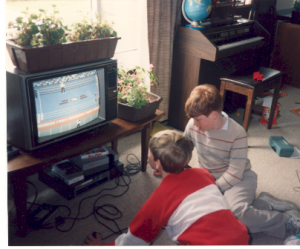
Aaron watching Tommy play Nintendo
Summer Activities| A Mother’s Hope for Her Sons with and without Disabilities
NOTE: This is when Tommy was 13 and Aaron 14 years old.
Is summer different for kids with and without disabilities?
This summer Tommy, my 13 year old son, …
• Went to 2 weeks of Boy Scout camp, an experience which included a hike on the Appalachian Trail.
• Had to choose between participating in baseball or soccer. In August, however, he began training for the school cross-country team.
• Was active in a neighborhood network of five boys who decided to start a Nintendo Gaming Exchange Club. His friends called him the minute he arrived home from activities, played games until supper.
* Was invited to stay overnight with a friend or cousin.
• Had a season’s pass to a nearby amusement park, and because he can use public transportation independently, spent at least one day there each week with friends.
The days of summer flew by for Tommy. He had individual activities with friends, but also family activities which included a camping vacation and travel to a National Park. His major frustrations were either the lack of time for pursuing all of his interests, or his Mom’s suggesting he do something “dumb” like reading a book or practicing his clarinet.
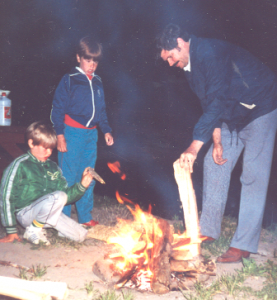
Our Family Camping Trip
Tommy’s brother, Aaron, age 14.
Aaron went to two weeks of special camp this summer.
Aaron’s major summer/weekend/vacation activity is watching Tommy play baseball, play Nintendo games…and riding to drop Tommy and his friends off.
Aaron also has a pass to the amusement park, but can only go with an adult (who so far is his mother).
Aaron spends every morning saying, “bus, bus…ready, set, go.” When the school bus doesn’t come, he sometimes licks on the front window, bites his hands and puts on his coat and backpack. He can’t figure out why his routine is different.
Aaron also can’t figure out why we spend all winter telling him to keep the front door shut, and all summer telling him to keep the front door open (but that’s another story.) *smile*
Aaron was on the waiting list for a short Easter Seals sponsored program in August, the only other community recreation opportunity available to him in our county.
What’s the Difference?
As I contrast the lives of my two boys, I can’t help thinking…
• …perhaps I wouldn’t feel Aaron’s isolation and lack of contact with any friends or same-age peers if Tommy had fewer friends.
• …perhaps I wouldn’t worry about Aaron’s behaviors, physical condition, weight and stamina if he were occasionally an active participant, rather than always an observer.
• …perhaps the hours and hours of inaction would not occur if Aaron had better skills or could entertain himself.
• …perhaps our family will adjust eventually to the sadness (and stress) we feel knowing Aaron’s only opportunities come from mom, dad or brother…and realizing it may always be that way.
* …perhaps we would feel so trapped if we could get respite regularly.
* …perhaps we’ll become accustomed to wearing a key around our necks so that the door can be locked with a deadbolt every time someone goes out or comes in (otherwise Aaron will run into the street or enter neighbors’ homes).
* …perhaps we’ll resign ourselves to our community’s “special” camps and “special” recreation programs, which effectively exclude Aaron from almost everything that is typical, regular, easily available and low cost. Perhaps hope will sustain us that someday a “community support” agency professional from somewhere, anywhere, could adapt, modify and begin to open community activities for Aaron and others.
* …perhaps our prayer will be answered that some child around Aaron’s age will care enough to help him join a circle of friends. Just once, even once.
* …perhaps/…oh perhaps…some wonderful person will believe that a community is more that a group of houses, businesses and people. Agency professionals must become bridge builders in the community. Families in which a child has a disability need the same support regular families have.
Summary: Separate is inherently Unequal.
The tragedy of having a child with a disability has nothing to do with a syndrome, impairment or disease. Words such as autism, CP, and intellectual disabilities are just descriptors the same way hair color, height, race, sex and personality are descriptors. Children don’t start out life knowing they are different. The tragedy is the reaction of families, neighbors and society, which emphasize differences.
The conflict for people with disabilities and for their families comes when the community limits opportunities, segregates and restricts individuals’ choices (e.g. Handicap swim is Tuesday; 1:30-2:30 p.m. and General swim is Monday to Friday 8:00–5:00).
It doesn’t matter that the limiting of opportunities appears, to have a good rationale or charitable intentions. Segregation limits freedom, limits choices, and limits development. “Special” means segregated.
Our Olympic Moment of Inclusion
One hot July day last summer, Tommy and his friends stopped by our house to make some peanut butter and jelly sandwiches for a picnic.
Unexpectedly, one of the boys asked if Aaron wanted to come along.
Five minutes later, all the kids were laughing, talking and riding their bikes to the park. One red-haired kid named Aaron was riding on a bike in tandem.
In about one-half hour the picnic ended and they brought Aaron back; that was the highlight of Aaron’s whole summer.
That moment for Aaron was sort of like the experience of a serious ice skater. Olympic gymnast, actor, or musician who practices day after day hoping to “bring it all together” for one magic performance or “big break” It was a “victory” –a spontaneous, normalized recreation experience, without his mom! Ahhh (smile-sigh). And now…back to work. But, perhaps, just perhaps…those wonderful, typical neighborhood kids will grow up more fully with the vision for and the experi3nce of community integration and freedom. They are the next generation of soccer coaches, swim instructors, church/synagogue group and scout learners.
The change of inclusion has begun.
Related Stories: (Click on title)
On the last day of Junior High School.
Dream Plan for Aaron–14 yrs old (Part 2).
America the Beautiful: A Family Vacation Plus
Keep Climbing: Onward and Upward
“When we stop to lift one another up on the climb, we all reach a higher place.”
All my best,
Mary
Comment:
What were your summer vacations like? Would they have been different if you had a label of autism or disability? If you were a parent of a child with a disability what would you be thinking? dreaming? Are summers different for kids with and without disabilities? Can you think of anything you could do to help?
by Mary E. Ulrich | Apr 13, 2024
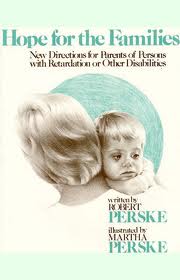
Hope For The Families
Robert and Martha Perske
Today I was thinking of Martha and Bob Perske. Martha’s beautiful sketches of children with disabilities are in frames over my desk and in buildings all over this country. Bob is now gone, but as we each get older and wonder if our lives really mattered Bob is one of my inspirations of a life well lived.
At one of my first TASH (then The Association for Persons with Severe Handicaps) conferences, I heard Bob Perske speak about Hope for the Families. His book, by the same name, helped me make sense of our family’s new life as parents of a son with the labels of intellectual disabilities, autism and more.
Bob Perske has been one of the pioneers for people with disabilities and their families. In Parallels of Time, Bob Perske is seen pictured with giants in our field. He has written many terrific books including Circles of Friends and Unequal Justice, his current work with people with intellectual disabilities caught in the criminal justice system.
Bob is an amazing minister, speaker, writer, and just a great person. People with disabilities and their families are fortunate to have him in their lives. Martha, his wife, uses her talent to create pictures that spread joy and a vision of inclusion across the world.
Below is one of Martha’s pictures and the introduction to Hope for the Families which I have passed along to my friends, my classes, and anyone who would read it.
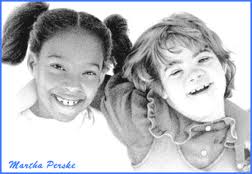
Two Friends by Martha Perske
Hope for Families of People with Disabilities
Not so very long ago, you and I were conditioned to perceive persons with handicaps as deviants. They were seen as…
Possessed by evil forces
Carriers of bad blood
A drag on the community’s resources
The products of illicit sex
Subhuman organisms
Too ugly to be seen in public
Objects to be laughed at
A Group that would outbreed us
People with contagious sicknesses
Sexual monsters and perverts
Children who never grew up
Our parents and teachers conditioned us by what they said—or didn’t say—to feel uncomfortable around hose imperfect people. We were led to believe that if we got too close to them, something evil would rub off on us.
Consequently, persons with disabilities were condemned to struggle against TWO handicaps. One was the actual handicap. The other was he additional wounding they received from our prejudices.
Wasn’t the handicap itself enough? Why did we have to cripple them further?
Let me offer one theory to explain such behavior:
Once we believed fiercely that the world was becoming better and better.
And in keeping with this belief, everyone was expected ultimately to develop…
A pure heart
A brilliant mind
A beautiful body
A successful marriage
A high-status job
And live in a perfect society.
Then along came a few defenseless persons with obvious physical and mental handicaps. Their presence rattled our plans for a perfect world as a high wind rattles a loose shutter. We didn’t like that, and the result was that we could not stand to have them around us.
World War II
Then something happened. One country, in an effort to create a super race, started a world war. By the time it ended, the minds of all humankind were trying to comprehend the terrible things some groups of human beings had done to other groups. All of us tried to understand what had happened in places like Buchenwald, Auschwitz, Hiroshima, Nagasaki, London, Bataan, and Corregidor.
After World War II
After World War II, our belief in the gospel of world perfection began to fall apart.
And, we were reminded of some terrible facts.
All of us have gaps in our bodies and minds.
All of us are unfinished.
Some of us can hide our deficiencies better than others.
None of us will ever achieve perfection.
Those of us who think we are closest to perfection may be most likely to drag the human race to new lows.
Today we do not know whether the world is getting better and better—we only know it is getting more complex.
And yet it is an astonishing fact that humankind’s healthy interest in person with disabilities began to mushroom after the Holocaust and the Atom Bomb. One cannot help wondering if there is a connection.
Robert Perske Hope for the Families: Abingdon Press, Nashville, TN.1981. Click here for Robert Perske’s website.
Today, advocates in North Carolina, Ohio, Wisconsin, Indiana, and other places around the country are asking the legislature to preserve Medicaid and other programs for people with severe disabilities. The crucial support programs our children need to survive are at risk.
Money is always scarce, but as Bob points out, we have made progress in our values and experiences of including people in the community. We have to believe in hope and better futures for our children.
I am reminded of two quotes:
“Those who do not learn from the past are destined to repeat it.”
“A measure of a society is how it treats its most vulnerable people.”
As parents we understand budget cuts and are even willing to concede progress will be slow, BUT we expect progress!
If you found this interesting you might also like a related article about Remarkable Parents who Never Give Up.
Keep Climbing: Onward and Upward
All my best,
Mary
What’s Your Take? Be Brave and Share
Do you think our society values people who are different or have special needs? or, are we still just a drain on the system and resources? Do you think people with disabilities have two handicaps?
If you like this, please retweet and share it with your community. Thanks.
Related Articles:
Unequal Justice| Bob Perske
Bob Perske| The Song of Joe Arridy
A Comparison of the Service System and the Community
2012 Article on Joe Arridy “Here lies an Innocent Man”
note: Bob gave me permission to print excerpts from his book Hope for the Families.

 Each aunt, uncle, cousin, grandchild in my family has their own experiences and beliefs about people who are different. Based on their ages and backgrounds they could have few or many inclusive experiences. Fortunately, Aaron is a part of the family, because of his blood, he belongs. They try to see the good things in Aaron, my son who has the label of autism. When we get together for family gatherings, they each try to fit Aaron into the environments and accommodate his needs.
