Dr. Annie Abram interviewed me about Special Education Inclusion on her weekly blog talk radio program: “Ask Dr. Annie Abram.”
Dr. Abram talks about “Parenting Across Generations” and has been doing several topics on autism.
Check it out. Tell me what you think in the comments section. It really has been a journey for Aaron–a person with a disability, for me–the parent of an adult with a disability, and for our family. And, the choices and decisions we made when Aaron was young definitely influence our choices and decisions now that he is an adult. In my heart I know we took the road less travelled and it demonstrated to the world that inclusion is a civil right–and Aaron is a full citizen.
Inclusive Education
Expecting Academic Achievement in General Education Curriculum
April 25, 2013
2-3:30 p.m. ET
This interactive training session provides teachers with a structured time to think and plan to enhance their students’ participation in the general education curriculum. Many teams have become outstanding supporters of inclusive education. However, what are the students’ goals in that setting? How much involvement do they have with the general education curriculum? What are the goals for the student’s academic achievement? Have we fully considered all the ways the student can attain access to and demonstrate an understanding of the general education curriculum?
Presented by Stacey Skoning, University of Wisconsin Oshkosh, and Denise Clark, University of Wisconsin Oshkosh.
TASH Members $50 (Individual) $80 (Group)
Non Members $70 (Individual) $100 (Group)
This is an inexpensive way to get the latest information for an inservice or parent group.
• Thriving in Transitions: Self-Directed Living, It’s Never Too Late! (Community Living)
Thursday, May 9 @ 1 p.m. ET
• Building and Sustaining our Communities through Time Bank Exchange (Community Living)
Thursday, May 16 @ 2 p.m. ET
• An Overview of Person Centered Planning: The State of the Art (Community Living)
Thursday, May 30 @ 2 p.m. ET
———————————————————–
Free Ideas for Inclusive Classrooms
If you want inclusive ideas for your child or your classroom, Paula Kluth is the best. Sign up for her blog. Paula Kluth
The Values of Inclusion: Valuable across the World
Jack Pearpoint is a true visionary. He shares his vision with others. I recommend subscribing to his Inclusion Network YouTube Videos (link below the video).
At the Down-Under Inclusion Institute, Jack showcases Heather Simmons from his trip to Sydney, Australia. “Heather summarized the simplicity and complexity of living an inclusive life in a welcoming society.” Enjoy. Isn’t it nice to know the ideas of inclusion are spreading around the world?
There is a content organizer below if you want to print it out and take notes.
Study Guide or Content Organizer: Print out and take notes while watching video.
The Values of Inclusion by Heather Simmons
Everyone is born “in”
All means “All”
Everyone needs to be “in”
Everyone needs to be
Everyone is ready
Everyone needs support
Everyone can learn
Everyone can contribute
Everyone can communicate
Together we are better
Additional Notes:
Any questions? Comment? Anything you would like to share about this video or others?
My parents, teachers and culture taught me to blend in, not cause trouble and certainly never ever draw attention to myself. That all changed when my son Aaron was born with autism and developmental disabilities. Aaron couldn’t speak for himself, mom had to do it. HAD TO–not something I chose or wanted to do.
Advocacy (speaking for others) is learned–the same way we learn to run a race, or learn to read. Advocacy takes much practice and the trial-and-error of many mistakes and some successes.
So as the parent of a person with disabilities I learned to ask questions, read, research, go to workshops and meetings, meet with like-minded parents and professionals AND with people who were 180 degrees opposed to ideas like normalization, inclusion and civil rights for people with disabilities. I learned about making change with Bronfenbrenner’s embedded systems: individual, local, state, national and world.
I learned to work with other parents, adults with disabilities and advocates. Our big successes were keeping IDEA alive when Pres. Reagan was trying to repeal it and helping pass the civil rights legislation: The Americans with Disabilities Act (ADA).
There is only one way to keep moving forward with civil rights—each of us has to make sure the law is enforced and vulnerable people have the same opportunities as others. One person. One situation at a time.
I am only one, but still I am one. I cannot do everything, but still I can do something; and because I cannot do everything, I will not refuse to do something that I can do. Helen Keller
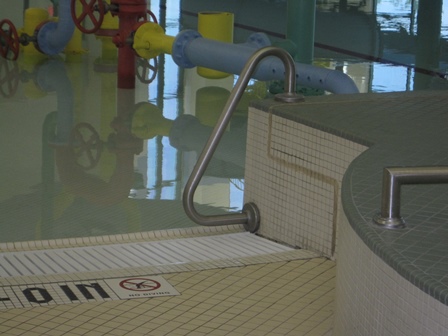
I joined the local community center and went to the pool. There was a lift for a person in a wheelchair and an entrance where the water gradually increased in depth 1 inch at a time.
But almost all of the seniors went down one step and walked along a side wall to get in. I almost slipped and fell trying to get down that step. I noticed several other people had the same problem creating a potentially dangerous situation.
I’m thinking a simple railing would solve the problem and help everyone who gets in the pool: children, adults and seniors. Universal design, right?
Okay, now I had belonged to this community center for approximately 45 minutes. I had the cheapest membership. I was still using a damn walker from a recent surgery. What should I do? Did I really want to raise a fuss? 45 minutes—I hardly had the right to say anything.
Stating the Problem:
Script of Conversation
I started with the immediate supervisor, the head Lifeguard and “I” statements:
Me (smiling): “I almost fell getting into the pool.”
Lifeguard: “There is a gradual entrance into the pool, it starts at 1 inch and gradually gets deeper.”
Me: “Yes, but there is nothing to hold on to. And I can’t walk without support. I’m having trouble putting any weight on my left leg.”
Lifeguard: “We have a wheelchair lift. We have steps with railings on the other side of the pool.”
Me: “Yes, but the concrete is slippery and it is far away from the locker room and main entrance. Everyone seems to be using this step and holding on the wall to get in, I saw several people almost fall.”
Lifeguard: “Yes, I hold my breath every day. It’s not a good situation.”
Me: “So, how can we fix it? It seems to me a simple railing would solve the problem. So, who could make the railing happen?”
Lifeguard: “Well, they won’t listen to me, so how about the director of the center.”
Finding the Authority who can Make Change
Me: “Hi, I almost fell when I got into the pool. I watched other seniors also have trouble. I talked with the Life Guard and a simple railing would be a good solution.”
Director: “This is the first time this has come to my attention. But we really don’t have the funds to fix this.”
Using the ADA Wildcard
Me: (I’m standing there with my walker) “I’ve noticed most of the seniors in the pool use canes or walkers. The concrete is very slippery even after the Life Guards sweep the excess water back into the pool. I’ve also seen the wheelchair lift and the showers with extra bars, seats and hand showers. So, I know you are trying to meet the requirements of ADA.”
Director: “Oh yes, we are very aware of ADA.”
Me: “Are you the compliance officer for ADA? I have been going to physical therapy in the rooms that adjoin the pool. They have an excellent staff and I’m sure they could give you good advice on the types of railings that would work the best.”
Director: “We really don’t have the funds to do this, and no one else has complained.”
Me: “Have you talked with your Life Guards about this?”
Director: (squirming) “We meet the minimum requirements of ADA. We have the lift, which was very expensive and doesn’t get much use. Thank you for coming, but I have another meeting to go to.”
Me: “A railing is a safety issue; it is a reasonable accommodation for the seniors (and everyone). Could I have the complaint form for ADA?”
Director: (giving me the once over) “Of course.”
Put it in Writing
I filled out the complaint form including not only the railing, but the lack of mats, hand showers some of which didn’t work well, and the fact that the seniors had to somehow maneuver the heavy doors into the locker rooms with their walkers and canes (while they were wet). I also made sure the date was at the top and asked for a copy of the form.
I handed it to the director, let her read it, then looked her in the eye and said, “Do we really need to file an ADA complaint? This is such a wonderful community center; surely there must be a way to make this happen. Do you have a suggestion form or some other form where I could give this information and it would be addressed?”
Director: (giving a sigh) “Yes, we do have another form for suggestions. I am beginning to understand some of your concerns. I’ll have my staff look at this and get back to you.”
Me: “Terrific, I’m sure you’ll see the problem. I’ll stop back when I’m going to therapy.”
The Slam Dunk
By the next week, the director had met with the Life Guards, checked out the locker room showers, watched some of the seniors and others who used wheelchairs, walkers and canes try and open the heavy doors to the locker room. She also consulted with the physical therapists who work in the pool.
She called and asked what kind of railing I wanted. I said whatever the professional team decided—they saw many people go into the pool, and I deferred to their judgment. She said in August, they drain the pool to do the necessary repairs. They could add the railing then.
I thanked her, again complimented her on the wonderful community center–and meant it.
ADA Works, IF You Use It
After I did a happy dance, I thought of Justin Dart, Ed Roberts, Bob Williams and all the other advocates who worked so hard to make ADA happen. I thought of ADAPT members getting hauled to jail. I thought of the public hearings, the many petitions, letters and phone calls we made. I thought of visits to the legislative offices of congress–Senators Harkin, Kennedy and Representative Coelho telling their personal stories. I thought of our local efforts to make ADA happen in our state.
ADA is our legacy. It is our gift to future generations. ADA has the power to make people listen. ADA impacts the present and the future—not just of people with disabilities, but all of us.
But, if I hadn’t spoken up, the step would still have no railing and the locker rooms would not have electric door openers. Now, maybe no one would have gotten hurt. But, just maybe, I helped save someone from a serious accident—maybe even me.
As a battle-worn advocate, in the big picture this was an easy victory. Granted it was very small. Only a handful of people even knew what happened.
But every time I enter the pool, I watch children, adults, seniors go up and down the step—and I smile. I did this!
Has anyone else had a success story (or not) with ADA? With Advocacy? Anyone else have tapes running in your head about being a “good” boy or girl and just accept things as they are? Can you name a specific accomplishment?
I’d love to hear from you in the comments. If you liked this story I ask that you use your social media to spread the story. Thanks, as always, for being part of our Climbing Every Mountain community.
The Right to Communicate| We are the (new) Experts
In the early 90s, Rosemary Crossley, Annie McDonald, Doug Biklen and others shocked the world with new ideas about people with the labels of severe disabilities and autism being able to communicate. They were pioneers who opened the world for many people to be able to use their voices to change their lives.
The movie Wretches and Jabberers is traveling to 40 cities to celebrate Autism Awareness Month in April. Click here for a schedule. I hope you will see the movie and share your thoughts in the comments.
Augmented communication made all the difference for my son Aaron, who has the labels of autism and developmental disability. He was able to work with our talented speech therapist and friend, Tina Veale, and discovered new worlds. He was able to attend general education classes for the first time. He was able to get the school to provide a full time facilitator who assisted him in these classes.
Here is an adapted version of the poem I originally wrote for Anne Donnellan’s “Moving On” series of books about Facilitated Communication.
(Ulrich, Mary in First Hand: Personal Accounts of Breakthroughs in Facilitated Communicating, (Anne Donnellan, editor), Richard, J., Jackson, K., Ulrich, Mary and Aaron (1993) DRI Press: Madison, WI. 45-46.)
Wrong and Right and the Paradigm Shift
They thought the world was flat and Columbus’ ship would fall over the edge.
But they were wrong!
God told them the sun went around the earth, so they excommunicated Galileo.
But they were wrong!
They taught Jupiter had three moons and marked children’s answers in red.
They swore Agent Orange and DDT were safe.
THEY…
They…
they…evaluated and labeled our children as “not educable,” “idiots” and said we “belonged with our own kind.”
In the name of charity and protection and “Heaven’s Very Special Child” they isolated and segregated us into institutions, ICFs, special schools, special classes, Special Olympics… lives of “specialness.”
But they were wrong!
They showed us their statistics, charts and test scores which PROVED we could not communicate,
were incapable of love
or feelings
and should be left alone because we wouldn’t “know the difference between a person and a rock.”
When we became “social critics” and protested with our behaviors, “for our own good” they shocked us with SIBIS or cattle prods, squirted us with vinegar, or put us in time-out … for life.
With their eternal trials of peg boards and beads, they made us prove we were “ready” for families, friends, regular classes, homes, jobs of our choice and … normal lives everyone else took for granted.
But their magic was limited to numbers and letters. And their motives–pure or sinister–fed their job security, tenure and egos.
But we knew all along, and it was these people who called themselves experts who were “not educable” and “idiots.”
Because… THESE EXPERTS WERE WRONG!
Now we only trust those professionals who repeat choruses of “Forgive us!” and
“We don’t know why, or how, but take our hands and we will learn together.”
Oh FC! Oh Skallagrigg!* Oh Judder!
We can communicate!
And with our new voices,
and new skills,
and confidence,
we will march into the future,
because
WE can love… and feel pain… and laugh… and cry… and…
We want to have families and friends and… be human.
We want to be people first and be raise our voices in making this diverse world a better place!
And, we will prevail, not because of laws or advocacy, or science but—because love has its own connection and
WE ARE IN TOUCH WITH WHAT IS RIGHT–
WE ARE THE EXPERTS!
* Horwood, W. (1987) Skallaggrig. London, UK: Penguin Books.
What do you think?
Have the people who called themselves “experts” changed and become more humble? Are they really just liked the cartoon graphic: Ph.D. (Piled Higher and Deeper)? Do people with autism and other severe disabilities now have new voices? As we get ready to celebrate Autism Awareness in April, is there new hope? Will you see Wretches and Jabberers?
Keep Climbing: Onward and Upward
All my best,
Mary
Related Posts:
Bob Williams wrote a much better poem than I: “What if”