by Mary E. Ulrich | May 5, 2018
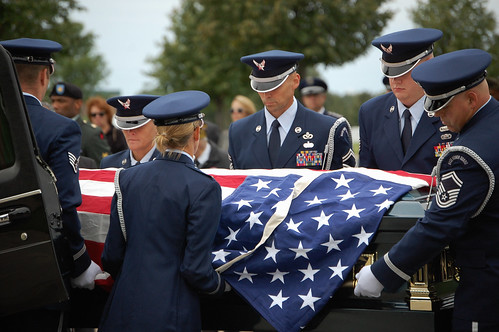
 photo credit: jpellgen
My granddaughter, Isabella, brought home a paper where all her classmates wrote a sentence about what they liked about her. It reminded me of this story. God Bless her third grade teacher, Mrs. Link.
This anonymous story is titled simply, “Teacher”.
I’ve read this many times and always think it is powerful. We don’t tell others often enough what makes them special, why they are important to us, why we love them. Likewise, we don’t hear from others why we are special.
Hope you can use this in your work and life. I think any group leader could adapt it for children or adults.
Comments:
The fact that you read my blog makes me love you. And since you are a chosen few, it proves you are unique:)
What makes you special? How have others told you or showed you they loved and cherished your unique gifts?
Would this be different for people with disabilities? How do people who don’t talk with words tell you they love you?
Could you use this activity? Like this story?
Please share you thoughts.
Keep Climbing: Onward and Upward.
All my best wishes,
Mary
One day a teacher asked her students to list the names of the other students in the room on two sheets of paper, leaving a space between each name. Then she told them to think of the nicest thing they could say about each of their classmates and write it down. It took the remainder of the class period to finish their assignment, and as the students left the room, each one handed in the papers.
That Saturday, the teacher wrote down the name of each student on a separate sheet of paper, and listed what everyone else had said about that individual.
On Monday she gave each student his or her list. Before long, the entire class was smiling. “Really?” she heard whispered. “I never knew that I meant anything to anyone?” and “I didn’t know others liked me so much,” were most of the comments.
No one ever mentioned those papers in class again. The teacher never knew if the students discussed them after class or with their parents but it didn’t matter. The exercise had accomplished its purpose. The students were happy with themselves and one another.
That class of students moved on. Several years later, one of the students was killed in the Middle East and this teacher attended the funeral of her former student. She had never seen a soldier in a military coffin before. Her student looked so beautiful, so mature.
The church was packed with the student’s friends. One by one those who loved the soldier took a last walk by the coffin. The teacher was the last one to bless the coffin. As she stood there, one of the soldiers who acted as pallbearer came up to her.
“Were you Tyler’s math teacher? He asked. She nodded, “Yes.”
Then he said, “Tyler talked about you a lot.”
After the funeral, most of Tyler’s former classmates went together to a luncheon. Tyler’s mother and father were there waiting to speak with the teacher. “We want to show you something,” the father said, taking a wallet out of his pocket. “They found this on Tyler when she was killed. We thought you might recognize it.”
Opening the billfold, the father carefully removed two worn pieces of notebook paper that had obviously been taped, folded and refolded many times. The teacher knew without looking that the papers were the ones on which she had listed all the good things each of Tyler’s classmates had said about her.
“Thank you so much for doing that,” Tyler’s mother said. “As you can see, Tyler treasured it.”
All of Tyler’s former class mates started to gather around. Charlene smiled rather sheepishly and said, “My list is in the top drawer of my desk, when I have a hard day I look at it.”
Mark’s wife said, “Mark asked me to put his in our wedding album.”
Then Vicki, another classmate, reached into her purse, took out her wallet and showed her worn and frazzled list to the group. “I carry this with me at all times,” Vicki said and without batting an eyelash, she continued, “I think we all saved our lists.”
That’s when the teacher finally sat down and cried. She cried for Tyler and for all her friends who would never see her again. She cried for all students she had ever had in class. The ones she knew did well, the ones who struggled, the ones who she could never figure out. She also thanked God for the inspiration to do an activity that was so simple yet obviously touched her student’s lives.
The density of people in society is so thick that we forget that life will end one day. And we don’t know when that one day will be. As teachers we work hard, we give our best, and every once in a while we are inspired.
So please think about your future as a teacher. Dream big. You will be in an awesome position to impact your students for a lifetime. Remember, you reap what you sow, what you put into the lives of others comes back into your own.
(Author unknown)
by Mary E. Ulrich | Mar 5, 2018
The “R” Word: A Challenge to Bloggers.
Stop the “R” Word

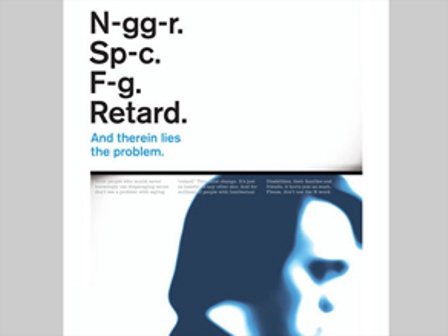
March 2018 is designated “Stop the ‘R’ Word day. If you go to their website they have many ideas for activities and actions. If we each do one thing, we can make a difference for the future of our children. Please share your thoughts and actions in the comments.
David Hinsburger and the “R” word.
David Hinsburger is an award-winning author and advocate for people with disabilities. His article titled: The People who “ARE” the “R” Word is a must read classic for anyone who doesn’t understand what the fuss is all about.
Sticks and Stones and names hurt
My Letter to a Major Blogger
As promised in my post “Definitions of “Retarded”, this is the letter I wrote to a major blogger when he used the words “retarded” and “idiot” in one of his posts. It is edited for this post.
Hi _____,
I have followed your blog ____ for a long time and enjoy your stories, ideas and writing style. However, I have issues with your use of the words: “retarded, idiot, moron and imbecile.”
You have made strong statements about using whatever words you want–even if they offend people and hit their hot buttons.
You can use words like “idiot, moron, imbecile, crip, tard…,” but why?
I agree this is America and defend your right to freedom of speech. I agree people who find these words offensive can just unsubscribe. But… you are a smart and thoughtful person. Why would you want to purposely offend vulnerable people?
I would rather believe you don’t understand how much these words hurt.
Mental Retardation–two words that matter.
My son has the label of “mental retardation” now called an “intellectual disability.” Because of those two words, he was not allowed to go to public school.
Because of those two words we had to spend three years in court, costing thousands of dollars. We, along with other parents, had to prove our children were human and had the right to “life, liberty and the pursuit of happiness.” We had to prove in court that our son would benefit from being around other people and his mere presence on the school grounds would not harm other children. Because of those two words he was not allowed to participate in swimming lessons with the other kids in our neighborhood PUBLIC park. Because of those two words our family has been refused to be served in a restaurant and a Doctor refused to have our son for a patient…need I go on?
But our problems were minor compared to people with the label of intellectual disability in the past.Parallels in Time: A History of People with Disabilities
Just a generation ago, because of those two words, people were treated as animals instead of humans. They were sterilized, given doses of radioactive materials in their oatmeal. They were taken from their families (“for their own good”) and warehoused in inhuman institutions. Some were not given clothes and had to sleep on straw. They were denied even the most basic human rights–all because one psychologist in one situation gave them one test and labeled them those two words.
Most history books have made people with disabilities invisible. So, you probably aren’t aware, but the words: “moron, idiot and imbecile” came straight from the medical manuals of less than 40 years ago.
There are still churches which will not allow people with the label of those two words to marry, some churches do not even allow “those” children to attend their services or receive the sacraments. Many private schools and churches legally still segregate and discriminate against our children with those two words.
There are many normal couples who joyfully want a baby–until they hear those two words, and then immediately abort. There are Baby Doe cases where if the baby has Down syndrome and is assumed to have mental retardation, the family refuses to take the baby home from the hospital and refuses to allow the baby to have food. There are cases of “wrongful birth” where the parents sue the Doctors for allowing their child with “mental retardation” for being born.
In 2012 we can add the case of baby Amelia Riveria who was refused a transplant because she had an intellectual disability. The hospital has recently apologized.
“Mental Retardation, retard, retarded” are not funny words”
In Ohio, the state legislature passed a bill in 2009 to remove the words “Mental Retardation” from state agencies and its documents. This was the work of numerous advocates and thousands of hours of public hearings.
This is a civil rights movement where we are fighting for the right of our children to live, work and recreate in the community. The right to be seen as human beings and citizens of this great country.
Sticks and Stones … and words can hurt.
When a label carries enough stigma that the label alone can cause discrimination–the label is a problem.
The civil rights movement of the 60’s laid the ground work for Sec. 504 of the Rehabilitation Act and the Individuals with Disabilities Education Act…. and our civil rights legislation, The American with Disabilities Act (1990). If you look at the closing statements in Brown vs. Board of Education (1954) you will see the school district’s argument, (paraphrased) “If you let negro children in the public schools, the next thing you know the school will have to educate retarded children and Indians.”
In 2012, our children have the right to go to public schools, and restaurants cannot refuse to serve us, or ask us to leave because they don’t like “the way we look”.
This is NOT ancient history. This is NOT some group of radical parents and advocates who just want people to be politically correct.
Churches, non-public schools and organizations can still discriminate and decide who they allow in their churches but because so many of our children are going to school and living with their families in the communities, there is not the fear that once existed. And the medical professionals have dramatically changed their low expectations and acknowledge the limits of the IQ test and other measures they used to label people.
Sure this came about because of civil rights court cases and federal legislation, but mostly it happened as decent people decided to give people who were different a chance. I know it is unpopular to say that the Federal Government and Laws are important. Many people say there is too much government. I wish there was more protections and enforcement for vulnerable people.
Challenge to Bloggers
My challenge to all bloggers is:
Will you take cheap shots and continue hateful language which hurts people? Or, will you use respectful language and recognize people with intellectual disabilities are people and at least give us all a chance to build a better world.
Words have power. You have power.
Will you use your power to continue to hurt people, or for change?
I know you didn’t mean to hurt anyone, but for those of us (like me) who have children with IQs below 50, children who were labeled “idiots” by our Doctors and medical professionals and who are struggling every day to try and make a better life for our children, the words: “retarded, idiot, moron, imbecile” are downright offensive. So forgive me that I rant today instead of ignoring it.
I know the words are used everywhere and people aren’t particularly trying to hurt people with intellectual disabilities but I would appreciate your consideration.
Thanks. Mary
The blogger I sent this letter to agreed to not use the offensive language only asking that he remain anonymous. I consider that a victory for all of us, and it has made me a loyal fan.
Rosa’s Law
Rosa’s Law was passed and signed by President Obama in 2009 to use People First language in all Federal documents. Love, NOT Labels| Rosa’s Law
I am hoping other bloggers will take up the challenge and use People First language and the words “intellectual disability” in a respectful way.
This is a fresh start. We can do it right this time.
What about you?
Will you take the challenge to remove the “R” word and other hurtful words from your vocabulary?
Will you help educate others who use the words?
Will you learn more about PEOPLE FIRST LANGUAGE?
Talk to me in the comments. Let me know what you are thinking.
Keep Climbing: Onward and Upward.
All the best,
Mary
Related Posts:
“Retarded” Keywords
Remarkable Parents who Never Give Up
Happy Feet, Retarded Teeth and Carnival Goldfish
Retarded| No More
Norm Kunc| What’s Your Credo?
People First Language| Building Community, “Wheelchair Becky” and Smoky Woods
by Mary E. Ulrich | Jan 23, 2018
People First Controversy
Background:
There is controversy in the disability community about the use of People First or Person First language.
I’ve written several posts about People First language:
*Rosa’s Law,
*Stigma and segregation caused by labels like “mental retardation“ and,
*Challenge to bloggers to use People First language.
Some self-advocates on the Autism Spectrum disagree They feel parents want to deny “autistics” and “aspies” their unique voices. They say parents only want to destroy autism and cure their children.
I am proud to support Rosa’s Law and advocate for People First Language. Perhaps these personal stories will explain.
I’m going to start and end with “Wheelchair Becky” but also share some stories about the past history of people with disabilities, my son Aaron, myself, and my hope for the future.
Is People First Language important for “Wheelchair Becky”?
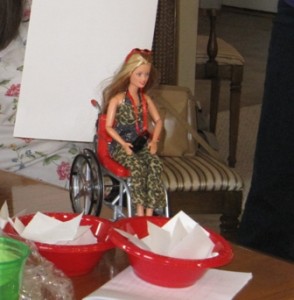
In a previous post: Building Community | Wheelchair Becky vs. Flat Stanley, I wrote about the way the Mattel Company thought “Wheelchair Becky” and “Black Barbie” would teach children about diversity and tolerance…and how it backfired.
I think People First language is part of the solution. If you disagree, that’s okay. It’s part of celebrating diversity.
Is People First language important for Aaron?
Aaron is my son’s name.
He has been depersonalized, reified and labeled by doctors, psychologists and other professionals as autistic, cerebral palsied, DD, MR, sensory deficit, movement disorder, severe/profound….
In the precedent setting Roncker case, the school psychologist testified under oath that Neill Roncker and others (like Aaron) had such low IQs “they wouldn’t know the difference between sitting next to a real person or sitting next to a rock.” So segregating them in separate schools with their own kind would make no difference. She considered their education a waste of school resources. Many people still agree with her.
So, I feel strongly People First language is important. Aaron is a person first. Others can give him labels. Some are medical and diagnostic but others are cultural: brother, son, uncle, cousin, friend, neighbor, patient, consumer, ….
This has nothing to do with wishing Aaron was cured. This is not denying the “autistic” culture. This has nothing to do with “disability pride.” It has everything to do with survival.
People First language reinforces the moral argument that people with severe disabilities are people and have a basic right to exist. A right to breathe, to be a member of the human race, to live with our families, go to neighborhood schools and community activities–rather than live in institutions.
Check out Parallels in Time history of people with disabilities It is filled with the abuse of those basic human rights. The more we know about our history, the more we understand the need to protect our rights to “life, liberty and the pursuit of happiness.” This is a daily challenge as we fight for caring staff, decent living conditions, health care, opportunities to be safe and belong to our families and communities. There are many people who see only the disability–and think that means we don’t need the same care and support–we are not really citizens, not really human.
Aaron is a “person” with wants, needs, likes and dislikes like everyone else. He is Aaron, that unique PERSON whom I love. He is Aaron a citizen with rights.
As I look at my life as a parent, advocate, teacher and friend to people with disabilities, I find I have excluded myself from my community. Yea, me–the advocate for inclusion.
Is Mary a Person First?
All mothers understand this conundrum. Especially when your child is so vulnerable. I’ve spent many years hanging around people working for the civil rights of people with disabilities i.e. Mothers of Special Children, Special Education Parent Groups, Arc, Autism National Committee, TASH…. I am a member of Disability World. Maybe not a primary consumer, but certainly a secondary consumer.
At some point, I realized I had to reclaim my own personhood. My personal resolution to rejoin the mainstream of my community included finding writers’ groups.
OVRWA
Fortunately, I found the Ohio Valley Romance Writers of America (OVRWA) in my community. These talented women have become more than mentors, they have become friends. I learned almost every one of them has a PEN Name, some have more than one.
Men with Pens
Men with Pens has also been a terrific community for beginning writers and bloggers. I’ve met James Chartrand who also wrote about using Pen Names and Pseudonyms.
Positive Solution: Writer’s Groups and Pen Names
So, it occurred to me: What if our stigmitized “Wheelchair Becky” started to include herself in these writing communities? After all, she’d graduated from the high school yearbook committee, right?
What if “Wheelchair Becky” chose her own Pen Name, became her own person, and like Flat Stanley started to integrate herself into the community?
Pen Names
Urban legend says one way to pick your Pen Name is to:
1. Write down the name of your first pet.
2. Write down the name of your street address when you
owned that pet.
I consulted with “Wheelchair Becky” and she agreed to make this into a community-building activity at the OVRWA holiday party.
Everyone wrote their pet’s name and put the papers in one red dish.
Everyone wrote their street address and put the papers into another dish.
Then “Wheelchair Becky” with the help of a friend, chose one name from each dish and VOILA—
Smokey Woods was born.
How do we build an Inclusive Community?
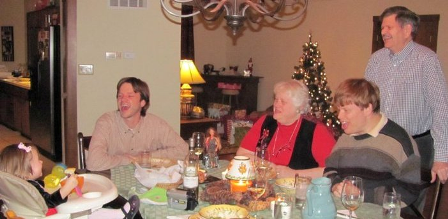
Smokey Woods toasts the New Year
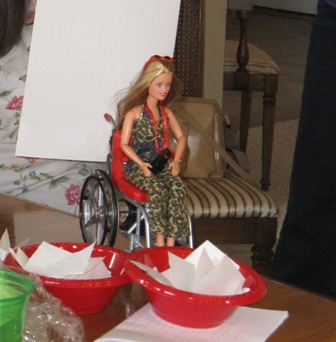
In the tradition of Flat Stanley and many writers, Smokey Woods began to make friends and include herself into the community. Here (at the head of the table) she is toasting in the New Year with our family. (BTW: She doesn’t eat much and is a cheap drunk.)
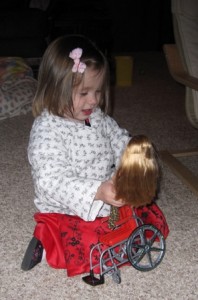
What a doll!
Here my precious granddaughter is playing with Smokey Woods the romance writer.
Smokey Woods is a doll, a toy. Smokey might use a wheelchair to get around, but she has a name.
My granddaughter represents the future. For Aaron, for me, for all people with disabilities. She will see people like Smokey in her classes and community. When she watches Glee on TV, she sees Artie singing and dancing. He also uses a wheelchair, but Artie has a name–and it doesn’t start with “wheelchair.”
Names matter. Aaron is Aaron. Mary is Mary.
I’m not promoting People First language because I am looking for a cure. I’m looking for survival and ways to prevent the abuse and segregation of the past. I’m looking for community inclusion.
For Aaron.
For myself and my family.
For all the next generation of little kids who will be learning about diversity by playing with dolls and watching TV.
I also think Mark Twain, Dr. Seuss and all the other writers who use Pen Names would approve.
Keep Climbing: Onward and Upward
All my best,
Mary and Smokey
Your Turn:
Did this make sense? Are there important reasons to use People First Language? Can we learn more about community inclusion and what it means to be a real person by looking at our language and the names we call each other? Do we need to study the past so we can move forward? In the comments please share your ideas.
by Mary E. Ulrich | Dec 25, 2017
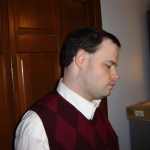
Blake Roberts an expert on DECtalk programming
Do You Hear What I Hear?
Do You See What I See?
In 1962, the song Do You Hear What I Hear? became an instant success when its lyrics asked us to hear, see, listen and “Pray for Peace, People Everywhere.” 1962 was a time of fear and uncertainty–much like 2017.
Today, as the year is coming to an end, I invite you to journey virtually to the Middle East–to the land of shepherds and millions of stars Listen and See this new version of a holiday classic.
‘Tis a Season of Magic
Blake Roberts and Pastor Snoopy Botten are musicians and visual artists who have collaborated on many CDs. Both are artists who inspire us to reach for the stars.
Their magic is their vision, talent and… a speech synthesizer with DECtalk software which helps people who can’t sing with words–sing with tech. Those who can’t see–paint with tech.
The result is poetry in motion.
Enjoy!
Do You Hear What I Hear? |Music and Visual Art
Do you hear what I hear?
In Blake’s Words:
Dectalk is a speech synthesizer that can be programmed to sing. I like Dectalk because I enjoy making it sing. Additionally, an almost infinite number of voices can be created with it.
Snoopi is a good friend of mine whom I met on the Internet several years ago. We enjoy working together on the CDs Snoopi has produced over the past couple of years. I did all the DECtalk programming and Snoopi mixed my DECtalk file with the karoake track.
My friend Snoopi is the same Snoopi you know on Facebook.
Snoopi programs Dectalk because it lets people who can’t talk sing like everyone else. I program Dectalk because I enjoy it.
I program songs at the same level of excellence as Snoopi. In fact, I am slightly better in some areas. Snoopi is the best Dectalkist in the world, I am second best. We never intended to be first and second best, we just are.
In summary, programming Dectalk is my favorite thing to do. Blake
More information about Blake and Snoopi:
If you would like to contact Blake Roberts go to: [email protected]
If you would like to contact Snoopi Botten email Snoopi at [email protected].
The video below is about Snoopi. Imagine, he sang the National Anthem for a professional baseball game. Don’t you love his confidence and spirit? His goal is to get a Grammy–and I think he will.
Keep Climbing and Singing: Onward and Upward
All my best,
Mary
What do you hear? See? Think? Want to discuss?
What did you think of Blake and Snoopi’s version of “Do you hear what I hear?” Do you know anything about DECtalk? or other programs to help people with disabilities talk/sing/dance/make beautiful art? I was struck how their work makes me listen and see differently, how it helps me see “goodness and light.” What about you? Do you know anyone who might also be interested in collaborating with Snoopi or Blake? Does their can-do spirit remind you of Aimee Mullins?