When I get depressed, I like to pull out a Nora Robert’s book. Don’t laugh:)
For a couple hours, I let the queen of romance weave a tale about another world where, no matter how impossible the conflict, the heroes and heroines will overcome all odds and there will be a happy ending. If only real life was like that. Sigh.
In Nora’s book, “Once Upon A Rose” the village WiseWoman conjures up a “forgetting spell” which protects a baby girl by making her invisible except to those who will wish her “good will”.
Of course any time magic is used, there needs to be a sacrifice to restore balance to the universe–so in this story the mother dies so the baby can live. Of Course.
I’m hoping a WiseWoman will come along and cast a “forgetting spell” on me. I’m saying this because I think “forgetting” is the key to solving so many of our problems. What if we could cast a “forgetting spell” so that Aaron would only be seen by those who wish him well? He would be surrounded by people who care about him.
I always felt “Inclusion” and blending into the normal life of a neighborhood is Aaron’s greatest safety–just as animals are protected by camouflaging themselves into their environment.
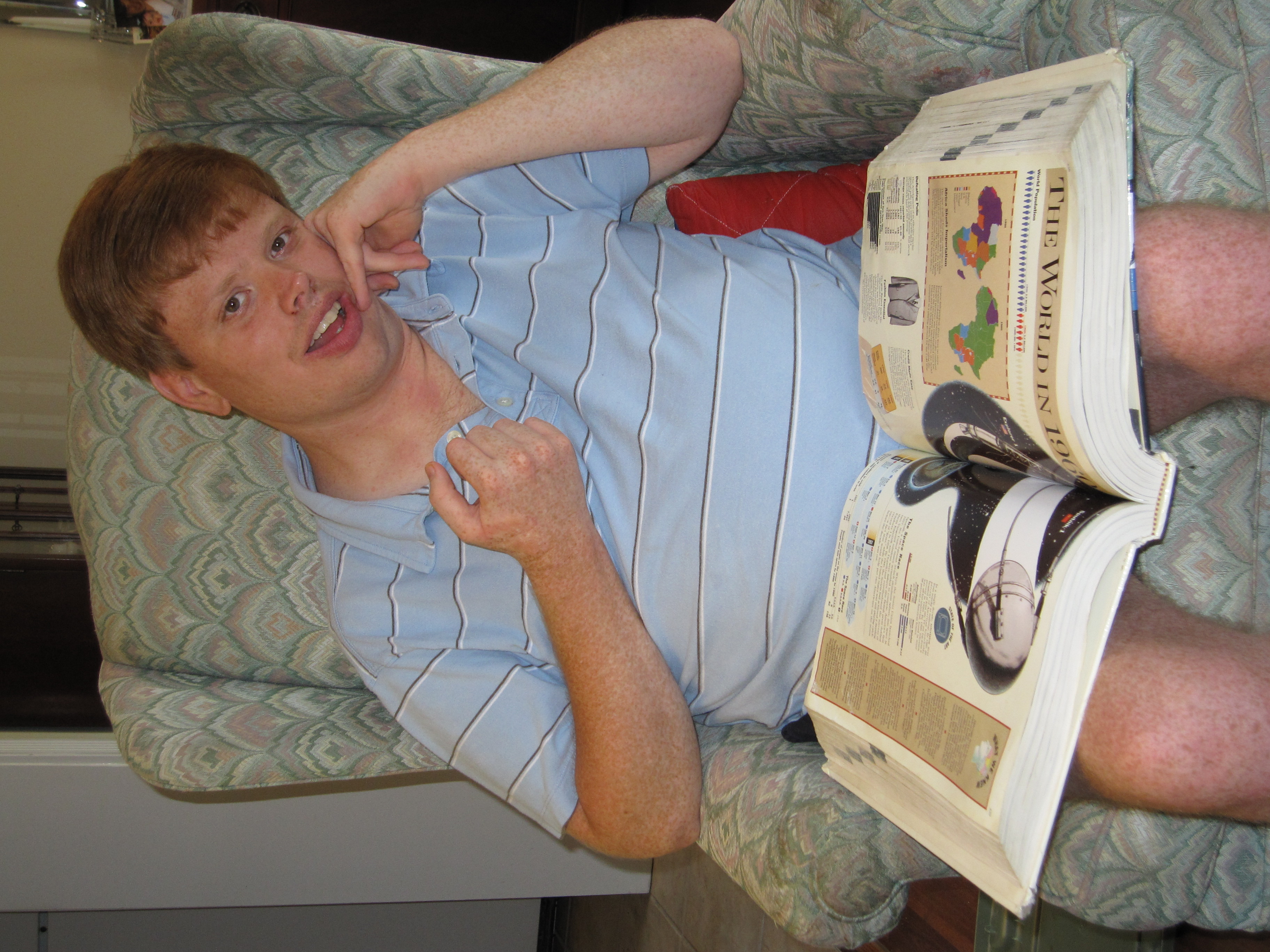
Aaron likes books, just like Mom
Success Story 1
Last week early one morning, the van driver from Aaron’s day program and his residential caregiver were having words in the driveway of Aaron’s house. GEESH! After all the community building I try to do with the neighbors GEESH ALMIGHTY–the normal adults (the paid professionals who are caregivers) are practically coming to blows in the driveway. And who do they call to fix it? NOT the two different agencies who are making thousands of dollars on Aaron, no of course not–they call me.
So, I handled it! YEA ME! It took several phone calls and a couple hours work, but starting next week a new van service will be providing transportation. Hopefully it is a win-win situation. Most of all, Aaron won’t have to have an emotional stressful start to his day. And any neighbors who might have noticed the commotion will forget about it and Aaron will go back to being invisible. He will just be a normal guy being picked up. No one will notice or be concerned. If there is ever a situation where Aaron is in trouble, I’m hoping the “forgetting spell” will bring out those who wish Aaron “good will” and they will speak up and protect him.
Success Story 2
Because I was unhappy with some of the things in Aaron’s life and took action, the agency which supports Aaron in his day and residential program have been very upset with me. I was the Wicked Witch, the Mother from Hell, the woman who just kept making trouble, anything but the “WiseWoman.”
Well, about 8:30 this morning, I get a call from the supervisor who previously would hardly even talk to me. He called and said our loving staff person who has been with us for over 8 years had a family emergency. Could I possibly go to Aaron’s house?
In twenty minutes I relieved the staff person and held down the fort until the supervisor could get there. In that time, I took both the guys to the bathroom, plunged the stopped-up toilet, and threw a load of clothes into the dryer. I got the guy’s back-packs and lunch boxes ready and when the supervisor arrived was able to give him directions to Aaron’s program and help them into his car.
I felt really good I could help our staff person, Aaron, his housemate and the company. I also felt good that they called me. It was the “community” the “team” the “extended family” I was always talking about.
What struck me was how the attitude of the supervisor had changed. Of course I can’t speak for him, but I think this was a transformational moment in the way he looked at my role as a mother and as part of the larger ecological support system (see related post).
At one point I almost thought he was going to give me a hug. This was incredible because only a couple days ago, I would have put money on the fact he was purposely trying to “punish” me for challenging his agency and his authority, adding roadblocks to our already difficult and complicated life.
Happy Endings
I wish I could craft a romance writer’s tool and create a nice story arc which would tie up this story in a nice circle. There was an opening conflict, it was resolved, and both parties were changed. But “happy ever afters” are just in fairy tales and romance novels.
And unfortunately Aaron’s story will have another opening conflict tomorrow and tomorrow and tomorrow.
And that is just normal life. It is true of every person’s life, not just people with disabilities and their families. The morning after… always opens a new chapter.
So just having a happy ending for one day is okay.
Our staff person’s family crisis worked out okay. She called and thanked me for being someone she could count on. Which is perfect, we need each other. But the big change is that I don’t think the supervisor will ever again see me as the “Wicked Witch” or “Mother from Hell”.
I’m sure we will have more disagreements. He is the representative of a company which has few resources and lots of responsibility and I am the mother of a 35 year old person with autism and severe disabilities who needs lots of resources and lots of responsible people to care for him.
But today we didn’t need bigger-than-life heroes and heroines who did heroic deeds, we just needed WiseWomen and WiseMen.
And maybe today, I’ve had my own transformational experience. Maybe when I am looking for the village WiseWoman to create magic, I’ve learned that WiseWoman must be me.
Today felt like it had a “satisfying ending” even Nora Roberts would approve. And maybe more days with just plain old “satisfying endings” will lead to that elusive “happy-ever-after” for Aaron and all people with disabilities.
Are you becoming a WiseWoman or WiseMan?
Tell us your story or experience with forgetting, and happy endings.
If you liked this story, sign up in the “Get My Newsletter” box (top left). Also, I would appreciate it if you would use the buttons below to Tweet, send to Facebook or whatever your favorite social media. Thanks for being part of our growing community.
Climbing a Mountain is a Team Effort, each person is important.
All the best,
Mary
Roberts, N. (2001) Once upon a rose: anthology. New York: Penguin Putnam.
When Aaron, our son with autism and a developmental disability, moved into a house with another man, we became his legal guardian.
It was the only way to protect Aaron legally. It was the right thing to do.
One of the first decisions became who was in charge of finances–the individual, the residential provider, or the guardian.
The Individual
Certainly if your son or daughter is capable, that is the first choice. Remember, the individual can get support on their ISP (Individual Service Plan) to help.
The Residential Provider
If you are the parent of an adult with autism or other disability who is not able to handle their own finances, then this service can be written into the ISP (Individualized Service Plan) and handled by the agency or residential provider.
The residential provider cannot charge for this service, but it is one of the services in the Individual Option Medicaid Waiver.
For 13 years, my husband and I let the residential provider be the SSI and SSDI “representative payee” and handle his finances.
We added checks and balances:
In Aaron’s ISP, the company would send us monthly statements by email and the County Service Coordinator checked the Residential Provider’s records, so it worked great.
After all, as parents we know we won’t live forever, why not put the financial system in place while we can still make sure it works.
Checks and balances plus it was less work for us–YEA!
Guardians become “Representative Payee”
Last month we fired our residential provider. This made things tricky so I decided to become the “representative payee” myself.
Here is what I’ve learned:
How do Guardians become “Representative Payee” for SSI, SSDI?
Go to your local Social Security Office, you cannot do this online. Allow at least an hour.
Bring:
Guardianship Document,
Your child’s Social Security Card
Your Social Security Card
Your valid Driver’s License with current address
The bank account number and routing number for the automatic deposit.
Sign in:
“OTHER”
You will need to have a face to face interview.
Make sure the agent changes the information for both SSI and SSDI if that is appropriate. They are two separate systems.
You will be given a contact person for your future needs.
Additional Information
You can call 1-800-772-1213 and ask for an “agent,” in addition they have recorded information on the responsibilities and frequently asked questions about “representative payee.”
Sept. 22, 2010 The US House of Representatives has unanimously approved a bill to replace the term “mental retardation” and “mentally retarded” with “intellectual disability” and “individual with an intellectual disability.” The Senate previously passed this bill. President Obama signed the legislation into law.
This is a triumph for all of us, but especially for people with disabilities, their parents and families who have carried the burden of the word retarded.
Tomorrow I want to talk about the role of parents and advocates in making a difference in our world and getting legislation passed. Rosa’s bill is named after a young woman with Down syndrome, you can bet her mom was involved.
But today I just wanted to show what a great press release and call to action looks like. So no need for phone calls–the bill is passed.
Comment
What are the components of this press release that would make you want to take action? no action?
Just for transparency, I support this bill and have been a member of Aut-Com and followed Our Children Left Behind almost since they began.
Keep Climbing: Onward and Upward
All the best,
Mary
Here is some information from the advocacy group, “Our Children Left Behind.” Posted by: “[email protected]” Tue Sep 21, 2010 7:57 pm (PDT)
Hi, all! This is from Jessica Butler, long time advocate and mom of a child with a disability. Legislation has passed the US Senate (“Rosa’s Law”) that would eliminate the use of the “R” word (“retarded”) with the less loaded term of “intellectual disability.” We believe this change would help eliminate the stigma currently associated with the “R” word, and this law would cost NO money to implement.
If you agree, please make a quick call to your U.S. (federal)
representative (see instructions below), and please share – thanks!
(The Senate has passed this bill but the US House still needs to – if it’s not passed before the end of the legislative term, the process will have to start all over again from the beginning in the next term.)
FROM JESSICA BUTLER – PERMISSION TO FORWARD/REPOST FREELY:
As the year winds down, we’ve all talked and debated many important policy matters. You’ve heard a lot about restraint/ seclusion/aversives, and you will be hearing more about legislation regarding these dangerous techniques. We’ve all called Congress about recovering expert witness fees, Buckhannon, unlevel playing fields, and woefully inadequate educations that do little to prepare children with disabilities to succeed (much less go to college or earn a living).
But as you sip your morning coffee, tea, or Mountain Dew, I’d like to try to convince you to make one more call to Congress– a short call for human dignity. The Senate has passed Rosa’s law (S.2781), a bill to replace “mental retardation” in our federal laws with “intellectual disability.” Now, it’s time to ask your Representative to do the same.
Maybe this isn’t as big a deal as all the other kinds of legislation. But as WE know, “retarded” is used as a slur, demeaning and denigrating to 6 million adults and children in America. The stereotypes associated with the “R” word connote the slamming door of “can’t” more than the hopefulness of “can” which encourages people to teach children with intellectual disabilities to succeed. Even some of our archaic restraint/seclusion practices are premised on outdated stereotypes that children with intellectual disabilities cannot understand anything else.
Eliminating the “R word” may not cure the stereotypes, but it will help bring society closer to realizing that people with intellectual disabilities are part of all of us. Of course, it’s hard to eliminate it when our core disabilities laws use it. Nearly 1/2 million children with IEPs are categorized as “mentally retarded.”
S.2781, Rosa’s Law, would change all of this. It will replace “mental retardation” and “mentally retarded” with “intellectual disability” in our federal laws. These include the Individuals with Disabilities Education Act, Elementary and Secondary Education Act (the law formerly known as No Child Left Behind), Rehabilitation Act, Public Health Service Act, Health Research and Health Services Amendments and a number of other health and disability laws. S. 2781 will also update federal regulations.
Some people think this bill is silly or wasteful; many of us do not.
It’s about dignity for people with intellectual disabilities.
Rosa’s Law will not impact services, rights or educational opportunities for people with intellectual disabilities. It just replaces one phrase with another; everything else stays the same. It will not cost any money. Federal Regulations and Statute Prints will be updated on the same schedule they always are. The bill will not force states to change their own laws if they do not want to. Rosa’s Law is a bipartisan bill, it was cosponsored by Senators Mike Enzi (R-WY), Richard Burr (R-NC), Barbara Boxer (D-CA), Barbara Mikulski (D-MD), and 40 other Senators from both parties. The Senate passed the bill last month and sent it to the House.
But now the legislative session is winding down. To make S. 2781 a
federal law, the House of Representatives must pass it. If the House does not, we start all over again next year…..from the very beginning.
INSTRUCTIONS FOR CALLING YOUR REPRESENTATIVE. Please take 5 minutes and call your Congressional Representative. Ask him/her to support S.2781. Dial 202-224-3121 (TTY 202-225-1904). Ask for the aide who handles disability or health care. If you get voicemail, please leave a detailed message. You can also find direct dial numbers on your Representative’s webpage at _http://www.house.gov_ (http://www.house.gov/) . If you do not know who your Congressional Representative is, go to _http://www.house.gov_ (http://www.house.gov/) and put your zip code into the box in the upper left corner. (You usually only need your five digit zip code, even though it asks for 9.)
It is much much better to make a call, because Congress is so busy in the final weeks that reading email will be delayed. If you cannot call due to disability or other severe constraints, please send an email but perhaps ask a friend to also make a call. Email can be sent through _http://www.house.gov/writerep_ (http://www.house.gov/writerep) .
Everyone should call your own Representative. But it’s particularly
important to call your Representative if he/she is on the House Education and Labor Committee (see _http://edlabor.house.gov/about/members/_ (http://edlabor.house.gov/about/members/) for a list of members) or House Energy and Commerce Committee ((for a list of members, go to _http://bit.ly/dfws6B_ (http://bit.ly/dfws6B) or go to _http://energycommerce.house.gov/_ (http://energycommerce.house.gov/) and click on About and then Members) or in the House leadership. Energy & Commerce handles the federal health laws, which Rosa’s bill will also update. If your Representative is on Energy & Commerce, please ask for the Energy & Commerce aide. Tell this aide this is why the Committee has the bill and ask them to support it. Both committees must approve the bill to send it on to the full House.
Perhaps Rosa’s Law is a small change, but it is one that will say a lot about our national cultural attitude toward people with intellectual disabilities. Updating our federal laws will not eliminate stereotyping or low expectations for children with intellectual disabilities, but it is a step in the right direction. It’s a way to make sure America’s laws stand up for human dignity rather than archaic terms.
More info on the web: S.2781, Rosa’s Law in full:
_http://www.govtrack.us/congress/bill.xpd?bill=s111-2781_
(http://www.govtrack.us/congress/bill.xpd?bill=s111-2781) .
Statement of Senator Mikulski (D-MD), Sen. Harkin (D-IA) and Sen. Enzi (R-WY) upon introducing the bill: http://mikulski.senate.gov/record.cfm?id=325272_ (http://mikulski.senate.gov/record.cfm?id=325272)
I wish you a great week. I hope you’ll join me in taking 5 minutes out to call your Congressional Representative and ask him/her to pass S.2781, Rosa’s Law. It’s a simple bill and an easy call to make. You have all you need above. If you agree with me, make a call and send this message on to 5 friends (or 20 or 50).
It’s a step for Human Dignity.
Thanks,
Jess
Jessica Butler
Congressional Affairs Coordinator
Autism National Committee (_www.autcom.org_ (http://www.autcom.org/) )
Former Chair, COPAA Board of Directors (2007-08) [email protected]_ (mailto:[email protected])
permission to forward is freely granted.
Sandy, Illinois ([email protected])
Our Children Left Behind (http://www.ourchildrenleftbehind.com)
(volunteers protecting special needs students through legislative and policy advocacy-join us!)
For other OCLB sites and our archives, check out:
ezBoard (archives) – http://p078.ezboard.com/bourchildrenleftbehind
blog – http://oclb.blogspot.com/
MySpace – http://www.myspace.com/oclb_team
Twitter – http://www.twitter.com/OCLB
—–
Representative Tony Coelho shares the reasons he introduced The Americans With Disabilities Act in Congress in the late 80s. Tony Coelho also is a strong supporter of Partners in Policymaking.
Tony Coelho had epilepsy and used his life experiences to make a difference for thousands of people with disabilities and their families, not only in the present, but in the future.
What Can I Do?
When I get discouraged and can’t solve basic day to day problems for Aaron, my son with autism, I try to look at the big picture.
ADA is only 22 years old. Think about it.
The US Constitution is over 200 years old and we still have lots of issues to resolve. 22 years is just infancy in the lifespan of the ADA civil rights legislation. So we have made progress, but there is still lots to do.
After my recent surgery I went to our local community center and joined the seniors swim hour. I was shocked to see that there was no railing going down into the pool. Since I was wobbly and certainly didn’t want to fall again, I needed a railing.
I watched the other seniors (many of whom were also wobbly) hold on a low wall and scoot as best they could to enter the water. I saw one gentleman almost fall.
Now, this was my first day in the community center. I went there to try and get healthy. Meet some new friends; distance myself from “disability world.”
I noticed the pool had a lift for people who needed it. The pool also had a large zero grade entrance where a person could just walk into the water without any steps. This insured no steps, but didn’t solve the problem for someone who needed a railing. They did have a three step entrance on the other side of the pool that had a railing.
Technically, this pool met ADA requirements.
But all the seniors using the pool climbed down off this low wall and were in danger of falling.
When I asked the head life guard about it, she just shook her head and said, “I agree it is a problem, but no one listens to me.” She suggested I could take my walker into the pool if I wanted, or she could hold my arm and assist me.
I looked at my walker and it was aluminum, but it had holes where you could adjust for height and the water would surely get in there. I could just picture my walker dripping water all through my house—so the walker in water solution wasn’t going to work.
I already felt self-conscious enough, new kid and all, so I really didn’t want a life-guard escorting me into the water.
We solved the problem by having one of the other seniors get into the pool and helping me with that first step. Then I was fine.
Fine, except I now had an 80 year old woman who weighed 100 pounds wet, helping me get into the pool. If either one of us had fallen, I would have squashed her like a waterbug. To say nothing to what this did to my self-esteem and confidence.
As I joined the flow of seniors exercising in the water current, I tried to ignore the whole thing and kept telling myself: “Boundaries Mary!” “Choose your battles.” “Can’t you be normal for once?”
I wanted to be “included” I wanted to belong. I didn’t want to start off causing trouble.
I almost had myself convinced until I had to get out of the pool–Then my advocacy voice started again.
I followed the other seniors out of the water as we all tried to maneuver the low wall and the big step.
And, then you know what happened. I pulled the ADA trump card.
ADA makes a Difference, but only if you use it.
I ask to see the ADA Compliance Officer to file a complaint. The Community Center Director immediately met with me and gave me an official form.
She sincerely said she didn’t know this was an issue and thought the pool met all the requirements. She said she would look into the issues I raised.
I asked if there was an alternative to filing an official complaint. She said they had a form for suggestions and concerns, so I gave her back the ADA complaint form and wrote a long description of the problem.
I figured, as long as I solved the problem, this saved her a lot of paperwork and bought me goodwill.
The Director took the issues seriously. She asked me, “What do you think will solve the problem?”
I suggested she talk with other seniors, the Life Guards, the OT and PT department which uses the pool for their clients (me included). I suggested she watch the arrival and departure of the seniors (basically an ecological assessment). I also suggested she look into the concept of Universal Design.
Good News
The Director did her job and I didn’t need to use ADA.
Wait, let me reword that. I used ADA (even if it was just the threat of a compliance violation and paperwork headache.)
The new accessible pool entrance designed by the lifeguards and PT department will be installed in August. Already they have put no-slip mats in the changing areas and installed automatic doors. I feel really good about this. My advocacy worked and made a difference.
ALSO,
When I got the Fall Community Center flyer, I noticed they have a new program to “include” kids in their day programs and camps. I had nothing to do with this, but someone did. Some advocate spoke up… now current and future children will have more opportunities for inclusion.
I’m reminded of the old UP WITH PEOPLE song: “Freedom isn’t Free.” You have to pay a price, you have to sacrifice for your liberty.
Can you make a difference, too?
As we celebrate the anniversary of ADA. We are standing on the shoulders of those who came before us. Thank you, Tony Coelho. Thank you Justin Dart, Bob Williams and Ed Roberts and the thousands of others who worked so hard to give us a chance at a better life and future.
There are many people who don’t think we need government laws. When ADA passed in 1990, I was only worried about my son Aaron. But today, I am the one using the walker and needing accommodations. Now, I also need ADA.
What can you do?
In the comments can you share your ideas? Is there some way you can make life more accessible either as a professional or as an advocate? Anything that has worked? Not worked?