by Mary E. Ulrich | Jun 1, 2013
In the last post, Memorial Day Parades and Attitudes toward People with Disabilities I talked about how Aaron, my son who has autism, worked at a cemetery after he graduated from high school.
To the best of my recollection, this is how it worked:
The Landscaping Mobile Work Crew
Definition: Supported Employment Model:
Mobile Work Crew
A small crew of persons with disabilities (up to 6) works as a distinct unit and operates as a self-contained business that generates employment for their crew members by selling a service. The crew works at several locations within the community, under the supervision of a job coach. The type of work usually includes janitorial or groundskeeping. People with disabilities work with people who do not have disabilities in a variety of settings, such as offices and apartment buildings.
Sometimes Cemeteries are for the Living.
JOB ANOUNCEMENT: The cemetery board posts the lawn maintenance jobs for bids in the local paper.
JOB DEVELOPER:
The County Board of Developmental Disabilities (CBDD) job developer bid the job. Because of the size of the cemetery, the administration of the cemetery awarded several contracts. (For the five years I was involved, the CBDD got one of the contracts each year.)
Paid Work
The CBDD paid the workers minimum wage from this contract. Each member of the Mobile Work Crew was already on Medicaid/Medicare and the seasonal wages were within the limits of their SSI and SSDI requirements.
The job developer negotiated the details of the contract as well as was the contact person for any problems between the cemetery administration and the board as well as members of the mobile work crew.
Natural Supports
The cemetery provided the equipment. There was a garage-type lounge for all the crews and workers with a table and restrooms. They could mingle with the other workers from other lawn companies (non-handicapped) in the lounge. There was some natural support from the other workers who were doing the same jobs and the same sweating.
SUPERVISOR OF MOBILE WORK CREW
There were six people with disabilities and a supervisor on the crew. The supervisor was a year long salaried employee of the county board of developmental disabilities. She had experience working with people with disabilities and had been trained as a special education teacher. She had total responsibility for keeping the workers safe, happy AND getting the job done. If she needed extra help, she would go to the job developer or her other CBDD staff.
Kim, Aaron’s job coach, was under her supervision (because she was in charge of the whole job) but worked independently with Aaron.
TRANSPORTATION
All the adults with disabilities would be transported from their homes to the sheltered workshop. The supervisor would drive a small van, similar to the vans the other lawn service companies used, from the sheltered workshop to the cemetery and then back to the sheltered workshop for the trip home.
Inclement Weather
On days when it rained, the crew could stay home if they wanted, or hang out at the sheltered workshop. If there was work at the sheltered workshop (usually not) they were able to jump in. If there was no work they could hang out with their friends and play cornhole, bingo or whatever the activity.
JOB DESCRIPTION
Ongoing Support
Before the crew began work, the supervisor and job developer made task analyses of each of the jobs. The individuals with disabilities applied and interviewed with the supervisor. If there was a good match, the training, modifications and accommodations were added to the individual’s Individual Service Plan (ISP).
OVERVIEW: How this worked
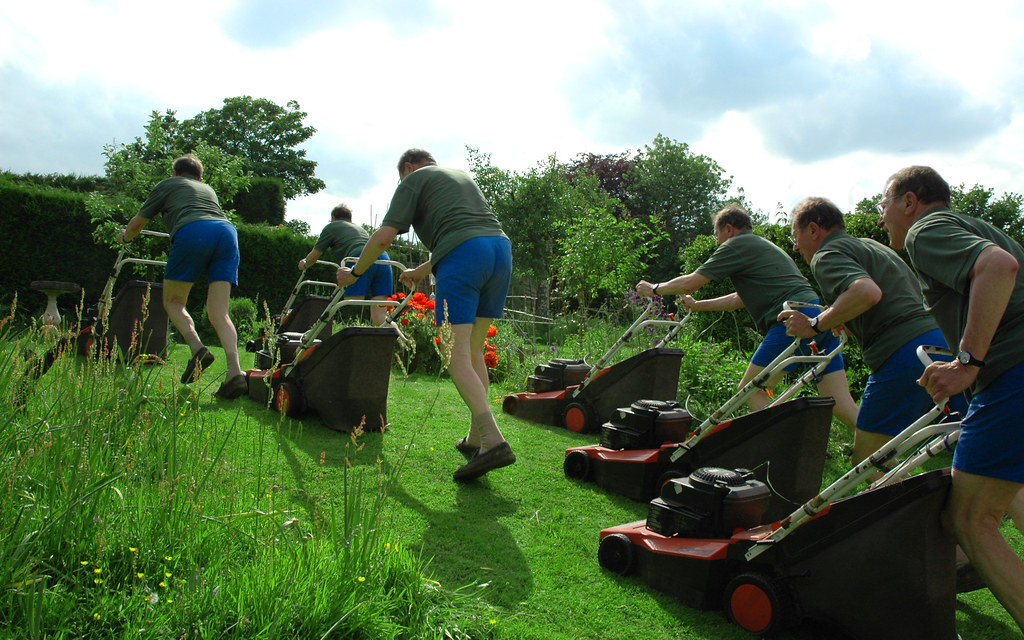
Who knew there were mowers about a foot wide which fit easily between the older tombstones? There were four mowers in this mobile crew.
There were two weed-wackers or whatever they are called. (The cords swing around and cut the weeds which the mowers miss.) There was a “task analysis” of each job.
They were trained on the job. (They didn’t practice cutting the concrete in the parking lot to get ready *smile*)
Because the job was repetitive, it was a perfect fit for many of the workers. They knew exactly what they were supposed to do, and after a short time, were independent in many parts of the job.
If any of the workers needed adaptations (shorter hours, more breaks, special gloves or boots…) these were included in their ISPs (Individual Service Plans). Therapists (Occupational Therapist, Speech/Language and Physical Therapist) were available for the initial evaluations/training, if necessary.
Establishing Routines
The supervisor would start the day with some conversation, some joking around and individual attention to each of the crew members. They would get a short break mid-morning, they brought their own bag lunch, and a mid-afternoon break. But most of the day, it was sweaty and hot and lots of hard work—serious business.
The supervisor made sure the crew members had sun-screen, hats, appropriate clothing, solid shoes (no sandals), water….
She also worked side-by-side with the workers. She made decisions to go to another section if a funeral was in progress, if the area was underwater…; she pulled weeds… and did whatever it took to make sure everyone was successful, and the finished job met the requirements of the cemetery board.
Partial Participation: How this worked for Aaron
Aaron, my son with the label of autism, does not have the skills to run a lawnmower or weed-wacker. He would not be able to be part of the mobile work crew of 6 workers who are mostly independent on the job once they are trained. Because Aaron was in the official “transition” from school to work, he was eligible for a job coach from Rehabilitation Services.
So, because he had the physical support of a job coach, Aaron had the opportunity to join the workforce.
Is there some job he could do at the cemetery? Could he partially participate in this work?
After doing an ecological assessment of the job, Kim (Aaron’s job coach) decided Aaron could pick up the sticks before the lawn mowers came. So Aaron and she would drive a golf-cart to the area where the crew was mowing, and then they would collect sticks, dead flowers, and other stuff left on the graves, put them in a trash container tied to the back of the golf-cart and then take it to the dumpsters.
Aaron loved this job. First of all, he loved Kim, the job coach. She made him feel important, she helped him when he had trouble bending over, she helped him put the sticks in the trash container, she helped him wheel the container to the dumpster. Kim, looked at every piece of the job and asked herself, “How could Aaron at least partially participate in this job?”
Plus, Aaron loved riding in the golf-cart. When Aaron did particularly well, Kim would give him an extra long ride around the large monuments.
The side benefits were Aaron made a small amount of spending money, he paid into social security, he was out in the sunshine (with lots of sunscreen) and glowed with health, he was physically strong from all the exercise, plus the emotional benefits: he knew he was contributing, he was part of a group of people who valued his work, he could make all the noises he wanted (and wouldn’t wake up the dead), he enjoyed riding in the golf cart, instead of physical therapy practicing his balance climbing steps to nowhere—he had a functional way of practicing his balance in the real world. He had a great friend and mentor in Kim. It was a terrific experience.
And, for Memorial Day, 4th of July, Veterans Day… Who was the person who put the flags on the tombstones?
It was Aaron.
Trivia too good to pass up: One of the cemetery monuments is enclosed and heated. Yes, the person who died years ago was so afraid of being “cold”–they stipulated in the will that the space above the grave would be heated (including a back-up generator in case the electricity failed.) That is a powerful “fear.”
Keep Climbing: Onward and Upward
All my best,
Mary
Comments:
Do you have any experience working with people with disabilities? Does you company use enclaves? mobile work crews? Have you ever seen a mobile work crew of workers and wondered how it worked? Is partial participation better than no participation? Should people with disabilities be allowed to work?
FOR MORE INFORMATION:
Article about Dial Soap hiring people with disabilities because it made good business sense.
Partners in Employment A FREE online course about supported employment.
Kill the Turkeys! Life lessons for people with disabilities
—
by Mary E. Ulrich | Apr 5, 2013
 photo credit: Okinawa Soba
Bulletin Board
Today and Everyday is “Stop the ‘R’ word” Day.
Parents, Advocates and Schools around the country are joining in.
Many people are always complaining that the world is too complex –there is nothing they can do.
Stop the “R” word Challenge
YOU can make a difference by choosing respectful language in your own conversations. Doable, Yea!
If you have a story, please share it in the comments.
Here are the articles I have posted on this topic as well as some information on Rosa’s Law which was passed last year to take the words “retarded” out of all public documents. This is more than just being politically correct, it is a step toward seeing people with intellectual disabilities as being “human.”
Love-not labels| Rosa’s Law
Retarded No More
The “R” word| A Challenge to Bloggers
Definitions of the word “Retarded”
Building Community| Using People First Language

Wolf Wolfensberger
Father of Normalization and Citizen Advocacy
Wolf
Wolfensberger
On February 27, 2011 Wolf Wolfensberger died.
Since 1973, Dr. Wolfensberger had been a professor in the School of Education at Syracuse University. His enormous contributions to the disability community will be felt for generations to come.
Dr. Wolfensberger was the originator of Social Role Valorization, the Normalization Principle as well as Citizen Advocacy: major concepts that strongly influenced disability policy and practice in the US and Canada.
He was widely recognized as a major contributor to the field of intellectual and developmental disabilities in the 20th century had a reputation for being a stirring and controversial speaker.
He was the author and co-author of more than 40 books and monographs, and more than 250 chapters and articles. His writing has been translated into 11 languages.
His best known books were: Changing Patterns in Residential Services for the Mentally Retarded, The Principle of Normalization, PASS, and PASSING (Evaluation tools for programs to meet the principles of Normalization).
by Mary E. Ulrich | Mar 28, 2013
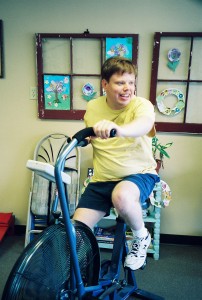
Aaron on exercise bike
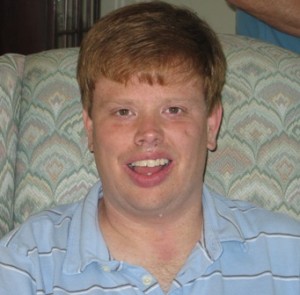
Aaron
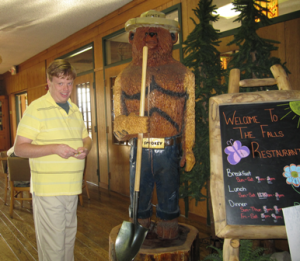
"Who are you?"
Roommate Needed in Mason, Ohio
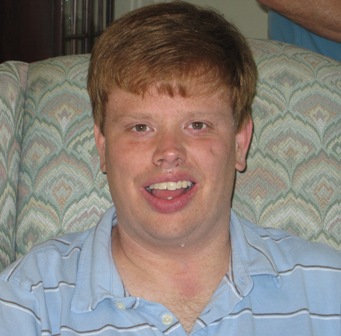
Aaron is a great guy who likes other people. He is looking for a roommate.
Aaron is 38 years old. He attended Lakota Schools and is currently in the Goodwill/Easter Seals Day Program in Lebanon.
Aaron likes to go for walks, ride the exercise bike, swim at the community center, go out to eat, listen to music, look at books, baseball cards and get involved in other inclusive activities in the community. He likes to be around other people.
He loves to go on vacations with his family and ride the trolley bus in Gatlinburg. He likes his Sunday visits with his family and playing with his niece. His family only lives a couple miles away.
Aaron doesn’t talk with many words, but he finds ways of telling everyone what he wants. He repeats phrases and is noisy which could bother some people.
The ranch house is in Mason, near a local park. It is wheelchair accessible. The home is owned and maintained by the Housing Resource Group of Resident Home, so this will be a permanent residence. Aaron has lived in a house managed by this non-profit for over 11 years and we feel they do a great job. We hope he can live here for the rest of his life.
Aaron has a level 5 Medicaid Waiver which will help pay for the 24/7 staff. He needs a roommate who is also on a waiver or private pay. We are working with our Warren County Board of Developmental Disabilities.
Anyone who has lived with other people knows the importance of finding a good roommate match. Aaron would like a new friend as well as someone who could be part of his extended family.
We would love for Aaron’s new roommate to be from the Mason community. We would love if another family would want to share all of our lives, so we could be a support to each other.
Aaron currently has staff who are loving and have known him for many years. They are part of our extended family and have hearts big enough to include another person.
If you know of someone who might be interested, please call me at 513-336-8271.
Comments:
It is difficult to describe Aaron. He is loving and wonderful, but a prospective roommate also needs to know Aaron is noisy and that might be an issue for some people with sensitivity to sounds. So, how can I give Aaron respect and dignity and yet be honest.
Aaron had the same roommate for 13 years. He and Jack are good friends and care about each other. Leaving Jack was one of the hardest parts about moving to a new county. Jack was a gentle man who was older than Aaron. They had their own hobbies and interests, but would go into the community together for shopping, large and small group activities and taking walks with their caregivers. Jack and Aaron had their own way of communicating and respected each other. We can only hope we will find someone like Jack, and as you know, everyone is unique. We ask your prayers.
Any suggestions greatly appreciated.
Keep Climbing: Onward and Upward
All my best,
Mary
by Mary E. Ulrich | Mar 22, 2013
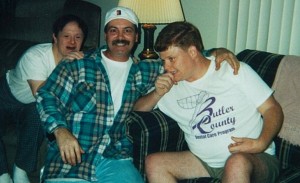
One big happy extended family
Home Sweet Home
The house is a little ranch in a quiet neighborhood. Aaron and Jack each have their own room which is decorated with their favorite things. We remodeled the back half of the garage into a room where the staff could sleep and maintain an office. Aaron and Jack need a staff person with them at all times. I’ll talk more about the staff in another post.
The guys have a HUD rent subsidy so they only have to pay one third of their income in rent. The house is owned by a non-profit agency that does the maintenance. Thanks to Aaron’s Uncle Steve, we learned about HUD and were the first people in Ohio to access this source of funds. Some day I’ll tell you all the details about the craziness of applying, it involved five people using speed-dial and having to call between 10:00 AM and 10:30 on a specific day to secure the limited vouchers. It was a group effort, and when we got the application we felt like we had won the lottery. It takes parents and other caregivers a lot of effort to keep all the funding balls in the air, but with some creativity it can work.
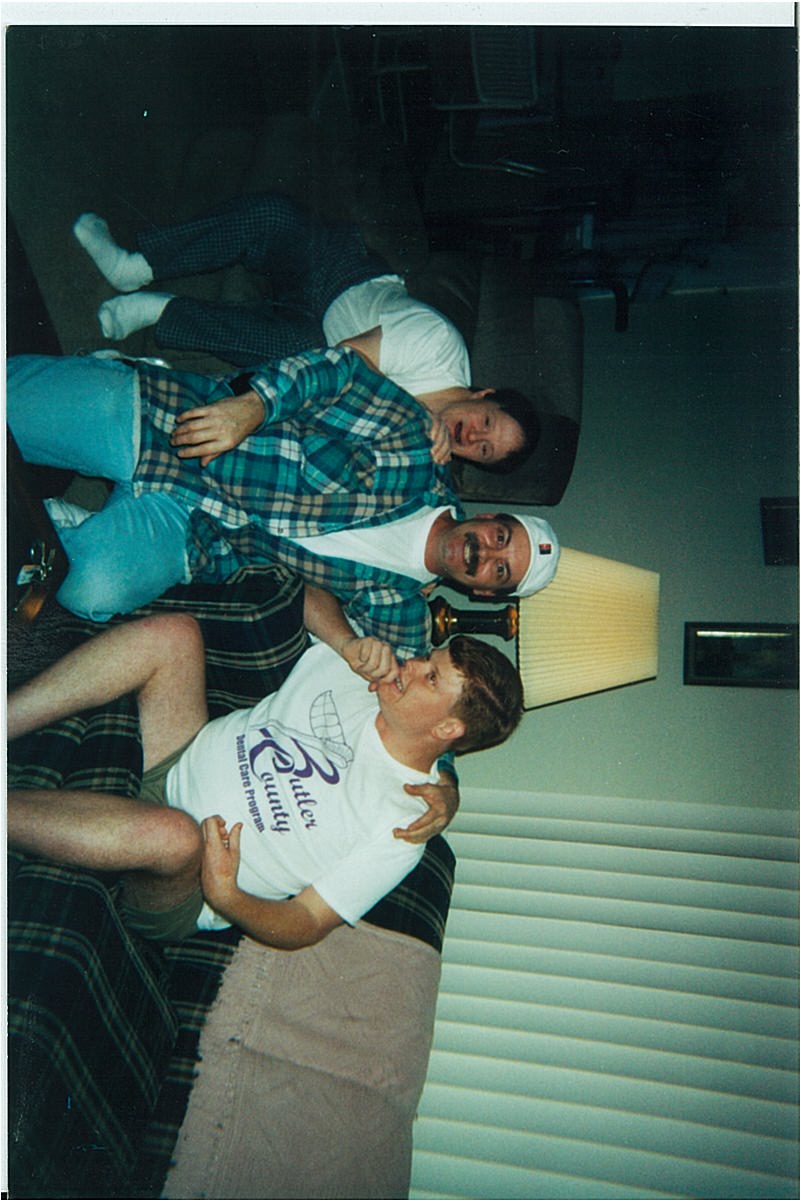
Aaron and Jack have lived together for over 11 years. Jack has Down syndrome and is in his 50s and Aaron is 35 and has the label of autism. They get along great. They just seem to know what the other person wants or needs. Jack will pick up stuff if Aaron drops it, and Aaron just seems to know when Jack wants to be alone with his videos. It is pretty remarkable that even without verbal language, they just seem to have an understanding, their own system of communication. They don’t go in each other’s rooms–even if the door is open. They know their own chair and place at the kitchen table and they each have a job around the house. Jack loves to choose and pass out different seasonal placemats (this week’s have watermelons). Aaron’s job is to clear the coffee table in the living room and water the plants.
Aaron’s makes choices
Aaron’s favorite things to do are to listen to music, go swimming, go anywhere–he likes cars, buses, trains, planes… if it moves, Aaron likes it. We bring Aaron to our house every weekend so we can be a part of his life, and to give the staff a break.
Neighborhood Welcome
When Aaron and Jack were first moving into the house, there was a huge lawsuit and neighbors across town were claiming that having people with disabilities would lower property values. Fortunately, Aaron and Jack’s neighbors have been wonderful. We planned a picnic last year for all of the people in Aaron’s day program and the family next door not only came to the party, they brought the potato salad and joined in the games. They have helped clear snow and would help in any emergency. We’ve watched the kids next door grow up and feel blessed to have them in our lives.
Update:
In November it will be two years ago since Aaron moved into a new home so he could live closer to my husband and myself. Aaron got a new residential company and new staff.
Jack stayed and got a new roommate though he did come to visit. When the residential company went bankrupt, his loving staff stayed with him for a while, but then moved on. The company that owned the house decided to sell it. So, Jack lost Aaron, his staff, his house and his security. Is it any surprise Jack’s health has suffered.
Next week, Aaron is going to try and visit Jack. There will always be a place for Jack in our hearts. He is a quiet, gentle man. There is no doubt, he and Aaron shared an important part of their lives. There is no doubt they loved each other and looked out for each other–just like a family.
Currently we are looking for a new roommate for Aaron. Jack lives in another county now, so he can’t join us. We meet a new man next week. Will he be someone who will be friends with Aaron. Can this new person be like Jack.
More later.
Keep Climbing: Onward and Upward
Mary