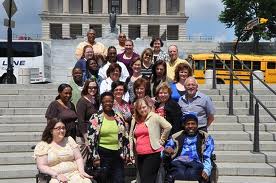
The Minnesota Governor’s Council on Developmental Disabilities (MN DD Council) does remarkable work. On this blog, I often reference the Parallels in Time(history of people with disabilities) and their Partners in Policymaking Program.
This week MNDDC announced a new FREE app called “Telling Your Story.” Already it has being downloaded around the globe.
EVERYONE has a story.
EVERYONE wants to solve their problems.
EVERYONE wants to be heard.
BUT, SOME People need extra support, skills and confidence to tell others what they want and need.
“Telling Your Story” is for Everyone
Everyone knows personal stories are the most powerful way to influence policymakers and legistlaters. Stories make the rules, regulations and policies become real.
The new “Telling Your Story” app for IPads is an organizational tool to make it easier to tell those stories.
It was created to help adults with disabilities be an active part of the democratic process and find their voice, their confidence and then–their Policymaker.
The “Telling Your Story” App is easy to use and is written for self-advocates–but mom, dad, brothers, sisters, grandparents and allies can use the same template.
The simple format helps advocates compose and practice the personal story they’ll present to elected public officials or other policymakers at all levels of government.
Some of the self-advocates learned to use this app in the Partners in Policymaking Program.
The app guides users through the steps:
–introducing yourself
–identifying the specific issue
–presenting a compelling personal story in text
–creating an audio recording to practice and rehearse their story
–selecting a photo they may wish to include
Budget Cuts| It’s Personal
Here is an example of one self-advocate’s compelling story using the new app. She is explaining how a recent budget cut affects her life and will cost the state more in the long run.
This is MY STORY:
My name is Thea Graham. I live in your district. I have been waiting all year to come to the Capitol to meet with you. I want to tell you a little about myself.
Currently, I live with my mother. She is very good to me and I love her a lot. I do know that I will not always be able to live with my mom. We have been looking at different residential support options to see what would be the best match.
I know when I move out, I will need staff to support me in using my “wise mind” since I can get upset. Staff will also need to help me with making sure that I look nice since this is very important to me. They will also need to help me drive to the doctor and help me understand what the doctor is saying about my health needs. My mom does all of this for me now.
I receive services at Merrick, Inc., a day program in Vadnais Heights. It is here that I have learned to use my “wise mind” more and more. Before I would swear, yell, and hit people when I got mad—now I use my “wise mind”. This means that I “stop, calm down, think, and come up with another solution that will help resolve the situation”. I do the following jobs at Merrick: pick up plastic recycling at the Maplewood Mall, package medical supplies, take Styrofoam from Culligen caps, and shred pull tabs. I love to make money and work like everyone else does. My job coach Kathy and “Christian” support at my job and they tell me I am doing a good job not only with jobs but how I handle things that come my way. Another thing that I like about Merrick is that I have learned to speak up for myself—doing so assertively not aggressively. Above is a picture of me running for office at a Wednesday morning self-advocacy group meeting. One of my role models is Rosa Parks and the difference she made on the lives of others. On Martin Luther King Day, I have been Rosa Parks showing her role in the bus boycott play. It makes me feel proud to be “Rosa Parks”.
I feel that I have come a long way since coming to Merrick over 13 years ago. However, my CSSA funding for Merrick was significantly cut as of January 1st.
Instead of receiving services for 5 days per week, I only have funding for 2 days. This is a huge burden on my elderly mother who now is taking care of me the 3 days I am not able to attend Merrick, Inc. My mother is not in good health and I am worried about her.
If I am sitting at home alone, I am not making money. I am not at my job where I am relied on to do my work. I am not continuing to build on my skills to cope with being frustrated and angry.
Please hear my story and know that I can’t sit at home. If I end up in crisis, it would cost the state a whole lot more than it would be maintaining my day program services. It is the proactive thing to do—it is the right thing to do.
Many children and adults with disabilities and their families are going to need technical and emotional support for using this app.
Some will not have an IPad available. Some will need coaching or help in transcribing their words onto paper. Some will need encouragement to overcome fears and answer questions.
Transition and High School Teachers:
There could be all kinds of uses for this app. especially in a Problems of Democracy class or in any advocacy or problem solving situation. I would think the format could be adapted for completing many general education projects and assignments. This could also be part of Transition or Speech Language Communication session (social stories?). Learning to use this technology and format would make an excellent IEP/ITP goal.
University Professors:
University students in Introductory to Special Education or Geriatrics, Disability Studies, social work, legal or medical professions could use this app to interview and help support a person who struggles in Making Your Caseand get their thoughts organized. This app could create cooperative learning and inclusion opportunities.
This would also be a great project for a Special Olympics Buddies, SCEC or Service Learning.
There could be research potential for all majors. Does this app empower and support vulnerable people? Does this make a difference?….
Self-Advocacy Groups:
This is a gold-mine for empowerment, self-determination, voting, citizenship and lessons on democracy. Veterans and senior citizen groups might also be interested in grants or projects for their own members.
Direct Care Workers:
I can see this being used at places of employment and leisure/recreation to help people tell their wants, needs, likes and dislikes and get a better quality of life.
What do you think?
Will this app “Telling Your Story” help children and adults with disabilities tell their own stories? Would this app make it easier for someone you care about? Do you think it is important that policymakers like school board members, county, state and national legislators hear from the people in their own voices? Tell me, will you download this app and use it?
This week I received an “incident report” from my son’s adult day program–they are the ones who take care of Aaron from 9-4 each day.
The residential staff, who prepared Aaron’s lunch, were written up for: “safety issue—undercooked pork leftovers in lunch.”
The report read:
“For the second day in a row, Aaron was sent in with pieces of pork chops that were undercooked. The insides were pink and bleeding.
Pork must be cooked all the way through or it can make you very ill. Our concern is that these are leftovers. So he was served this raw the first time.
We cooked the pork to completely done before serving it to Aaron to insure his health and safety.”
What to do?
Since Aaron is 37 years old, as his parents and guardians, over the years we have had scores of “incident reports” since he moved into a supported living home with another young man. So, no panic–but certainly there is concern. Aaron has autism and can’t speak for himself, he is totally dependent on others.
The day care staff solved the immediate health and safety issue. Thankfully, they took the extra time to cook the pork chop for Aaron’s lunch and he didn’t go hungry or get sick.
Now, the issue becomes one of communication and prevention.
How can we get everyone to work together so this and other safety and health issues don’t happen again?
Calling in the Team: Making the System Work
I called our case manager and asked her to set up a meeting to talk about pork chops, transportation, personal care and communication. The pork chop “unusual incident report” is just one of several items of concern: late arrivals, communication charts not filled out….
No one wants to go to meetings, no one wants confrontation–and everyone seems to want to point fingers.
Safety is More than Just about Cooking
It used to be illegal for one company to provide the house that Aaron rented, the residential support staff that took care of him from 4PM to 9AM and the day program staff who support him from 9AM to 4PM.
Because of current “anti-government” feelings, those restrictions were changed. Now one company can have the contracts on all three services: rent, residential and day care services–Sort of like the institutional model of old.
Fortunately, Aaron has three different companies and I think this gives him a better system of checks and balances and the day program could report the residential company and vice versa. Aaron can’t be dismissed or forced to move out if the only company decides there is a problem or the parents ask too many questions.
The real health and safety issue in this story is that Aaron, and other vulnerable people, need caring professionals who are willing to advocate for him and file incident reports and communicate problems.
Separate companies make this more feasible.
The real bleeding only happens when professionals keep quiet and don’t report problems and help make the system work.
HOLIDAY BONUS for Independence Day
Check out Mike Korins singing “Up to the Mountain” (a Martin Luther King song). He is an 18 year old man with the label of autism.
I agree with him that this song could also describe those of us living in a segregated and “special” Disability World who want to find an inclusive free world and go “Up to the Mountain.”
P.S. Yes, some people with autism can not only talk, they can sing!
Up To The Mountain (MLK Song) Lyrics
I went up to the mountain
Because you asked me to
Up over the clouds
To where the sky was blue
I could see all around me
Everywhere
I could see all around me
Everywhere
Sometimes I feel like
I’ve never been nothing but tired
And I’ll be walking
Till the day I expire
Sometimes I lay down
No more can I do
But then I go on again
Because you ask me to
Some days I look down
Afraid I will fall
And though the sun shines
I see nothing at all
Then I hear your sweet voice, oh
Oh, come and then go, come and then go
Telling me softly
You love me so
The peaceful valley
Just over the mountain
The peaceful valley
Few come to know
I may never get there
Ever in this lifetime
But sooner or later
It’s there I will go
Sooner or later
It’s there I will go
Share your thoughts:
Do you have any similiar stories? Isn’t Mike Korins terrific? Do you think there are adequate checks and balances? Should one company be allowed to do all three services (rent, residential and day supports)?
Being able to communicate is like winning the lottery.
Do you start out the day asking, “What is my purpose?”
Sometimes that question will motivate me. Sometimes it is whispered in anger or despair; sometimes as a prayer for direction. But I wonder how I would ask about my purpose in life– if I could not speak with my voice. Like most people, I take so much for granted.
How would I feel if no one ever listened or thought I had anything important to say?
Perhaps you have already seen these videos on YouTube, but they are new to me. In the comments I hope you will share what you think, did these videos communicate new ideas, new questions, rock your world, move you to actions?????
Being able to communicate is like winning the lottery.
We usually think about winning money when we think about winning the lottery. But what would be more precious than money?
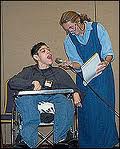
Andrew is a 13 year old young man who has the label of autism. He is communicating by pointing a pencil to a letter stencil board made by his grandfather. Andrew and his mom have been communicating this way for over 4 years. Notice how they pass the pencil as each takes a turn communicating.
Andrew: Non verbal autism + communication Part 1
Part 1: Script
Mom (M): I thought it would be interesting if you could talk a little bit about the difference that being able to communicate has impacted your life—like if you could not communicate and now that you can communicate.
Andrew (A): Yes. Now that I am using the letter board my life is having more meaning.
Since I was a little boy what I really wanted was to be treated as a normal boy
with pieces of my sensory system out of functioning.
M: Can you talk some more about that?
A: All autistics think
What is my purpose if no one thinks I can learn?
Then my mom found I am learning more… (con’t in part 2)
Part 2
Part 2: Script
A: …then she thought.
M: This is good keep going. This is really good.
A: You see all autistics have motor issues that limit their ability to communicate.
M: Keep on. You need to move your elbow, pick it up.
A: So once I had a new way to communicate
M: Keep going.
A: I felt like a kind of Lottery Winner in Life.
M: That’s a good way to put it.
A: So now I’m hoping to graduate from high school and lead a fulfilling life.
M: So, if you had any words of wisdom for parents and your teachers, what would you say?
A: See each individual as a respecting individual who deserves to have an education and live in their communities as productive citizens.
.
When I watch these videos, I am struck with how much we can learn from people with autism. The classic definition of autism talks about “difficulties in social interaction, social communication, and stereotypical behaviors.” But as Bob Williams wrote so brilliantly in his poem “What if,” maybe the difficulty in communication is our problem.
There have been many breakthroughs in communication showcased by The Wretches and Jabberers movie and new technology like the IPad and new applications.
Call to Action
My son Aaron used to type when he was in high school. Then, he graduated and his facilitator moved away and he didn’t want to type with me, his mom. But now we’re taking action. We hope to begin Aaron’s augmented communication again this month. It’s time.
We’re going to be getting an IPad and some applications. If you have any advice, let me know.
Share your thoughts:
Some people still think this is all a hoax. Some people think it is a miracle.
What do you think?
What did you think of the videos of Andrew and his mom? Do you think Andrew was really communicating? Do you think Andrew is smart? Was his mom manipulating him? Is there any person you know who might be able to better communicate with some technology?
Do you agree that the right to communicate is the most basic of human rights?
If you couldn’t talk, would you think being able to communicate was like winning the lottery?
Keep Climbing: Onward and Upward
All my best,
Mary
Giraffes teach their young to stick out their necks
“Partner in Policymaking graduates are members of the Giraffe Society–they are willing to stick their necks out.” Ed Roberts
Partners in Policymaking Celebrates 25 Years: 1987-2012
It is popular to complain, “We need to get rid of government programs–they don’t work.” But if you are a parent or person with a disability, you know you can’t do it alone. You know you need help to survive.
And, maybe the question we need to ask is: “How can I get involved and make government programs work better…for myself and others?”
If you are struggling to find services and build a network of support for yourself or your young child, I highly recommend Partners in Policymaking. It is the best resource I know.
Partners in Policymaking is a program that not only works–it teaches parents, self-advocates and policymakers HOW to make government programs work.
In 1987, Dr. Colleen Wieck of the Minnesota Governor’s Developmental Disabilities Planning Council created Partners in Policymaking.
For 25 years the goal is still to create a win-win partnership between people who need and use services and the people who make public policy.
With 21,000 Partners in Policymaking graduates in the United States, and 2,000 Partners graduates internationally, parents, self-advocates and policymakers are changing the world.
Why Partners?
Partners is designed for adults with disabilities and families of young children, but some programs expand that target group.
The goal of Partners is to teach “best practices” and the skills necessary to “change systems.”
State-of-the-art information gives Partners the big picture, allows them to dream big, and gives them strategies to turn their dreams into reality.
Partners participants become competent to change their own lives, and then to work for changes that will affect others with disabilities at local, state, and national levels. Partners graduates are expected to be agents of long term change. They learn there are no “quick fixes.” They are trained to achieve long term successes.
Who are the “Policymakers”?
Policymakers are the people in government who are elected or appointed to make decisions about rules, regulations and resources. They legislate on school boards, city councils, county and state agencies and governments, federal congressional legislators, and others who shape disability issues at all levels of government.
Some Partners graduates have become elected and appointed public officials.
Partners in Policymaking is the Instruction Book
How many times have you heard parents wish, “If only I had an instruction book”?
Partners in Policymaking IS the instruction Book.
Here is a video that explains the facts about the Partner’s Program from the United Kingdom.
.
Texas, 20 Years of Partners in Policymaking (2006) “It is the Power of the Dream that brings us here.” (You will love this song.)
New Classes Forming Now: The Power of the Dream
Find the Partners contact person for your state/country.
Find out the target audience for the Partners Course and if you are eligible–sign up.
If you are not eligible, see if you can still be part of the Partners network.
Everyone can take the online courses.
Here is the Homepage for the Partners in Policymaking Website. You can find contact information for where you live, you can find online courses, you can find Parallels in Time: A History of People with Disabilities and a wealth of other resources. But most importantly, you will be able to network with others who are sharing your journey.
Any success stories about Partners? Any success stories about partnerships between advocacy groups and local leaders? Does this sound like a good idea? Who would you suggest for speakers on state-of-the-art? Do you think the power of the dream can bring people together?