Is it to give Mom and Dad a rest? Or someplace for the kids to go while she/he works?
Is it only to learn to read and write?
When our country was founded, education was generally for the male children of rich property owners. They were to prepare to become businessmen and the governors of the lower classes.
Jeffersonian Philosophy of Education
Is the reason we go to school the Jeffersonian concept that a democracy depends upon an educated population?
This philosophy teaches we need to learn so we can become knowledgeable voters, dedicated citizens and choose wise leaders who govern for the common good.
This makes sense to me, but if you listen to many of the current politicians and public media personalities they seem to suggest the purpose of the school is to teach everyone to think the same way?
Their way.
And if you don’t, they will pull their children out of public school and either home school or put them in private schools where they can control the curriculum and the way people think.
They seem to think this is protecting their children from harm—these strange people and ideas would hurt their children.
But what about people who are different, including people with disabilities?
Measure of a Society
“The true measure of a society is how it treats its most vulnerable citizens.”
So, is part of the reason we go to school to learn how to live with society’s “most vulnerable citizens”? To learn about how we can all share the resources and problems of our common society?
To learn to care about others?
To learn to see strength in diversity?
To prepare ourselves and others to become one of those “most vulnerable citizens”?
Is the American school still the great melting pot that gives us all a common experience? and sees value in our diversity?
If everyday ALL children go to the same schools, get to know each other on a personal level, share time on the playground and lunchroom and bus and in the classrooms–there are valuable lessons in just being together with people who are different than we are.
And maybe one of the lessons is–we are not so different–inside we are the same.
What do the history books say?
In the late 90s, I was teaching education majors who wanted to be teachers.
I took my Introduction to Exceptionalities classes to our university library which had a collection of textbooks being used in classrooms all over the country.
Their assignment was to examine one of the high school textbooks in American History, Problems in Democracy or World Histories and look for pictures or references to people with disabilities. Many of these college sophomores were able to find the same textbooks they used when they were in high school.
Out of the 20 different textbooks they evaluated, no textbook had more than four references to anything about disabilities.
The references, in a sentence or two, referred to:
Helen Keller was deaf and blind and traveled in the Wild West Show, President Roosevelt used a wheelchair, and the American with Disabilities Act passed in 1990. In several of the textbooks, an additional reference said, “deinstitutionalization caused many people who were mentally ill to become homeless” with a picture showing a man sleeping on a park bench. That was it! And the last message was not positive.
People with Disabilities are often Invisible People
People with disabilities have been basically excluded and invisible in the traditional curriculum.
In a culture that asks its children to “not stare,” and “beware of strangers” we have taught our children to ignore and avoid people with disabilities. Many churches only teach about praying for miracle cures and giving charity and alms to the “handicapped” (word from “cap in hand”). So, though there has been some progresss, it is not surprising our textbooks still avoid the whole conversation of disabilities and differences.
The increase in college “Disabilities Studies” majors and minors across the country is a strong beginning and step in the right direction. Kudos to those who are pioneers in this new movement. The recent Tribute to Ed Roberts is an example of people who care recognizing the contributions of great Americans to the freedom and inclusion of all.
Yet, I would bet if we repeated this textbook assignment today in 2013, there would still be a scarcity to references about people with disabilities and of all minorities; though I think the textbook companies are responding to some of the criticism.
What is the purpose of education?
So besides becoming informed citizens, what is the purpose of education, except to prepare each of us in the attitudes, vocational, domestic, community, and leisure skills we need to function successfully the 50-60-70 years of the rest of our lives?
How can we learn to make choices? To learn to ask questions? To learn to solve problems? To learn to work and live together? To learn about ourselves, our ways of making sense of the world? To learn about diversity?
Would our government officials act differently if they followed Thomas Jefferson’s ideas on education? If they went to school with people who had disabilities or had differences?
Schools and Parents
One teacher, one therapist may be great for a year or two but professionals come and go. The parent is the constant in a child’s life. We know our children the best and are the experts on our child’s likes and dislikes, their learning styles and behavior in the home and community. We know our child’s history better than any psychological profile that sits in the school office. We know our child is more than the words on their Individualized Education Plan (IEP).
Our role as parent is a difficult one because we represent the continuity of our child’s life. We know their past, we are part of their journey. But are we willing to risk our children learning about diversity and differences?
There are many parents of children with disabilities who are afraid, it is understandable, but will that fear hurt our children and the next generation of citizens.
We know our neighbors, our community, the life our child has outside of school. Check out related story: A new year of learning. We can share our child’s dreams for the future and help them to come true.
Each day parents are challenged as “care managers” to insure cooperation and creativity among those who provide service to our children.
Each day, as our children climb on the school bus, they are a step closer to being adults. They step on the magical bus into their future and the future of our country.
Each day, we must ask ourselves: “Are the skills they are learning going to prepare them to become productive adults, caring and responsible citizens?”
Magic Bus Ride?
The school year is a precious opportunity for new growth. An opportunity to forget the hurts of the past, no matter how difficult. A new school year is a fresh start.
Build that future dream with much hope and picture the magic bus that can take you and your child into a year of wonder, new adventures and new learning in a land of diversity. We learn from our children and they learn from us, and that is also magic.
Wishing you a great year full of magic.
Comments:
When you were in school, how did you learn about people with disabilities, differences? Do you think there are things to be learned by sharing your lunch with someone who doesn’t talk with words? With someone who uses a communication board to talk? With a classmate who learns differently? With a friend who just happens to have a label of disability?
There are many legends around the origins of the Olympics. But the main idea was countries and individuals would meet every 4 years and set aside conflicts–and this shared experience would lead toward greater understanding and fewer conflicts.
Many believe the ancient Olympic games began with a foot race.
The 2012 Olympics were held in London, England. And, a footrace is not so simple. It turns out, the definition of a “foot” became a source of controversy.
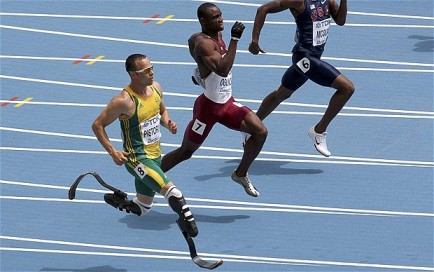
Even with later personal tragedy, The Olympics story of Oscar Pistorius from South Africa is an inspirational lesson about the inclusion of people with disabilities.
Check out this video, “The fastest man with no legs” who uses his “blade runners” to race in the finals of the Olympics.
Yes, he races in the segregated Paralympics, but also in the inclusive regular Olympics.
This is an example of inclusion, self-advocacy, the power of a supportive family and an exceptional adult with disabilities.
I think this is also an excellent example of what the Olympic Spirit is all about. The Greek founders might never have envisioned this sort of story, but I’ll bet they were cheering up on Mount Olympus as Oscar became one of the fastest runners in the world.
“Unfair Advantage?”
If you have feet, you have tendons and muscles which give a “spring” to your step.
If you don’t have feet, you … what—sit at home? OR…
You have the choice of a segregated Special Olympics or a Parolympics event.
As Dennis Burger says, “I always think it’s ironic when officials claim an unfair advantage by a guy with a prosthetic device. Go Oscar!”
Why is it that those of us who would never spend 10 seconds playing or watching ping pong, or skeet shooting, or footraces… voluntarily devote our precious time to these events on TV?
Why is it we choose to root for one team or one person?
With all the important events happening in the world, why would the evening news start out with the country’s Olympic medal count?
What is the magic that draws our attention?
I think the answer has to do with the concepts of “Us” and “Them.” The answer is rooted in our deep psychological need to belong.
We can wonder about the concepts of nationalism but like it or not, we are part of a tribe, a nation, we are part of “Us.”
And when the collected ego of our nation wins, we win.
So we say, “Go USA” or “Go England” or “Go Canada” when we really don’t care one bit about archery or who can do the backstroke.
The Need to Belong
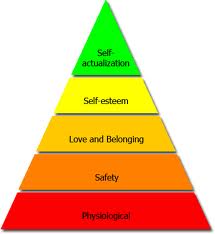
In Maslow’s famous “hierarchy of needs” belonging and having people who care about you is critical to survival–more important than how many skills you have or self-actualization. Sometimes this means being part of a tribe, sometimes being part of a family, sometimes part of a church, school or … nation.
Or, sometimes sharing a bond with someone with a disability.
So when we hear about a runner who uses blades because he has no feet, or a woman who only has one hand and is a table tennis champion—suddenly we care about them.
We drop our nationalism and transfer all our goodwill to these courageous individuals because they have a disability and are part of our TEAM INCLUSION. We don’t know them personally, we aren’t a part of their country, but they are part of our heart.
They prove that all our daily advocacy efforts are worth it. That the dream of inclusion can be real.
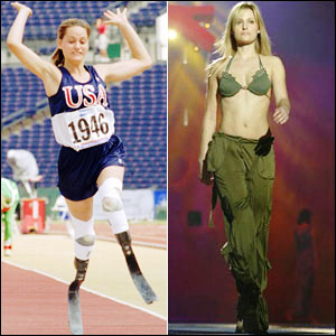
TED is for the “thought leaders” of our generation. I’m so glad Aimee Mullins stood up in front of the world and talked about the words we use, the way we tell stories, our prejudices about people with disabilities, and our ability to change and influence lives.
I’m thrilled she is beautiful, an accomplished athlete, and can deliver a message with the best communicators in the world. Chalk one up for our side. Aimee, you did us proud.
Language
The definitions struck me. Yes, even in 2010 the words “disability” and “handicap” carry such derogatory connotations. Every time I hear the traffic report and they say, “There’s a disabled blocking the west lane” I just cringe.
I recently spent some time looking up the words: “retarded, moron, idiot, and imbecile” and their histories (click here for related articles).
I particularly liked Aimee’s references to Darwin. Our ability to adapt, change, and transform determines the “survival of the fittest”.
Inclusion is our “survival of the fittest.”
This is why I believe in inclusion I agree it means the difference between survival and a decent quality of life. (related article).
Inclusion is about adapting, changing and transforming. It is about blending into the normal population the same way animals learn to camouflage themselves into their environments
My takeaway moment was when the medical doctor said she was an example of the “X” factor.
WE ARE THE X FACTOR.
If you are interested in my take on the differences between the label of “disability” and “handicapped” (click here). I would love to be able to pass this information on to Aimee. Perhaps it might help.
Many people have a hard time understanding the concepts of independence vs. interdependence, inclusion, multiple intelligences and cooperative learning. I thought a revision of The Animal School by George Reavis might explain it all.*
THE ANIMAL SCHOOL
Once upon a time the animals got together and decided to start a school.
The parents and teachers wanted to make everything FAIR, so they decided ALL the animals would take ALL the subjects. No exceptions.
The curriculum consisted of classes in swimming, running, flying and climbing. Each student would need a grade of C to pass. There would be a competition to see who could get the best grades.
DUCK
Doug the duck was excellent in swimming, in fact, better than his instructor. But Doug made only passing grades in flying and was getting Fs in running and climbing.
At a team meeting, it was decided he needed to drop swimming and take remedial classes to practice running.
This continued until Doug the duck’s webbed feet were badly worn and he was only average in swimming.
But average, or C, was acceptable in school, so nobody worried about that—except Doug and his family.
RABBIT
Rene the Rabbit started at the top of her class in running. But she soon had a nervous breakdown because she was failing in climbing and the others made fun of her in flying and swimming classes. She passed the standardized tests but the last day of class she buried her books and said she would drop out.
SQUIRREL
Sam the Squirrel was excellent in running and climbing. He also had high marks in flying until the teacher read a research study that said everything should be taught from the ground-up, not the tree-top down.
EAGLE
Edward the eagle was the problem child. He bit the other animals in running class. He perseverated on flying. In the climbing class he insisted on using his own way to get to the top of the tree. After several discipline meetings, it was decided his diving into the river for fish would count as swimming credit. He was considered a loner with no friends. “He just keeps flying off,” the teachers complained and suggested he be put in special education.
CHIPMUNKS
The chipmunks were excluded from school because they could not pass the prerequisite swimming tests. They protested and demanded digging and burrowing be added to the curriculum. This caused hot debate among the parents and students. The rabbits and squirrels thought digging and burrowing should replace swimming. The ducks thought there should be better discipline and a subject on following the leader.
Conclusion:
Even though he got a D in flying, one frog won the student competition and was valedictorian. All the students and their families were unhappy.
Further, the chipmunks boycotted school board meetings and joined the groundhogs and snakes to start a charter school.
Once upon a time the animals got together and decided to start a school.
The parents and teachers agreed that if the purpose of school is to learn the skills required AFTER graduation, then the students needed a course called “Survival 101.” The school would be at the pond, because that was where they lived.
The school board announced, “Our common survival depends on learning to live interdependently in our community. Lessons need to be differentiated according to each student’s learning styles, gifts and talents.”
The parents and teachers wanted to make everything FAIR, so they decided ALL the animals would have Individualized Education Plans with curriculum goals and objectives.
The teaching methods would be functional activity-based projects which stressed cooperation and problem solving. “Safety at the pond,” was the thematic unit.
There would be individual goals and objectives and each student would work hard, improve on the skills they have, and contribute their talents and strengths to the group project. The stress would be on cooperation and interdependence, rather than competition and independence. There would be no bullying or fighting.
DUCK
Doug the duck was excellent in swimming, in fact, better than his instructor. Duck was also gifted at getting animals to follow in line.
At a team meeting, it was decided Doug would help supervise all water activities and be the project manager. Doug the duck was excited to be given leadership activities. His goals were: to improve his dive, his endurance swimming across the lake; his life-saving safety skills; and, learn to give specific directions to get the younger ducks in a row.
RABBIT
Rene the Rabbit was a great runner and jumper. Since she was close to the ground, she was in charge of everything on the earth’s surface. She would learn to: identify animal tracks, and, alert squirrel if needed. Because Rene was worried she wouldn’t be able to do her best job, Eagle offered to mentor her.
SQUIRREL
Sam the Squirrel was excellent in running and climbing. He volunteered to be the lookout and guardian of the trees and wildlife. His goals were to develop safety plans in case of danger. He would run messages, organize safety drills and practice his alarm calls. To help Sam learn to stay on task, he would also be the time keeper at all meetings.
EAGLE
Edward the eagle was excited he could fly. Doug the duck, the project manager, asked him to survey the pond from the air. He wanted Edward to use his “eagle eyes” to scout for trouble, trespassers, pollution, and any animals in trouble. Eagle’s short term goals would be to learn about weather, air pressure, rain and wind.
CHIPMUNKS
The chipmunks, snakes and groundhogs were welcomed in the school. They became a part of the community. They gave digging and burrowing tips to squirrel and rabbit. When a fallen tree threatened to block the water flow, they helped dig a channel.
Conclusion:
In the course of the year, Doug the duck saved squirrel when he almost drowned. Eagle saved Duck when he got caught in the ice and almost froze. Rene got enough confidence that she wants to be the project director next time. Sam raised the alarm when a group of Girl Scouts came camping and thought it would be fun to catch animals and dress them in hats.
Because all the animals cooperated and learned together, their pond community was a happy and safe place, each animal was respected and valued for their contribution, and, everything was FAIR.
Instead of one standardized test or grades, each animal had gifts, they all survived, learned new skills, made new friends, and could celebrate the true nature of community: interdependence and inclusion.
Does this fable have a moral?
Keep Climbing: Onward and Upward
All my best,
Mary
Please add your comments:
Do you know any Dougs, Renes, Sams or Edwards?
Do you know any students who are excluded and asked to go elsewhere? Are the students treated like individuals? Is the curriculum differentiated? Does everyone feel happy, safe and like valuable members of the community? Are students encouraged to build on their strengths and talents or does everyone have to learn the same things in the same ways? Are the students learning skills that will help them in Survival 101 after graduation?
*Like my husband, George Reavis taught in Cincinnati Public Schools. The original The Animal School was published around 1940 in The Public School Bulletin long before inclusion was even a dream–or was it?