What do you do when someone wants to cure your child with Lourdes Water or the “laying on of the hands”?
True Story
“Where’s Aaron?” my mother asked while I was still putting the phone to my ear. I explained Aaron was at his house and we wouldn’t be seeing him until the weekend.
“Well, as soon as you pick him up, you need to bring him here. My friend got holy water directly from the fountain of Lourdes and she gave me a small bottle.”
I took a deep breath and knew exactly where this conversation was going. My youth was filled with The Song of Bernadette and books of Saints and miracles.
With more enthusiasm than I’ve heard from my mother in years, she said, “I’ll make the sign of the cross on his forehead and we’ll see if we can cure his autism and disabilities.”
I hesitated and didn’t say anything, but mom gushed about her friend’s trip, the history of Lourdes, photos of the shrine, and the walls of abandoned crutches each with written testimonials and pictures from the people who were miraculously cured.
My mom was eager to start her letter of Aaron’s miracle.
So, What do I say:
1. Mom means well. Her religion is important to her. She would love to be the one to “cure Aaron.”
2. This isn’t the first time this has happened. I’ve had strangers in the grocery line want to “lay hands on Aaron and cure him.”
3. I really don’t want to go down this road again.
So, what to do?
In the comments please share your thoughts.
Comments
Remember there are no “right or wrong” answers. Please share your thoughts. What would you say to my mother or another person who wanted to try and cure your child? Would you allow her to use the holy water on your child? What attitudes and messages does this convey for the individual, the family, the church, the culture?
Have you tried any miracle cures? If you don’t want a cure, what does that say?
When Marsha Forest, Judith Snow, Jack Pearpoint and Father Pat started spreading the gospel of inclusion, they talked about the ABC’s Of Inclusion.
A = Acceptance
B = Belonging
C = Community
I’ve spent a lifetime learning and working for inclusion for Aaron, my son with the label of autism, and other people with disabilities.
But as hard as it is to create inclusion for Aaron, it is also just as difficult for parents to have inclusive experiences. Moms, Dads and Family Members are always being segregated into “special” groups… Special Olympics, Autism Speaks, Arc, TASH….
My Circle of Friends
Inclusion for Moms
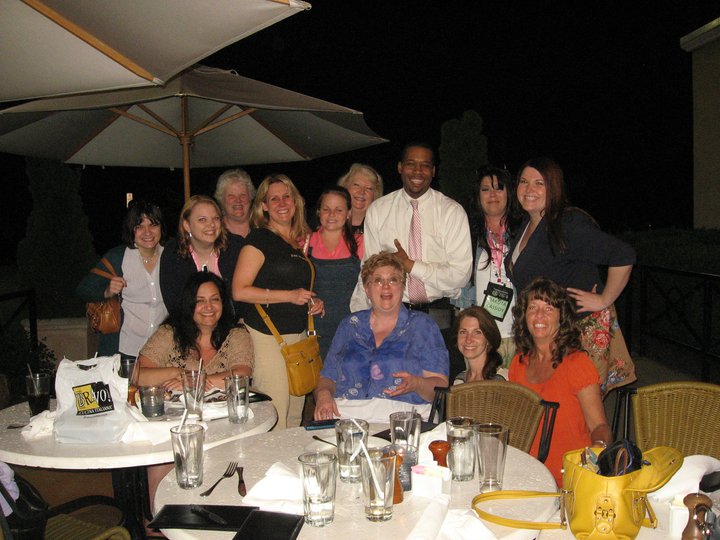
Four years ago, I stumbled across an ad in our community newspaper about the Lori Foster Gathering for Readers and Writers. The “Gathering” was at a nearby Marriott Hotel and looked interesting. Plus, it had NOTHING to do with disability issues.
It became a transformational experience in inclusion–NOT for Aaron, NOT for Aaron’s mom, but for me.
ACCEPTANCE
Over 300 authors and readers of romance novels were gathered around tables in the conference room. Decorated baskets were being raffled and authors signed their books. Books were everywhere.
Many of the women were in costumes that corresponded with the themes of their books. They wore cat ears and tails, fairy wings, Victorian hats and jewelry, pirate and cowboy hats, wedding veils, capes, Hawaiian flowers in their hair… They were young mothers and white hair grandmothers. They were unpublished and New York Time bestselling authors.
I learned “romance” novels ranged from: sweet to exotic; contemporary to historical; “All-American” to English royals to Scottish highlanders to space aliens to vampires; time-travel, mystery, suspense and even inspirational tales of the Amish…. Who knew?
Hey, I guess if these women could dream up relationships with werewolves and fairies, they could accept anyone—even a plain old mom who’s got a kid who isn’t “normal.”
I was accepted.
BELONGING
In the first couple minutes, I was embraced as an old friend. It was that easy. I sat down and was welcomed into the group.
I didn’t have to join a committee, volunteer or sign any oaths of allegiance. I was okay just the way I was.
Some authors published several books a year. Several published none, but bought and read books—thus supporting everyone as loyal fans. There was a continuum and only support–no competition.
In “disability” conferences, there was stress. I was always looking for help for the current disaster in Aaron’s life.
There was always a pending national crisis: Special Education was losing funding; someone just died a tragic death in an “institution”; an amicus brief had to be written for an innocent person on death row; signatures were needed for some campaign or new legislation; some non-profit was going bankrupt…. There were always a hundred heartaches. Sure, there were people who supported each other—but they were often just keeping their heads above water.
SHARED INTERESTS
One of the requirements of making friends and community connections is about “shared interests.”
The women at my table shared stories of their favorite authors and books. They pointed out Lori Foster and Dianne Castell, the organizers. They gave me books from the “trading library.”
There were national issues about publishing, I met a woman who had been kicked out of the national RWA organization ten years ago because she wrote an “ebook” when only print books were considered legitimate. Changing paradigms is difficult, leaders struggle in every field.
But, there were no tears or gut-wrenching stories with no solutions. As the authors spoke of their writing, they added information about their family lives in Canada, Texas, California, Vermont or where they lived, but they were happy people. They had the usual family dramas, but that was not the focus of why they were in Cincinnati. Several people had family members with labels and disabilities, but the conversation was about writing and publishing–not a single IEP issue.
And, I belonged.
COMMUNITY
Proximity
People being together in the same place is another requirement for making friends and community connections.
The members invited me to join The Ohio Valley Romance Writers of America (OVRWA) chapter which met the second Saturday of each month. This became the highlight of each month. Each meeting had veteran writers giving clinics and informational sessions on branding, plot development, submission guidelines…. Though we socialized after, this was a serious professional group of writers. Some were stay-at-home mothers of young children, but there were lawyers, college professors, nurses, teachers…. Sometimes we would meet for a “Girls Night Out” or go out after the meetings.
Nothing against the “Mothers of Special Children” or the “Lakota Parents of Special Education Students” groups, but this was the closest to “normal” I’d ever experienced.
Sisters of the Heart
I thought of true stories of friends and relatives meeting their spouses, and decided to try my hand as a romance writer. What a joy to be thinking about happy stories, rather than writing about the autism wars or inclusion battles.
I started to learn everything I could about writing and publishing. I entered and judged contests, went to a writer’s conference in Columbus, local workshops. I was getting new skills…and new friends.
When I went to the Lori Foster Gathering the next year, I was an editor of a small e-publisher and had close friends in the Ohio Valley Chapter.
It was the first time in my life I was included, and it had nothing to do with disabilities. I was a person-first. Imagine.
I want a Happy-Ever-After
Last weekend was my fourth Lori Foster Gathering. There were 400 people from all over the continent. Proceeds from the basket raffles went to soldiers in Afghanistan, a pet shelter, and a local non-profit. We raised around $10,000.
And, we had a ball.
I laughed and cried. I talked about books, authors and only occasionally about Aaron. I actually went out to a restaurant and didn’t get home until almost midnight. I relaxed.
Many of my friends are now published authors. I’ve watched them grow and bloom. I’m so proud of them.
My core group of friends encourages me in my own writing and in my life as Aaron’s mom. They know some of Aaron’s story and our continued struggle as we try to find a home for Aaron, try to figure out the government regulations and funding. They read my blog (hi everyone) and are my biggest supporters as they retweet and spread the message on social media networks. Their questions help guide the information I give. We “inclusionists” often only talk among ourselves–what an irony. They help me spread the real message of inclusion to just good folks who live in our communities.
They are friends… and in the process have become sisters of my heart.
After all, “my people” know about more than just romance. They know about love.
They know the A, B, Cs. They may not be able to give a definition, but they know about inclusion.
They might call themselves writers, but they are also healers and teachers who are helping me find the land of “happy-ever-after.”
Keep Climbing: Onward and Upward
All my best,
Mary
Join in the discussion
What do you do to “include” yourself in the community? Are you a member of any social groups…? Do you agree parents and professionals often segregate and isolate themselves in the struggle for inclusion? Have you read any good “happy-ever-after” stories lately? Will our children with autism and other disabilities also find “happy-ever-afters”?
It stood majestically with its head tilted upward and its slender white body contrasting with the green of the newly planted tomato plants.
The bird looked around for a long minute, and then flew away.
Wait! An egret? This isn’t Florida or South Carolina. The ocean is a thousand miles away.
It got me thinking:
How did an egret end up in our garden? Was there a transportation glitch? Will s/he be back tomorrow? Does an egret worry? How does s/he solve problems?
Thinking, Worrying and ACTION
Like many parents of people with disabilities, I spend most of my days trying to see the world from my son Aaron’s point of view.
Thinking and trying to problem solve;
Worrying I won’t find an answer in time to help Aaron.
Now, I don’t stop there.
After my thinking and worrying,
I take ACTIONS to solve the problems, one step at a time.
This is a full time job. One I didn’t want, one I didn’t plan for, one I have to do every day.
Last week’s problem: Aaron’s 3.5 hour daily Van Ride.
Thinking and Worrying:
Will Aaron have a 90 minute ride today (the legal limit for one way)?
Or, will he and the other 5 people have to sit in the van and wait (and the van ride will actually be 110 minutes) because the staff is too irresponsible to open the doors on time?
Will Aaron chew the collar on his shirt to shreds in the 90-110 van ride? (I have had to buy him a new coat each of the last 3 weeks, he was actually spitting out the metal zipper pieces on one coat.)
Will he bite his hand and draw blood while he is frustrated?
Will he have to go to the bathroom? Have an accident? Get constipated because he is holding it for the 4 hours a day he spends in the van?
Will the van driver sing to him if he starts to get agitated? Will the van driver write Aaron up as a behavior problem?
Will the other people in the van get upset?
Will it be too hot in the van? Too cold?
Last week’s immediate ACTION
Ecological Inventory
I comfort myself that Aaron likes van rides, and Bruce, the van driver, seems to care about him.
After I had my thoughts together, I checked the documentation on the pick-ups/delivery times (the daily chart/notebook I wrote into the ISP), analyzed Aaron’s van behaviors, talked with the staff at both Aaron’s house and day program, made several phone calls, wrote a couple emails about the problem, found out a couple key people were on vacation, make a couple more phone calls….
Immediate Solutions I hoping for:
1. The staff of the day hab center (drop off point) now open their doors on time–removing the extra 15 minute wait time.
2. The van is repaired (storm damage) for our new Goodwill/Easter Seals program and available to pick up Aaron.
3. Aaron won’t have to be on the other van at all with the 5 other people.
4. Aaron will get a direct route to his new program which is 21 miles away, reducing his 4 hour daily ride to 2 hours.
“For every action there is a reaction.”
Long Term Solutions for the Transportation Problem
In the next few weeks, I’m hoping the van for the Goodwill/Easter Seals program is repaired from storm damage and will transport Aaron.
I know the never-ending cycle of thinking-worrying-actions will repeat:
Will the new van driver be as good as Bruce? Will s/he care about Aaron?
Since Aaron and his housemate will be taking different vans, the residential staff will have two different pick-up/drop-off times. They don’t have autism, but they don’t do well with change. (Little humor there.)
A shorter van ride for Aaron means the home staff will have to adjust their work schedules and add an extra half hour in the morning and evening. They will see this as Aaron messing with their day. Since they get paid by the shift, not hour—no extra pay, just an extra hour of responsibility.
I know, I know… I can hear many of you saying: “They work for Aaron, they should do what is best for him.” And, you are right. That is the bottom line and the reason Aaron will have the more direct, shorter route. But that doesn’t mean they will like it, or do it with a smile.
Short-term and Long-term Problems
Each day, I work a little on the long-term solution to Aaron’s residential staff issues. Some problems can be addressed in a week, unfortunately, others take years.
And, while I can pull a Scarlett O’Hara and say, “I’ll think about that tomorrow.” My child is waiting for me to fix this.
If I don’t do it, no one will do it.
A Parent’s Life:
I’m writing this because I want to believe the egret was a “sign.”
I want to think the wonder of the unexpected, the unusual, the beautiful will help me focus on the good, so I can stop thinking and worrying about Aaron and the bad things that still need action.
Live for Today
I tell myself—quit thinking and worrying. Just enjoy! Just remember the sight of this regal bird and the unexpected pleasure it brought.
I remind myself–that’s enough thinking and worrying today. Get a cup of tea; take a bath; read a book with a happy-ever-after …and thank God for an egret.
Because even after you finish your thinking and worrying about the transportation issue, there is still the issue that one of the staff people doesn’t give Aaron a bath every night…and the million of other issues that need action.
There will ALWAYS be more battles to fight.
There will not always be more days to just enjoy life.
Maybe my advocacy actions will give Aaron a shorter, safer ride to his day program. And maybe I’ll be able to chip away at the residential problems, and maybe Aaron will get a bath tonight.
I can’t fly away like the egret.
But, maybe today I can stop thinking and worrying–at least for a few moments. And maybe that is the exact ACTION I need.
Your Turn:
In the comments tell us: What are you thinking about? Do you wish you could fly away from your problems? Have you seen something today that was unexpected and brought joy? Do you think and worry? Or, do you think, worry and–take action?
Keep Climbing: Onward and Upward.
All my best,
Mary
Quote: “You can always tell a mother. She’s the one who wears her heart on the outside of her body.”
Disability Advocates Arrested over Budget Cuts in Medicaid
For those of us who care about people having the choice to live in the community and not in nursing homes, ADAPT members are marching and being arrested for all of us. See related story
Disability Law Handbook – Available in English and Spanish
The Disability Law Handbook is written in FAQ format and answers questions about the ADA, the ADA Amendments Act, the Rehabilitation Act, Social Security, the Air Carrier Access Act, the Individuals with Disabilities Education Act, the Civil Rights of Institutionalized Persons Act, and the Fair Housing Act Amendments.
If the term “reasonable doubt” means anything, Richard Lapointe should get a new trial. The meek, uncoordinated, mentally handicapped Manchester man was convicted of a violent crime he may not even have been able to commit, based on confessions of highly dubious merit.
But his efforts to have his case retried suffered another setback Friday when Superior Court Judge John J. Nazzaro rejected arguments that prosecutors had withheld important evidence, that Lapointe’s trial and appellate lawyers were incompetent and that new evidence proved Mr. Lapointe was innocent.
It can’t end here. The Lapointe case has seriously shaken confidence in the state’s criminal justice system. Officials should take a step to restore that trust, and that is to run tests on the other major suspect in the case.
Coerced Confession?
Mr. Lapointe was convicted in 1992 of the brutal rape and murder of his wife’s grandmother, 88-year-old Bernice Martin, in 1987. He wasn’t arrested until 1989; police were first interested in another suspect, a grisly career criminal named Frederick Rodney Merrill. But Merrill was eventually dropped as a suspect, at least in part because his blood type didn’t match a blood and a semen stain at the scene.
Mr. Lapointe, a dishwasher with no history of violent behavior, had been asking Manchester police officers about the case, and eventually drew their suspicion. On the Fourth of July in 1989, the police asked Mr. Lapointe to come down to headquarters and kept him there for more than nine hours. He didn’t have a lawyer and the session was not electronically recorded. Over the course of the evening Mr. Lapointe gave three confessions that were either nonsensical or didn’t jibe in major detail — how Mrs. Martin was dressed, how she was sexually assaulted, how she was strangled — with how experts later said the crime was actually committed.
Yet jury members said after the 1992 trial that it was the confessions that convinced them of Mr. Lapointe’s guilt. Since 1992, much has been learned about false or induced confessions; they happen with alarming frequency. Mr. Lapointe, alone and tired, said he told police what they wanted to hear so he could go to the bathroom and go home.
Tantalizing Evidence
Whoever killed Mrs. Martin was physically strong. He violently assaulted, tied up, raped and stabbed a woman who was short and weighed at least 160 pounds. Mr. Lapointe can barely tie his shoes, and has trouble lifting heavy objects. He has to keep checking and adjusting a shunt tube that extends from his skull through his neck and into his stomach that drains fluid from his cranial cavity, a result of his mental condition, called Dandy-Walker syndrome. But if he didn’t commit the crime, who did?
There is tantalizing evidence that Manchester police had the right man the first time.
A Manchester woman testified she saw a man much taller than Mr. Lapointe — about Mr. Merrill’s size and build — running madly from the housing complex where Mr. Martin lived at about the time of the crime. Mr. Merrill was seen in the neighborhood that weekend, and three days later committed an eerily similar crime, a violent sexual assault on a woman in her home in South Windsor, just a few miles away.
In the most recent appeal, lawyers for Mr. Lapointe presented DNA evidence that a pubic hair found in Mrs. Martin’s bedroom belonged neither to Mrs. Martin nor Mr. Lapointe, and that a pair of gloves found at the scene could not be tied by DNA to Mr. Lapointe. Although Judge Nazzaro didn’t find this evidence strong enough to grant Mr. Lapointe a new trial, for a number of reasons, he did allow that the pubic hair “may have come from the perpetrator.”
Well, let’s at least find out if the hair and other items found in the apartment are a DNA match with Mr. Merrill. Such action would not be unprecedented. In recent years state’s attorneys have voluntarily reanalyzed evidence in at least three cases in which convictions were reversed. The questions surrounding Mr. Lapointe’s case argue for a similar review.


 photo credit: Lawrence OP